

Reviewed · TOURS IN CANTERBURY
The Canterbury Classic Tour
Canterbury’s best stories are often tucked beside ordinary streets, and this 90-minute walking tour knows where to point. You’ll hear about Chaucer, Thomas Becket, Christopher Marlowe, Roman Canterbury, odd bits of architecture, and even a dove flying into a pope’s ear. I like the small groups, capped at 10, and Sam’s lively way of mixing serious history with strange little details.
I also like the price, $19.44 per person, for a compact introduction to the city. The main thing to consider is that this is an outdoor walking tour, and several sights are viewed from outside rather than entered. Bring a coat or umbrella if the forecast looks uncertain.
Key things to know before you book
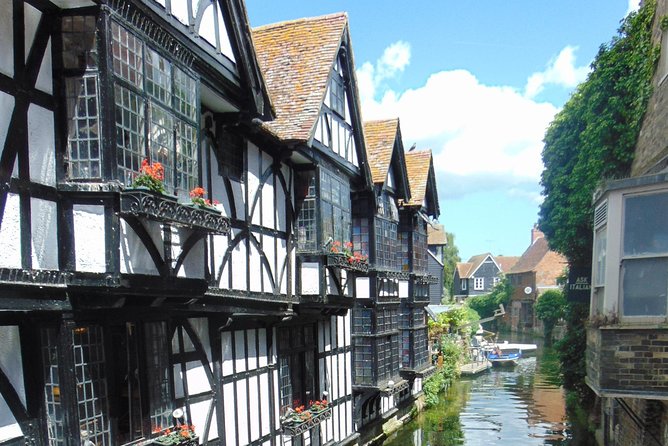
- A compact route through central Canterbury: The walk begins at The Beaney House of Art and Knowledge and ends beneath Saint George’s Tower.
- Stories rather than a checklist: You’ll hear about Chaucer, Marlowe, Becket, Roman Canterbury, medieval defenses, and the city’s stranger details.
- A genuinely small group: The maximum is 10 people, giving you room to ask questions and stay close to the guide.
- Sam is the named guide: The tour’s strongest praise centers on Sam’s humor, warmth, enthusiasm, and command of Canterbury’s past.
- Good for families: Children aged 6 and 11 were kept involved, and teenagers were also reported to enjoy the tour.
- A walking introduction, not a cathedral admission: The route helps you understand Canterbury before you explore its major buildings on your own.
Why this short Canterbury walk works
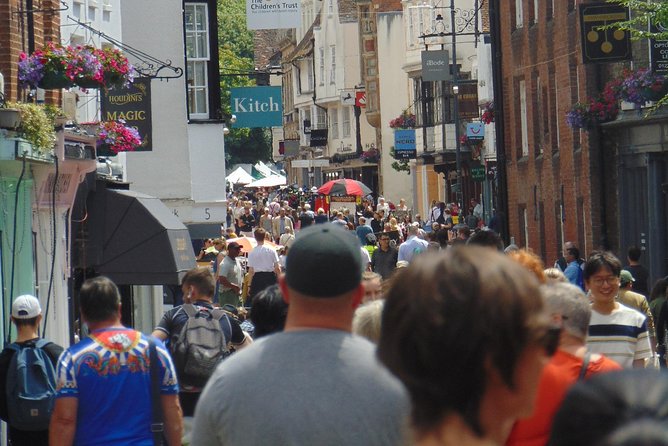
Canterbury can look simple at first glance. There is the cathedral, a few shopping streets, the old walls, and plenty of people taking photographs. Then someone points out a medieval gate, a church tower, a coat of arms, or an odd carving, and the city suddenly becomes much more layered.
That is the strength of this tour. It gives you a framework for the city without taking up half a day. At about an hour and a half, it is long enough to connect Roman, medieval, Tudor, and modern Canterbury, but short enough to fit into a day trip or the first afternoon of a longer stay.
I especially like the blend of major figures and small curiosities. Chaucer gives you the literary connection. Becket explains why Canterbury became one of Europe’s great pilgrimage destinations. Marlowe adds drama, crime, and espionage. The bull’s head, the dove, the unusual clocks, and the old city gate keep the walk from becoming a parade of dates.
Sam is the guide named throughout the tour information, and the strongest praise focuses on his relaxed delivery and ability to answer questions. He is described as funny, approachable, and able to keep both adults and children interested. That matters in a city where a guide can either bring the buildings to life or make them blur into old stone.
Other trips people book in England:
- Stonehenge, Windsor Castle, and Bath from London
★ 4.5 · 18,662 reviews - London Big Bus Hop-On Hop-Off Tour with Optional River Cruise
★ 3.5 · 10,803 reviews - London Small Group Tour of Historical Pubs
★ 5.0 · 10,422 reviews
Starting at The Beaney and meeting Chaucer
The tour begins outside The Beaney House of Art and Knowledge at 18 High Street. This is a sensible meeting point in the center of Canterbury, with facilities available before the walk begins. If you arrive early, you are already in a useful place to get oriented.
The first stop is the statue of Geoffrey Chaucer, the author of The Canterbury Tales. You will hear why Chaucer’s work made Canterbury famous in literature, and how the city’s identity became tied to pilgrims, storytelling, and the road to the shrine of Thomas Becket.
This is a good opening because it starts with the city’s best-known literary link rather than a list of construction dates. It also sets up the tone of the tour: Canterbury is presented through people and stories, not only buildings.
The stop itself is brief, listed at about five minutes. That means you should expect a focused explanation rather than an extended lecture. The value comes from using Chaucer as a key to the city, then walking on to see the places behind the stories.
Westgate Towers and Canterbury’s medieval defenses
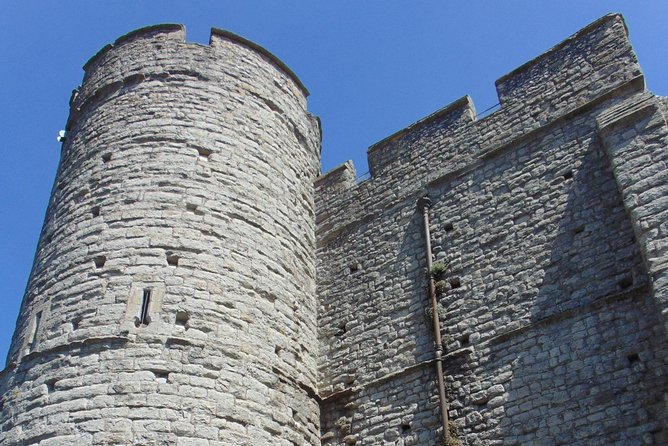
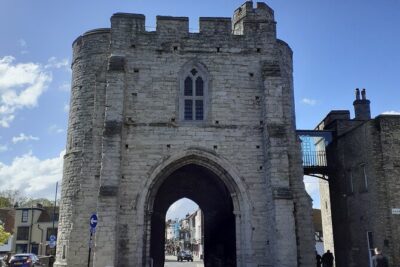
Westgate Towers is one of the most memorable parts of the route. It is the largest surviving medieval city gate in the United Kingdom, and the tour explains how it worked as both an entrance and a defensive structure.
You will hear about the methods used to attack and protect the gate, and why its design was considered innovative for its time. The tour also includes a story connected to the tower that is described as worthy of a short film. That promise fits the stop well: Westgate is not just an impressive piece of masonry, but a place shaped by fear, control, and conflict.
The tour does not include admission to the Westgate Towers Museum and Viewpoint. You see the exterior and hear the story as part of the walk, then you can decide later if you want to return and pay to go inside.
That arrangement is useful if you are trying to keep costs down. It also means the guide can introduce the tower without committing your whole visit to one attraction. If you want interior views or the museum displays, allow extra time after the tour.
Christopher Marlowe beside the modern Marlowe Theatre
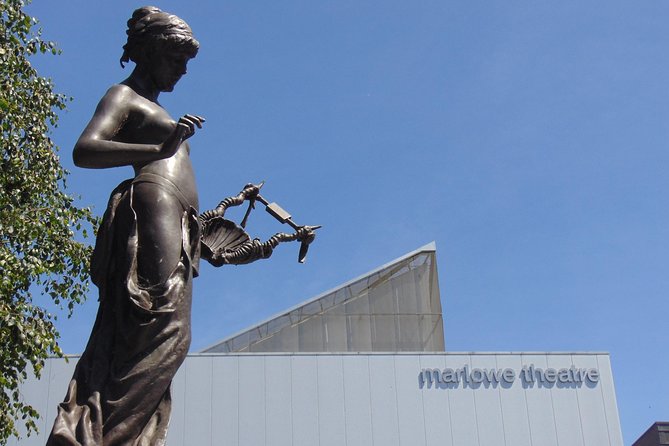
The Marlowe Theatre gives the walk a sharp change of mood. The building itself is modern, but the name reaches back to Christopher Marlowe, the Canterbury-born playwright whose life included theater, danger, and espionage.
Sam’s presentation of Marlowe is one of the tour’s more colorful elements. Marlowe was not simply a playwright sitting safely at a desk. His reputation includes hard living and work as a spy, making him a lively figure to introduce while discussing Canterbury’s connection to the written word.
The stop also shows how the city’s cultural life has changed. You move from Chaucer, whose Canterbury stories helped define the city for centuries, to a modern theater carrying Marlowe’s name. I like that the tour does not treat history as something locked in the past. The old names still shape the places you see today.
Again, the stop is brief and viewed from outside. That is enough to explain the connection, but not enough to explore the theater as a venue. If you are interested in performances or the building itself, you will need to make a separate visit.
Same base, a different kind of day:
- Beatles Magical Mystery Tour
★ 5.0 · 9,266 reviews - Liverpool: “Blue Route” – City & Beatles Tour
★ 5.0 · 8,562 reviews - Stonehenge, Windsor Castle and Bath with Pub Lunch in Lacock
★ 4.5 · 7,402 reviews - Oxford University Walking Tour With University Alumni Guide
★ 5.0 · 6,905 reviews
Christ Church Gate and a Tudor surprise
Christ Church Gate is tied to a Tudor prince and his Spanish bride, but not the royal couple many people first expect. The tour uses the gate to explain both the original commemorative purpose and the surprising changes it has undergone.
This is a good example of the kind of detail that can be easy to miss on your own. You might pass beneath or beside the gate, admire its shape, and move on. A guide gives you a reason to pause and ask who built it, why it mattered, and how its role changed over time.
The stop is short, around five minutes, so the explanation stays focused. You are not getting an architectural survey of every stone. You are getting the story that makes the gate worth looking at.
That approach suits anyone who wants a lively first look at Canterbury rather than a specialist tour. If you already have detailed knowledge of Tudor architecture, you may want more depth. For most first-time visitors, the quick story is exactly the point.
Roman Canterbury and the clues in Butchery Lane
Outside the Canterbury Roman Museum, the tour turns to the city before the medieval pilgrimage age. You will learn about Roman Canterbury and how the remains were rediscovered after the destruction and rebuilding connected with the Second World War.
That link between archaeology and wartime damage is particularly useful. It shows that the ancient city was not always visible in a neat, preserved form. Some of what we know came to light because modern destruction exposed older layers below.
The museum itself is not included in the tour, which is worth noting if you want to see the Roman displays. The guide’s explanation gives you enough background to decide if it deserves a return visit.
The walk continues through Butchery Lane, where the Bell Harry Tower of Canterbury Cathedral, the city coat of arms, and a bull’s head all become part of the discussion. This is one of the route’s best ideas. The guide takes familiar sights and gives you several different things to notice at once: cathedral architecture, civic identity, and an odd detail that you would probably miss without help.
Thomas Becket, the church, and the dove in the ear
At St Thomas of Canterbury Roman Catholic Church, the tour turns to the figure who shaped Canterbury more than any other: Thomas Becket.
You will hear the full story of Becket, including how a man who was not from Canterbury became the city’s defining historical figure. His death and the pilgrimage tradition that followed made Canterbury an international destination, and the tour uses this stop to explain why his name appears so often in the city.
The stop also includes one of the tour’s more unexpected details: Pope Gregory the Great and the dove flying into his ear. It is exactly the sort of small, strange image that helps a walking tour stick in your mind. You may forget a date, but you are less likely to forget a pope with a dove at his ear.
This part of the route works best if you are interested in the connection between religion, politics, art, and travel. The tour does not offer entry into Canterbury Cathedral, and cathedral admission is not listed as part of the experience. Instead, it gives you a useful introduction before you decide how much time to spend inside the cathedral later.
Ending beneath Saint George’s Tower
The tour finishes under Saint George’s Tower at 27 St George’s Street. The tower belonged to the former St George’s Church, and today it sits among a busy shopping area.
That contrast gives the final stop a clear purpose. The guide explains how an old church tower became a reminder of Canterbury’s earlier shape while the surrounding area changed around it. It is a fitting end to a walk that repeatedly connects old stories with modern streets.
Ending here is also practical. You are still in central Canterbury, with the rest of the city close by. You can continue shopping, look for food, visit another attraction, or walk back toward the cathedral and city walls.
The start and finish are different locations, but both are central. You should not need special transport between them, and Canterbury’s compact layout makes the route manageable for most people.
What the small group adds
The group limit of 10 is one of the tour’s strongest practical features. Small groups make a real difference on a city walk. You can hear the guide more easily, ask questions without interrupting a large crowd, and point to details without being pushed to the back.
The tour’s customer comments repeatedly praise the chance to ask questions and the personal feel of the walk. One evening tour went ahead with only one person, and the guide still delivered it with the same enthusiasm. That suggests the format is built around conversation rather than simply reciting a fixed script.
Families can also make good use of the small group. The tour kept children aged 6 and 11 involved, and teenagers were described as enjoying it too. The mix of legends, odd details, famous names, and visual clues gives younger visitors more to hold onto than a long lecture about dates.
Still, you should remember that this is a walking tour, not a seated attraction. You will be outside for the full experience, and the weather can affect your comfort. The tour has been enjoyed on cold mornings and in unpredictable weather, but you should dress for the conditions.
Is $19.44 good value?
At $19.44 per person, the tour is reasonably priced for a 90-minute guided introduction to central Canterbury. You are paying mainly for the guide’s interpretation, not for admission to several attractions.
That distinction matters. The Westgate Towers Museum, Marlowe Theatre, and Canterbury Roman Museum are not included as paid entries. Several stops are also outside buildings, so you should not book this expecting a series of interior visits.
I see the price as good value if you want context before exploring Canterbury on your own. A guide can show you where the important stories happened, explain details you might miss, and help you choose which places deserve more of your time. The tour is less good value if your main goal is museum access or a long cathedral visit.
The free cancellation policy adds flexibility. You can cancel up to 24 hours before the start time for a full refund. Changes or cancellations made less than 24 hours before the start time are not accepted, and the cutoff uses local time.
Who should book this Canterbury walk?
I would recommend it to first-time visitors who want to get their bearings quickly. It is especially useful at the beginning of a stay, since the route can help you decide what to revisit in greater detail.
It also suits day trippers. The city is compact, the route lasts about 90 minutes, and the tour covers a wide sweep of Canterbury without demanding a full day.
Families should consider it too. Sam’s humor and use of unusual stories appear to work well with children and teenagers, while adults get architecture, politics, literature, religion, and archaeology.
You may want something else if you are looking for a specialist cathedral tour, a Roman archaeology visit, or extensive access inside historic buildings. This experience is a broad city introduction. Its strength is the connections between places, not lengthy time inside any one attraction.
The tour is offered in English, uses a mobile ticket, allows service animals, and is near public transportation. Most people can participate. Wear comfortable shoes, arrive at The Beaney House of Art and Knowledge, and remember that you finish at Saint George’s Tower rather than back at the starting point.
Should you book The Canterbury Classic Tour?
Book it if you want Canterbury to make sense fast. For $19.44, you get a short, personal walk through the city’s main stories, plus the odd details that make those stories memorable. The group limit of 10 is a real advantage, and Sam’s friendly, energetic style appears to be the heart of the experience.
Skip it only if you need extensive indoor sightseeing or a detailed visit to a single attraction. For a first look at Canterbury, especially with children, teenagers, or limited time, this is a sensible and affordable choice.
FAQ
Where does The Canterbury Classic Tour start?
The tour starts outside The Beaney House of Art and Knowledge at 18 High Street, Canterbury CT1 2RA.
Where does the tour end?
The tour ends beneath Saint George’s Tower at 27 St George’s Street, Canterbury CT1 2LE.
How long does the walking tour last?
The tour lasts approximately 1 hour and 30 minutes.
How much does the tour cost?
The listed price is $19.44 per person.
How many people can join the tour?
The group is limited to a maximum of 10 people.
Is the tour offered in English?
Yes. The tour is offered in English.
Are museum or attraction admission fees included?
The tour includes the guided walk and outside explanations. Admission to places such as Westgate Towers Museum and Viewpoint, the Marlowe Theatre, and Canterbury Roman Museum is not included.
Can I bring a service animal?
Yes. Service animals are allowed.
What is the cancellation policy?
You can cancel up to 24 hours before the experience starts for a full refund. Cancellations or changes made less than 24 hours before the start time are not accepted.
Just added in England
- The Beatles and a Secret pub★ 4.5 · 36 reviews
- The Beatles & Liverpool Magical Mystery Tour from London★ 4.5 · 80 reviews
- Airport Coach Service from Heathrow to Oxford★ 3.5 · 67 reviews
- The Beatles Magical History Black Taxi Tour London★ 5.0 · 51 reviews
- The Beatles London walking tour. From Abbey Road to the Roof Top★ 5.0 · 61 reviews
- Private The Beatles Taxi Tour in London★ 5.0 · 12 reviews
- The Beatles London Walk★ 4.5 · 120 reviews
- Dinner and Jazz Cruise on the River Thames★ 4.0 · 140 reviews
Tours in Canterbury, compared.

Official Canterbury Guided Walking Tour – 11.00 Tour
Read our review →

Cultural Homestay Exploring London, Oxford and National Parks
Read our review →


Browse the lists this tour appears in