
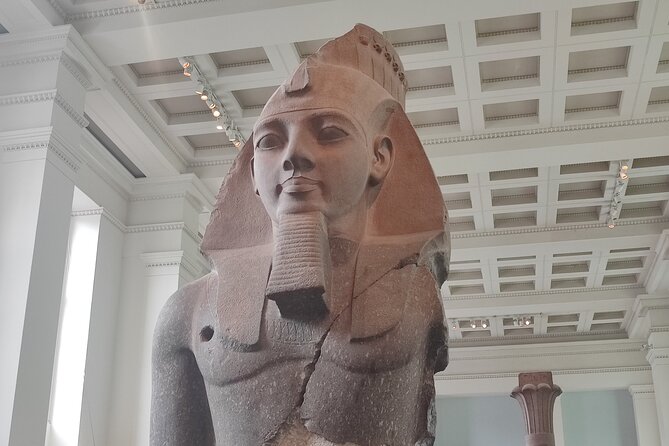
Reviewed · MUSEUMS
British Museum Private Tour: Ancient Daemons and Timeless Beauty
The British Museum holds more than 8 million objects, so the real challenge is not finding something interesting. It is knowing what to see first. This private tour gives you a clear route through famous treasures, from the Rosetta Stone and Egyptian mummies to Sutton Hoo and the Lewis chessmen, without leaving you to wander its enormous galleries alone.
I like the private format and the guide’s ability to adjust the visit. Richard has tailored tours to family interests and even added about 30 minutes at no extra charge, while Yuliya Ousarenko has been praised for bringing unusual detail and warmth to the objects. The main consideration is the price: $203.65 per group is good value for several people, but less so for one or two guests.
Key points to know before you book
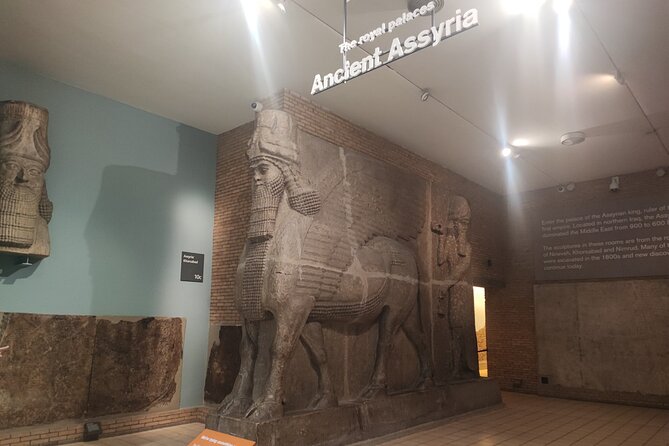
- Follow a focused route through 8 million objects: The guide helps you spend your limited time on major pieces instead of trying to see everything.
- Expect an art specialist storyteller: Richard and Yuliya Ousarenko are named guides associated with this experience, with a style built around clear explanations and questions.
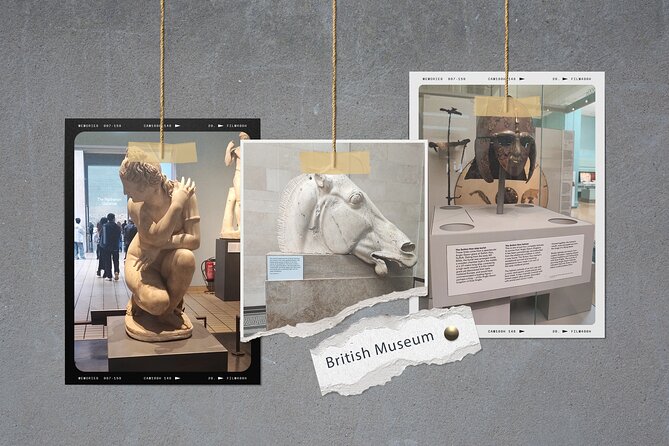
- See objects from many civilizations: The route can include Egyptian mummies, the Rosetta Stone, Parthenon Marbles, Sutton Hoo, Lewis chessmen, Shiva Nataraja, and ancient sculpture.
- Use the private setting to shape the visit: Your group can ask for more attention to particular cultures or objects.
- Plan on about two hours: The advertised duration is two to three hours, while the included guided portion is about two hours.
- Check the group-size detail: The price is listed for up to eight people, while the highlights describe groups of up to six, so confirm the exact limit before booking.
Why the British Museum needs a plan
The British Museum is not a small collection that you can casually sweep through before lunch. It holds objects from many periods and places, displayed across a large central building in the heart of London.
That size creates two problems. First, you can spend half your visit walking between rooms. Second, the famous objects do not always explain themselves. A carved stone, damaged statue, or case of small game pieces may seem quiet until someone points out what it tells you about language, power, belief, or daily life.
This tour solves that problem with a theme built around ancient daemons and timeless beauty. The concept links very different objects through human questions: How do people record language? How do empires present power? What happens after death? How do artists define beauty? How do games, stories, and religious images reflect the world around them?
I like that approach more than a rushed list of dates. You still see major highlights, but the objects have a reason for appearing together. If you are new to museums, that structure can make the building feel manageable. If you already know the British Museum, the guide’s interpretation may help you notice links between collections you would otherwise treat as separate.
The museum’s Great Court, with its large glass canopy designed by Norman Foster, is part of the visual experience. It is a useful meeting point and a dramatic place to begin, though the building can feel crowded and busy. A guide helps you move with purpose rather than spending your time checking a map.
More museums in London:
- Chelsea FC Stadium Tours and Museum
★ 5.0 · 1,908 reviews - Official tickets: Moco Modern & Contemporary Art Museum
★ 4.5 · 1,157 reviews - British Museum London Guided Tour Semi-Private 8ppl Max
★ 5.0 · 984 reviews
The Rosetta Stone and the power of written words
The Rosetta Stone is one of the clearest examples of why a single museum object can matter far beyond its physical size. Its inscriptions helped scholars compare different writing systems and make progress in reading Egyptian hieroglyphs.
You will not just be looking at a dark slab of stone. You will be considering how language can disappear from daily use, then become readable again through careful comparison. That makes the object a strong early stop because it turns an ancient artifact into a story about persistence, scholarship, and access to the past.
A guide can also explain why the stone is famous without drowning you in technical detail. That balance matters in a private tour, especially if your group includes children or adults with different levels of museum interest. You can ask basic questions without feeling you are slowing down a larger group.
The drawback is that the Rosetta Stone is among the museum’s best-known objects, so it may attract a crowd. Your guide cannot control how many people are gathered around it, but can help you understand what to look for and move on when the moment is right.
Egyptian mummies and the human side of death
The Egyptian galleries offer a quieter change of mood. Here, the focus turns from writing and public power to the way people faced death, memory, and the afterlife.
The mummies rest in silence, but the display is not only about remains. It opens questions about preparation, belief, family, and the wish to preserve a person beyond death. A guide can help you look past the visual impact and consider what these objects meant to the people who made and used them.
I find this part especially useful for visitors who might otherwise move quickly through the Egyptian rooms. A private guide can explain the difference between seeing a mummy as an ancient curiosity and understanding it as part of a belief system. The pace also allows you to ask about details that catch your eye.
Some people may find this section solemn or unsettling. That is not a weakness, but it is worth knowing before you book. The theme includes death as well as beauty, power, and invention.
The Parthenon Marbles and difficult museum questions
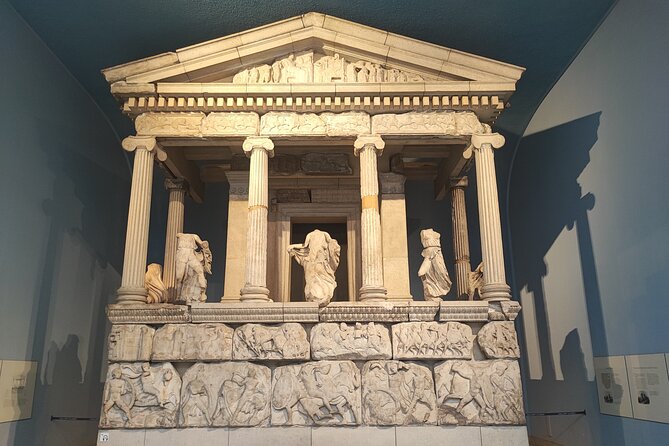
The Parthenon Marbles bring ancient Greek sculpture and modern museum debate into the same room. You can look closely at carved figures and architectural pieces while thinking about how objects were removed, collected, displayed, and claimed by institutions.
The tour presents the marbles as a chance to recall the glory of past empires, but you can also use the stop to ask broader questions about ownership and cultural heritage. A good guide will give you context without turning the visit into a lecture.
The sculptures also fit the tour’s focus on changing ideas of beauty. Their proportions, poses, and carved surfaces show how artists represented the human body and the divine. Comparing these works with pieces from other parts of the museum can make the visit more useful than seeing Greek art in isolation.
The practical issue is time. The British Museum has enough Greek material to fill a much longer visit, so you should tell the guide if this is your top priority. A private tour works best when you say what you most want to understand.
A few more things to do in London worth a look
- The Premier Classic London: Private 4-Hour Tour in a Black Cab
★ 5.0 · 2,737 reviews - Stonehenge Inner Circle Private Tour from London with Bath Visit
★ 5.0 · 1,909 reviews - Private Tour: Black Taxi Tour of London
★ 5.0 · 1,153 reviews - Private London Arrival Transfer – Airport to Hotel / Accommodation
★ 3.5 · 1,085 reviews
Sutton Hoo and an Anglo-Saxon voyage
Sutton Hoo offers a different kind of ancient story. Instead of a famous stone or a large classical sculpture, you encounter the remains and objects connected with an Anglo-Saxon burial ship.
The display raises a strong question: what can a burial tell us about the person, society, and beliefs behind it? The reference to the last voyage of an Anglo-Saxon warrior gives the collection a human shape. You are not simply examining metalwork and objects in cases. You are trying to reconstruct a life and a ceremony from what survived.
This stop is valuable for visitors who want more than the standard Egyptian and Greek highlights. It also gives the tour a distinctly British chapter, linking the museum’s global collections to the early history of the islands.
The Sutton Hoo material may appeal most to people who enjoy archaeology and interpretation. If your group mainly wants sculpture or ancient Egypt, tell the guide in advance so the time is balanced sensibly.
The Lewis chessmen and the pleasure of small things
The Lewis chessmen are among the most approachable objects on this route. Their faces and poses make them easy to study, even if you know little about medieval history.
The set opens a story about games, strategy, craft, trade, and personality. Each small figure seems to have its own character, which gives the guide plenty to discuss. The pieces also show how a familiar activity can connect people across centuries. You may recognize the basic game while seeing how different the materials, design, and social setting can be.
This is a particularly good stop for families. Children can respond to the figures first as people, then learn why they matter. Adults can ask about the wider world that produced them. The guide’s storytelling style is important here, since the objects reward observation more than a long list of dates.
Do not expect the chessmen to be a major room-sized display. Their scale is part of the charm, but you may need to look closely and listen carefully.
Shiva Nataraja and the rhythm of creation
The image of Shiva Nataraja introduces a powerful religious and artistic idea: creation and destruction as part of a continuing cosmic cycle. It gives the tour a different visual language from the Egyptian, Greek, and Anglo-Saxon objects.
This is where the theme of timeless beauty becomes especially useful. The sculpture is not simply attractive. Its movement, gesture, surrounding symbols, and balance carry meaning. A guide can help you connect what you see with the religious ideas represented by the dancing figure.
The stop also reminds you that the British Museum is not mainly a collection of European antiquities. Its value comes from the range of cultures represented under one roof. That range can be confusing without help, but it becomes rewarding when the guide explains why each object belongs in the larger story.
If Indian art is a priority for you, say so at the start. The route includes Shiva Nataraja, but the exact amount of time spent there will depend on your group’s interests and the guide’s plan.
Ancient sculpture and changing ideas of beauty
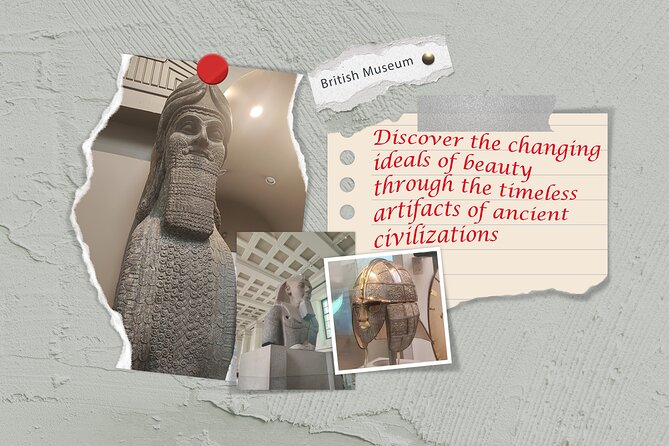
The tour also considers how standards of beauty change across cultures and periods. That is a more interesting question than asking which statue is simply the most attractive.
You may compare idealized bodies, faces, poses, clothing, and signs of age. A sculpture made to show divine perfection serves a different purpose from an object made for a tomb, a temple, or a household. The guide’s job is to help you notice those differences.
This part can be especially useful if you have seen major museums before and want an interpretive thread rather than a basic highlight tour. Instead of treating each gallery as a separate stop, you are encouraged to compare ideas across civilizations.
The phrase timeless beauty should not be taken to mean that beauty is fixed. The more useful lesson is that people in different societies have always made choices about what deserves admiration, and those choices reveal something about them.
What the private guide adds
A private tour gives you a level of control that a large group cannot. You can ask why an object matters, request more time in a particular gallery, or move on when a subject is not holding your attention.
The named guides bring different strengths. Richard is described as flexible and willing to tailor the visit, while Yuliya Ousarenko is associated with detailed explanations, kindness, and an engaging manner. Yuliya has also accommodated a group arriving a little late, though you should still aim to reach Montague Place on time.
The guide’s storytelling style may be the most important feature. The museum contains plenty of labels, but labels do not always show how objects relate. A good explanation turns separate displays into a sequence: writing, empire, death, burial, play, religion, and beauty.
You should also speak up before the tour begins. Tell the guide if you are visiting with children, if you want more Egyptian material, or if Parthenon sculpture is your main reason for booking. The private setting has value only if you use it.
Is $203.65 good value?
The listed price is $203.65 per group, not per person. For a full group, that can be a sensible way to buy expert attention in one of London’s largest museums. Split among several people, the cost is easier to justify than individual tickets for a private specialist service.
For two people, the price feels less attractive, especially if you are comfortable reading labels and planning your own route. The main thing you are paying for is not admission to the museum. The guided visit, fast-track entry, and time saved are the real benefits.
The group-size information needs clarification. The price is stated for up to eight people, while the highlights describe a private group of up to six. Ask MyLondonGuide to confirm the permitted number before you book, particularly if you are organizing for a larger family.
Food and drinks are not included, so plan those separately. The tour lasts about two hours, with the wider experience described as two to three hours. That makes it easy to fit into a London sightseeing day, but you should not expect to cover the entire museum.
Meeting point, timing, and cancellation
The meeting point is on Montague Place in London, and the activity ends back at that meeting point. The location is near public transportation, which helps when you are building a day around the museum.
A mobile ticket is provided, and the tour is offered in English. Confirmation arrives at booking. Most people can take part, but the supplied details do not give a more specific accessibility description, so contact the provider if your group needs particular arrangements.
The cancellation policy is forgiving if your plans change early. You can cancel at least 24 hours before the local start time for a full refund. Cancellations or changes made less than 24 hours before the start are not refunded or accepted.
Who should book this British Museum tour?
I would choose this tour if you have limited time, dislike wandering without a plan, or want an adult and child-friendly explanation of major objects. It also suits a family or group that wants to ask questions freely rather than follow a fixed crowd.
It is a good match for first-time visitors who want the Rosetta Stone, mummies, Parthenon Marbles, Sutton Hoo, Lewis chessmen, Shiva Nataraja, and sculpture highlights in one coherent visit. The guide can make the enormous collection feel less like a maze.
I would skip it if you prefer to spend a full day moving at your own pace, or if you already have a carefully planned list of galleries. You may also find the cost hard to justify for one or two people.
Should you book it?
Book this private British Museum tour if interpretation and efficient use of time matter more to you than an inexpensive museum visit. The strongest reasons are the focused theme, fast-track entry, private format, and the chance to shape the route around your interests.
The experience is not a complete survey of the British Museum, and you should confirm the group-size limit before paying. But for a family or small group facing London’s enormous collection for the first time, a skilled guide such as Richard or Yuliya Ousarenko can turn famous objects into connected human stories. That is where the $203.65 price makes the most sense.
FAQ
How much does the private British Museum tour cost?
The price is $203.65 per group. The supplied information lists the price for up to eight people, while the highlights describe groups of up to six, so confirm the exact limit with the provider.
How long does the experience last?
The experience lasts about two to three hours. The included guided museum portion is described as about two hours.
What language is the tour offered in?
The tour is offered in English.
Is the British Museum admission included?
The guided tour includes fast-track entry to the British Museum. The itinerary also lists the admission ticket as free.
Where does the tour begin?
The meeting point is Montague Place, London, UK.
Where does the tour end?
The activity ends back at the meeting point on Montague Place.
Is this a private activity?
Yes. Only your group participates in the private tour.
Are food and drinks included?
No. Snacks, food, and drinks are not included.
Can I cancel for a full refund?
Yes, if you cancel at least 24 hours before the experience start time. Cancellations or changes made less than 24 hours before the local start time are not refunded or accepted.
Just added in London
- The Beatles and a Secret pub★ 4.5 · 36 reviews
- The Beatles & Liverpool Magical Mystery Tour from London★ 4.5 · 80 reviews
- Airport Coach Service from Heathrow to Oxford★ 3.5 · 67 reviews
- The Beatles Magical History Black Taxi Tour London★ 5.0 · 51 reviews
- The Beatles London walking tour. From Abbey Road to the Roof Top★ 5.0 · 61 reviews
- Private The Beatles Taxi Tour in London★ 5.0 · 12 reviews
- The Beatles London Walk★ 4.5 · 120 reviews
- The Alfred Hitchcock London Walk with Sandra Shevey★ 5.0 · 15 reviews
Museums, compared.

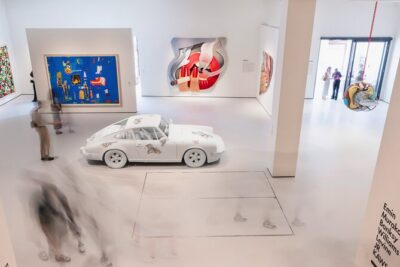
Official tickets: Moco Modern & Contemporary Art Museum
Read our review →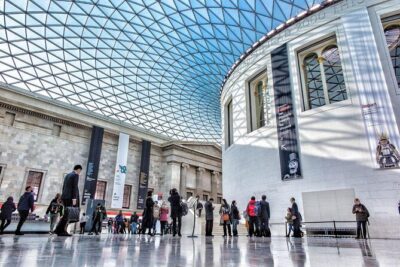
British Museum London Guided Tour Semi-Private 8ppl Max
Read our review →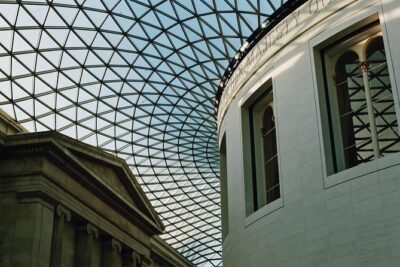
The British Museum London – Exclusive Guided Museum Tour
Read our review →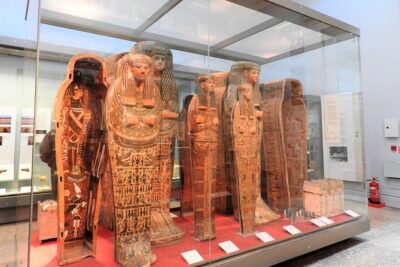

Skip the Line: Liverpool Beatles Museum – The perfect tribute to the Beatles
Read our review →
Browse the lists this tour appears in