
Reviewed · TOURS IN WEYMOUTH
Private Tour Winchester
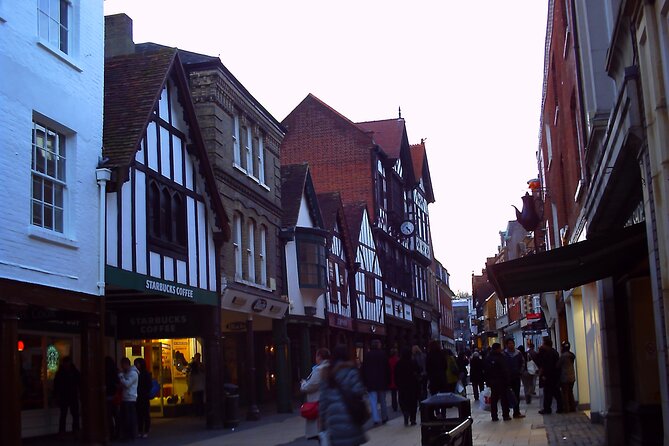
Winchester’s story is unusually easy to follow on foot: Anglo-Saxon kings, medieval bishops, Tudor royalty, Jane Austen, and a remarkable Jewish businesswoman named Licoricia all appear within a short city walk. This private 90-minute tour gives you a useful first look without asking you to spend an entire day on formal sightseeing.
I like the personal format and the strong focus on local stories. Guides such as Dr Lillian Gonzales, Michele, James, and Sam have led this walk, with several bringing academic training or a clear passion for Winchester. I also like that the route includes both major sights and less familiar figures, especially Licoricia. The main caution is the city’s steep hills, along with the fact that the cathedral entrance fee is not included.
Key points to know before booking
- Licoricia of Winchester: Begin with the story of one of medieval England’s most important Jewish women at The Arc.
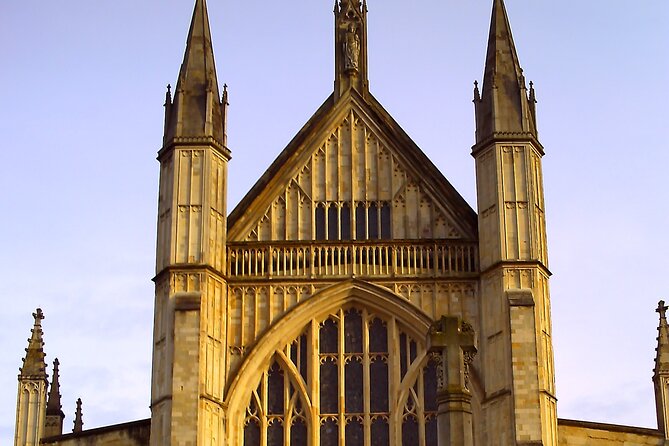
- Winchester Cathedral: Learn how a modest Anglo-Saxon church became one of England’s great Gothic buildings.
- Private guide format: Only your own group takes part, so questions and walking speed can be adjusted.
- Jane Austen connection: See the historic college area beside the house where Austen died.
- Wolvesey Castle: Explore the ruins of the bishop’s palace and hear about the breakfast held there for Mary I and Philip II of Spain.
- Hilly walking route: Wear sturdy, waterproof shoes, especially if rain is expected.
Why Winchester works so well as a walking tour
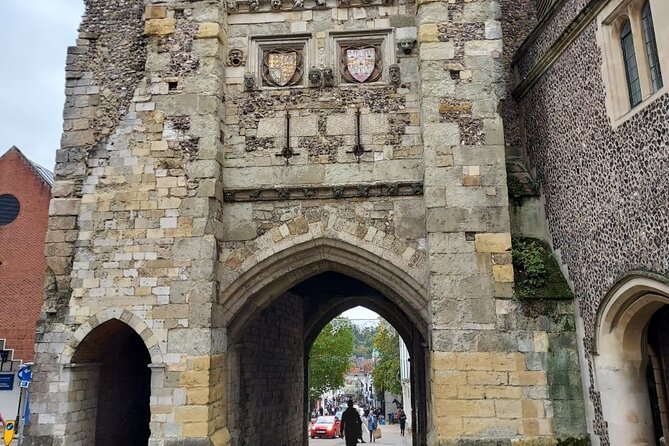
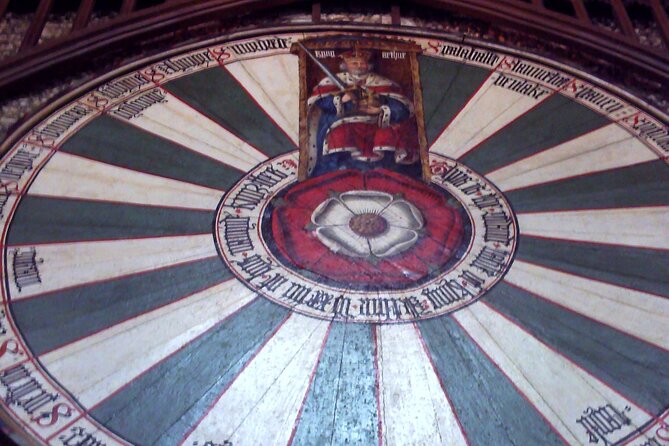
Winchester was once the seat of power for Wessex and one of the most important cities in England. That gives the tour a clear thread. You are not simply looking at old walls and impressive stonework. You are moving through places tied to kings, bishops, religious change, royal marriages, education, literature, and everyday commerce.
The route lasts about an hour and a half, which is a sensible length for a first introduction. It is long enough to connect several major sites but short enough to fit into a day trip from Bournemouth or a wider visit to southeast England.
I especially like the private setup. A group of your own family or friends can ask why a building matters, pause over a detail, or steer the conversation toward a favorite period. Guides have also adjusted the pace for slower walkers and added rest stops during hot weather. That flexibility is harder to get on a large scheduled walk.
The tradeoff is that 90 minutes passes quickly. You will hear about the cathedral, but the entrance ticket is separate, and this walk is not a full interior visit. You also will not have a long stop at every location. Think of it as an orientation with stories, not a complete museum-style tour.
A few more things to do in England worth a look
- The Premier Classic London: Private 4-Hour Tour in a Black Cab
★ 5.0 · 2,737 reviews - Stonehenge Inner Circle Private Tour from London with Bath Visit
★ 5.0 · 1,909 reviews - Private Historical Walking Tour of York
★ 5.0 · 1,324 reviews
Starting at Winchester Railway Station
The meeting point is Winchester Railway Station on Station Road. This is practical if you arrive by train and removes the usual worry about finding a small street or statue in the old center.
From the station, the route heads toward the historic heart of town. Since the end point is different from the starting point, you finish in a more central area rather than returning to the station. The exact ending place should be confirmed at booking if you need to catch a train immediately afterward.
The tour operates daily between 10:00 in the morning and 7:00 in the evening during the published operating period. Confirmation is provided when you book, and the activity is offered in English.
Bring shoes with a good grip. Winchester is hilly, and rain can leave puddles along the route. One practical tip is to wear waterproof footwear rather than relying only on an umbrella. The walk is not recommended if hills are difficult for you.
The Arc and the story of Licoricia
The first stop is The Arc, where Winchester Library exhibits a statue of Licoricia of Winchester. The stop takes about five minutes, but the subject gives the tour an important human scale.
Licoricia was a wealthy Jewish woman in medieval Winchester and one of the city’s most significant historical figures. Her story opens a window onto commerce, religion, money, and the position of Jewish communities in medieval England. It also helps prevent the tour from becoming a parade of kings and bishops.
I like this opening because it signals that Winchester’s past is not only about royal power. A short explanation here can change the way you read the rest of the city. You begin thinking about the people who financed buildings, traded goods, worked in town, and lived under rules set by powerful institutions.
The stop is brief, so anyone wanting a full account of Licoricia’s life will need more time elsewhere. Still, it is an effective introduction, especially if you are interested in social history rather than only architecture.
Winchester Cathedral and its long transformation
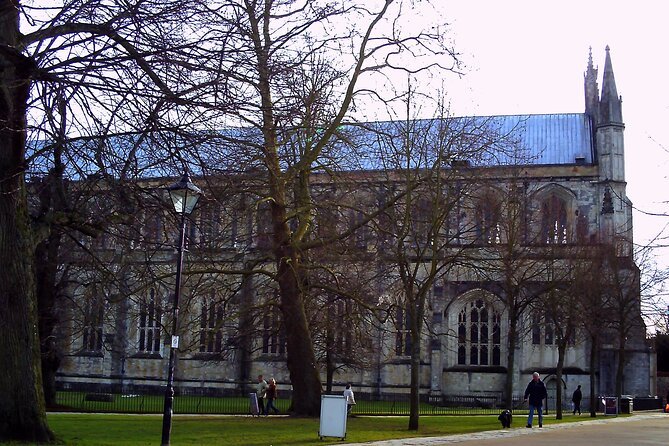
The cathedral receives about 15 minutes of attention. Even from outside, it is one of the major visual moments of the walk, and the guide explains the change from Winchester’s Anglo-Saxon beginnings to the Gothic building you see today.
This is where a good guide can make the stones readable. You learn that the cathedral did not appear in one finished burst of construction. Its form reflects centuries of religious and political change, with later bishops reshaping an older foundation.
The cathedral is also the place where a short tour can feel frustratingly brief. The entrance ticket is not included, so you need to budget separately if you want to go inside. The walk gives you context and helps you decide what deserves a longer visit, but it does not replace exploring the interior.
I would use this stop as a preview. If you have time afterward, enter the cathedral on your own and let the guide’s explanation give meaning to what you see. If your schedule is tight, the exterior conversation still gives you a useful sense of why Winchester mattered.
The guide’s treatment of Bishop William of Wykeham is one detail worth listening for. His work helped turn the cathedral toward the Gothic style, and the architectural changes become easier to understand when tied to a particular person and period.
Same base, a different kind of day:
- Stonehenge, Windsor Castle, and Bath from London
★ 4.5 · 18,662 reviews - London Big Bus Hop-On Hop-Off Tour with Optional River Cruise
★ 3.5 · 10,803 reviews - London Small Group Tour of Historical Pubs
★ 5.0 · 10,422 reviews - Beatles Magical Mystery Tour
★ 5.0 · 9,266 reviews
The historic college and Jane Austen’s final Winchester connection
The route continues past an iconic college building described as one of the United Kingdom’s top five colleges. It sits beside the house where Jane Austen died in Winchester.
The college adds another layer to the city. Winchester was not only a royal and religious center. It was also a place shaped by education, status, and long-running institutions. The setting makes it possible to connect medieval power with later English literature in just a few minutes of walking.
Jane Austen’s Winchester connection is especially useful for visitors who know her novels but may not realize how closely the city is tied to the end of her life. The nearby house gives the story a precise location rather than leaving it as a vague literary association.
The stop is not described as an interior visit to the college or Austen’s house. You should expect an exterior explanation and historical context. That is enough to add texture to the walk, but it is not a substitute for a dedicated Jane Austen visit.
Wolvesey Castle and a royal wedding breakfast
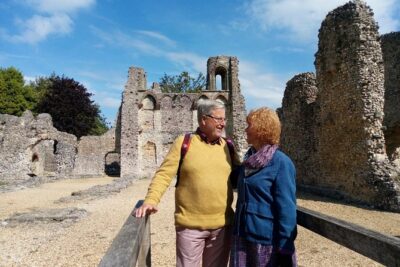
At Wolvesey Castle, you reach the ruins of the former palace of the bishop of Winchester. The stop lasts about five minutes and is free to enter.
Ruins can be difficult to interpret without help. Walls alone rarely explain how a palace functioned or why it mattered. Here, the guide connects the site to the bishops who once held major religious and political power in the city.
The most memorable story is the breakfast held here for Queen Mary and Philip II of Spain during their wedding. That detail brings the ruined palace into the Tudor period and gives you a sense of its ceremonial role.
I like this stop because it compresses several themes into one place: church authority, royal ceremony, international marriage, and the practical life of a palace. It also breaks up the grand cathedral visit with a more open, fragmentary site.
The short stop means you will not receive an archaeological study of every surviving wall. If Wolvesey Castle interests you, you can treat the tour as a first look and return for a slower inspection.
Guildhall and the statue of King Alfred
The final part of the route uses Winchester Guildhall as a gateway to the statue of King Alfred. Alfred was the great Anglo-Saxon king associated with Winchester and Wessex, so this is a fitting place to bring the city’s early political story back into focus.
King Alfred gives the guide a chance to explain why Winchester became so important before the Norman period. The statue is more than a convenient landmark. It represents the city’s role as a center of Anglo-Saxon rule and helps tie together the earlier discussion of the cathedral’s origins.
By the end of the walk, the sequence makes sense. Licoricia shows you medieval urban life and commerce. The cathedral shows religious power and architectural change. The college and Austen connect Winchester to education and literature. Wolvesey points to bishops and Tudor ceremony. Alfred takes you back to the city’s royal foundation.
That is a lot for 90 minutes, but the route is designed as a broad introduction rather than a specialist study.
The guides and the private experience
The strongest part of this tour depends on the person leading it. Dr Lillian Gonzales is described as having a PhD in history and a strong command of Winchester’s past. She has been praised for answering detailed questions, linking political and religious events to ordinary life, and bringing historical figures such as Jane Austen, William the Conqueror, and Henry VIII to life.
Michele has also been described as warm, flexible, and willing to adjust the pace for a slower walker. James has been praised for his friendly manner and clear explanations. Sam is completing a master’s degree in history at the University of Winchester and has led the tour as part of the wider team.
The description allows for a guide from the trained team rather than guaranteeing Dr Gonzales herself. That matters if her academic background is the main reason you are booking. Ask at the time of reservation if you specifically want her, and understand that another guide may lead the walk.
The feedback about guiding style is not entirely uniform. Many people have enjoyed animated storytelling and detailed answers, while one person found Sam too quiet and monotone. That is a useful warning for anyone who needs a very strong voice or lively presentation. A private tour gives you a better chance to ask the guide to speak up or pause for questions, but the guide assignment still affects the experience.
Is $34.53 good value?
At about $34.53 per person, the price is reasonable if you want a private introduction to Winchester and you are traveling with several people. You are paying for a guide focused only on your group, not for transportation, lunch, or a cathedral admission ticket.
For one person or a couple, the cost is higher than joining a large public walk. The value comes from flexibility and conversation. If you have a family member who asks many questions, a teenager who needs a shorter pace, or a particular interest in medieval religion or Jane Austen, the private format can justify the extra cost.
Gratuities are included. Private transportation is not, but that is not a serious drawback here because the route begins at the railway station and moves through central Winchester on foot.
The tour is booked, on average, 39 days ahead. That suggests you should reserve before your visit if your date is fixed, especially if you want a particular guide or a convenient time.
Who should book this Winchester walk?
I would choose this tour for a first visit to Winchester, particularly if you want the city’s main historical themes explained before exploring on your own. It suits history fans, families, couples, and small groups who prefer questions and conversation over a fixed lecture.
It is also a useful first morning or afternoon activity during a longer southeast England trip. One person used it as the starting point for a week in the region, which makes sense. After the walk, you can decide whether the cathedral, Wolvesey Castle, Jane Austen’s house, or another site deserves more of your time.
I would be more cautious if you have difficulty with hills, need a fully accessible route, or want a long interior visit at the cathedral. The activity is near public transportation, and service animals are allowed, but the supplied information does not promise a step-free route or detailed accessibility arrangements.
Should you book it?
Book this tour if you want a compact, private introduction to Winchester with a strong emphasis on people and power. The route covers more than famous buildings, and the stories of Licoricia, King Alfred, the bishops, Mary and Philip, and Jane Austen give the city a human shape.
Before paying, confirm the guide assignment if Dr Gonzales is important to you, and plan a separate cathedral visit if you want to see the interior. Wear comfortable waterproof shoes, leave room for hills, and allow extra time after the tour for the places that catch your interest.
Free cancellation is available up to 24 hours before the start time for a full refund. The experience also requires a minimum number of participants, so a cancellation by the operator may lead to another date, another experience, or a full refund.
FAQ
Where does the Winchester tour start?
It starts at Winchester Railway Station on Station Road, Winchester SO23 8TJ, United Kingdom.
Where does the tour finish?
The activity ends at a different location from the railway station. The exact ending point is provided in the booking details.
How long does the tour last?
The walk lasts approximately one hour and 30 minutes.
Is Winchester Cathedral admission included?
No. The cathedral entrance ticket is not included in the tour price.
Is this a private tour?
Yes. Only your own group participates in the private activity.
Is the tour suitable for people who struggle with hills?
The tour is not recommended if hills are difficult for you because Winchester is a very hilly city.
Can I cancel for a full refund?
Yes. You can cancel at least 24 hours before the experience start time for a full refund. Changes or cancellations made less than 24 hours before the start time are not accepted for a refund.
Just added in England
- The Beatles & Liverpool Magical Mystery Tour from London★ 4.5 · 80 reviews
- The Beatles and a Secret pub★ 4.5 · 36 reviews
- Airport Coach Service from Heathrow to Oxford★ 3.5 · 67 reviews
- The Beatles Magical History Black Taxi Tour London★ 5.0 · 51 reviews
- The Beatles London walking tour. From Abbey Road to the Roof Top★ 5.0 · 61 reviews
- Private The Beatles Taxi Tour in London★ 5.0 · 12 reviews
- The Beatles London Walk★ 4.5 · 120 reviews
- Dinner and Jazz Cruise on the River Thames★ 4.0 · 140 reviews
Tours in Weymouth, compared.
Lulworth Cove & Durdle Door Mini-Coach Tour from Bournemouth
Read our review →
Full Day Jurassic Coast Mini-Coach Tour from Bournemouth
Read our review →
JURASSIC SPECTACULAR | 10+ Stops on the Jurassic Coast!
Read our review →

2 DAY TOUR | Jurassic Coast, Glastonbury, Stonehenge & Salisbury
Read our review →Browse the lists this tour appears in