
Reviewed · WALKING TOURS
Private Sightseeing Walking Tour of The City Of London
The most interesting part of this walk is how quickly London’s layers appear. In three hours, you move from Roman Londinium and the London Stone to the Bank of England, wartime memorials, ruined churches, royal prisons, and the modern City. It is a history lesson delivered on pavement, with the city itself as the classroom.
I like the private format, especially for a group that wants to ask questions or adjust the pace. I also like the unusual stops: St. Dunstan in the East, the tiny London Stone, Ye Olde Watling, and the College of Arms are easy to miss on your own. The main drawback is clear: you see major sights from outside, so this is an orientation walk rather than a Tower of London or St. Paul’s interior tour.
Key points to know before booking
- Sixteen or more landmarks in about three hours: You cover a lot of ground, from Trinity Square to St. Paul’s Cathedral.
- A private group of up to 15: Your guide’s attention stays with your party, not a large shared crowd.
- Unusual City of London stops: St. Dunstan in the East, the London Stone, Ye Olde Watling, and the College of Arms add character beyond the usual postcard sights.
- The Tower and St. Paul’s are exterior visits: Plan separate time and tickets if you want to go inside either one.
- A strong first-day orientation: The route helps you decide which major sights deserve a longer visit later.
- Good value for a full group: At the listed $171.09 per group, 15 people would pay about $11.41 each, though a couple would carry the full group price.
Why this City of London walk is different
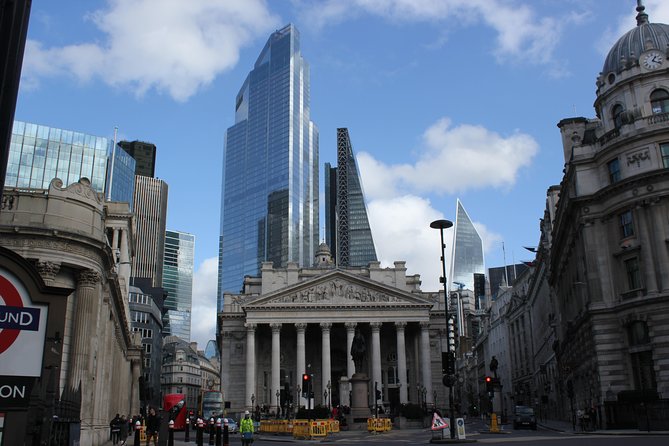
This is not a general tour of all London. It focuses on the compact City of London, the historic core and present-day financial district. That focus makes the route useful. You are not spending the whole morning crossing town between attractions.
The walk begins at The Monument, at 18 Fish St Hill, and finishes outside St. Paul’s Cathedral. The route links the River Thames, old churches, markets, financial institutions, royal stories, and film locations. You can choose from morning or afternoon departures, which helps you fit it around a museum visit or a theater booking.
The tour is private for your group, with a maximum of 15 people. That matters on narrow streets and at small sites such as the London Stone. You can ask why a church was rebuilt, how the City operates, or which stories are fact and which are legend without trying to speak over a large crowd.
The tour is priced at $171.09 per group. For a full group, that is excellent value. For two people, it is a more serious purchase, but the private guide and three hours of focused sightseeing may justify it if you prefer personal attention over a cheaper shared walk.
More city tours in London:
- Westminster to Greenwich Sightseeing Thames Cruise in London
★ 4.5 · 2,969 reviews - London Sightseeing Tour: Guard Change with Tower of London Option
★ 4.5 · 2,672 reviews - Hop-On Hop-Off Sightseeing River Cruise on the Thames
★ 4.0 · 1,256 reviews
Trinity Square and the Tower of London
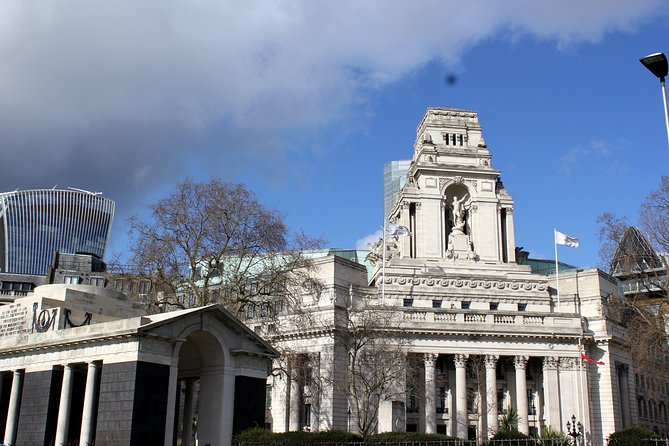
At Trinity Square, you first see 10 Trinity Square, the former home of the Port of London Authority. Its setting makes sense once you remember how important the Thames was to London’s trade. The building also hosted the United Nations’ inaugural reception, giving the guide a chance to connect the City with modern international affairs.
Nearby, the Merchant Navy memorial honors sailors who suffered heavy losses in both world wars. This is a useful stop because it points to a side of British wartime survival that many visitors miss. Ships carried food, fuel, and supplies, and the memorial helps explain how dependent Britain was on sea routes.
The Tower of London is one of the major sights on the route, but you remain outside. That is not a small distinction. The Tower can take several hours by itself, especially if you want to see the Crown Jewels, so this walk gives you the story and location without replacing a full visit.
Your guide covers the Tower as royal palace, prison, execution site, and secure home of the Crown Jewels. The stories also reach beyond the usual kings and queens, including London Zoo, the Kray twins, and Rudolf Hess, the senior Nazi figure imprisoned there during the Second World War.
I like this approach for a first look. You get context before deciding if you want to return with a timed admission ticket. If the Tower is your main reason for coming to London, book separate entry and allow much more time.
St. Dunstan in the East and Leadenhall Market
St. Dunstan in the East is one of the most atmospheric places on the route. The church began in the 12th century, and Sir Christopher Wren added its tower in the late 17th or early 18th century. Bomb damage left the church as a garden of arches, stone, and greenery.
You receive about 20 minutes here, enough to take photographs and hear how fire, flooding, and bombing changed London. The site rewards a slower eye. Instead of looking at a complete church, you look at what remains and imagine the building that once filled the space.
The stop is free, but the path and garden setting still require comfortable walking shoes. It is also a place where your guide can point out how London’s past remains visible without a formal museum around it.
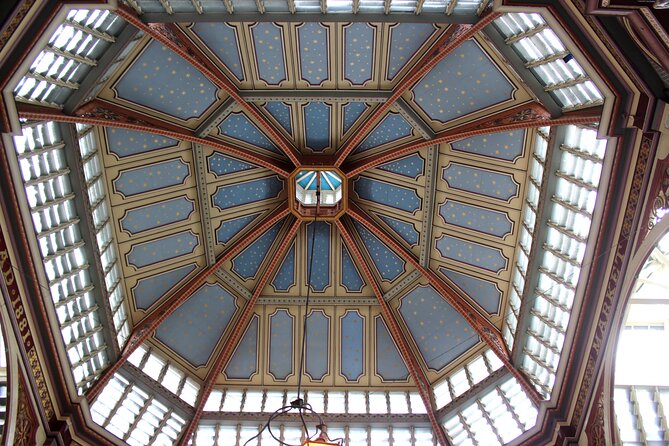
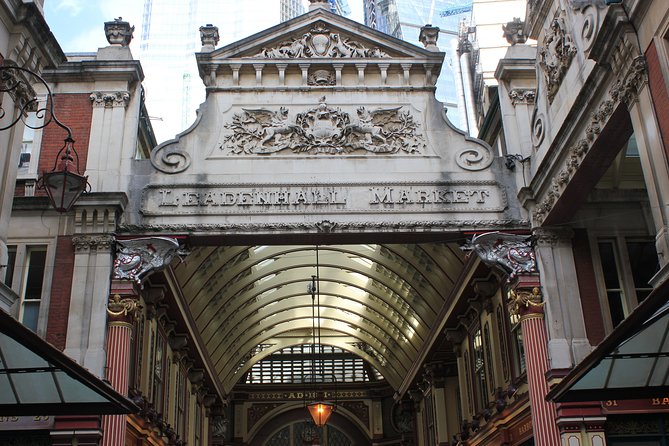
Leadenhall Market offers a sharp change of mood. It occupies the area of the old Roman Forum in Londinium, while the current market is a decorated Victorian structure designed by Sir Horace Jones. Crimson, green, gold, and silver details give it a theatrical look.
You may recognize the market from Harry Potter and the Philosopher’s Stone. The useful part of the stop is not only the film connection. You also learn how the market was used and how its name relates to the lead roofed hall that once stood there.
The two stops work well together. St. Dunstan shows London as a surviving ruin. Leadenhall shows London repeatedly rebuilt and dressed for a new age.
London Bridge, the Thames, and HMS Belfast
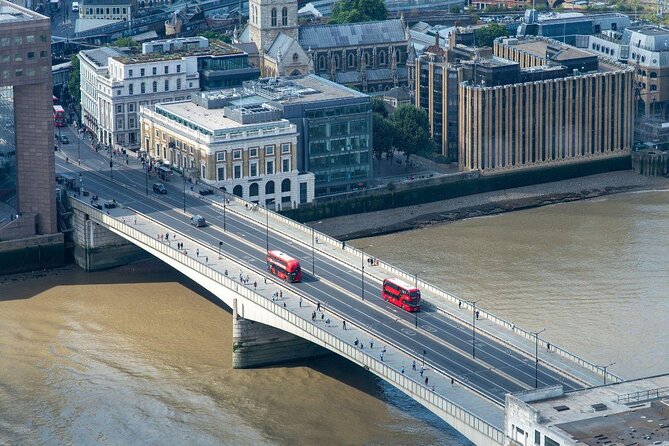
The route then reaches London Bridge, a crossing with a long and complicated past. For centuries, it was the only bridge across the Thames in London. The guide explains its Roman connection, including the pontoon bridge used during the Roman invasion, and the old belief that the 18th-century bridge helped influence Britain’s habit of driving on the left.
The wording of the route also refers to views from Tower Bridge. You should expect a riverside viewpoint rather than a visit inside a bridge. From this area, you can look toward the Tower of London, Tower Bridge, and HMS Belfast.
HMS Belfast gives the guide another way to discuss 20th-century Britain. The former Royal Navy cruiser saw action during the D-Day landings and the Korean War, and it is part of the UK’s Historic Fleet. You do not board the ship on this walking tour, but you get useful background before deciding if you want to visit it separately.
This is a short stop, listed at about 10 minutes. That is enough for river views and orientation, not enough for a detailed study of the bridge or ship. Keep that in mind if you are hoping for a long photography session.
More walking tours in London:
- Tour for Muggles The Ultimate Harry Potter Walking Tour in London
★ 5.0 · 4,684 reviews - London Jack The Ripper Guided Walking Tour
★ 5.0 · 3,131 reviews - Changing of the Guard Guided Walking Tour in London
★ 5.0 · 1,793 reviews - The Great British Rock and Roll Walking Tour
★ 5.0 · 1,371 reviews
The Monument and St. Magnus the Martyr
The Monument to the Great Fire of London commemorates the disaster of 1666 and the rebuilding that followed under Charles II. Here, the guide explains why the fire spread, the conspiracy theories that grew around it, and why rebuilding London proved more difficult than simply drawing a new plan.
You also learn a well-known nursery rhyme connected with the fire. That small touch keeps the story from becoming a dry list of dates. The Monument is a quick stop, about 10 minutes, so the value comes from the explanation rather than a long visit inside.
St. Magnus the Martyr is one of the route’s more distinctive churches. It was rebuilt after the Great Fire by master mason George Dowdeswell under Wren’s supervision. The church is also linked to Charles Dickens’s Oliver Twist.
Inside, you can see a replica of old London Bridge. That model helps explain why crossing the original bridge could be difficult. The church receives about 20 minutes, making it one of the places where the walking tour feels more personal and less like a checklist.
Admission is included at no extra cost at the listed stops, but church access can depend on circumstances outside the tour’s control. The supplied details identify the stop as free admission, not a guaranteed private opening.
The London Stone and Oxford Court
The London Stone is easy to miss. It sits behind glass today, though it has been treated as an important London object for at least 500 years. Its story reaches back to Roman Londinium, when it was described as a central place for proclamations and important public events.
Legend adds Arthur, Excalibur, and the idea that London’s safety depended on the stone remaining in place. You do not need to accept those stories as fact to enjoy the stop. They show how Londoners have used one small object to express the identity and fortune of the city.
The visit takes about 10 minutes. This is exactly the kind of stop that makes a private walk worthwhile, since a guide can point out something you might pass without noticing.
Oxford Court marks the former site of St. Swithin’s Church. The story here concerns the wife of Edmund Mortimer, daughter of the last Welsh Prince of Wales, Owain Glyndwr, who was held there with her children until her death in 1413.
The garden now includes a memorial to her. The guide uses this site to explain how London drew people from Wales, Scotland, Ireland, England, and much farther away. It is a quieter story than the Tower or Great Fire, but it helps explain the capital as a meeting place.
Mansion House, the Royal Exchange, and the Bank of England
Mansion House is the official home of the Lord Mayor of London and one of the finest Georgian palaces in the City. You view the exterior, including its elegant classical design, but do not go inside.
The building is also tied to the annual Mansion House speech by the Chancellor of the Exchequer. This gives the stop a modern financial role rather than leaving it as a pretty old facade. Allow about 20 minutes here.
From Mansion House, you can view the Royal Exchange. Elizabeth I opened the building, and the guide explains its place in the history of commerce. It is also described as one of the oldest stock exchanges in the world and possibly the oldest shopping mall still operating.
At the Bank of England, the focus shifts to money and economic power. The guide discusses the central bank’s role, the enormous gold reserves in its vaults, and how the vault has been opened by accident. You also hear how old and new systems help secure it.
This is a very short stop, about five minutes. You will not enter the vaults or tour the bank, so think of it as an explanation from the street. I find that useful because the financial district can otherwise seem like a wall of office buildings with little obvious meaning.
Ye Olde Watling and One New Change
Ye Olde Watling is a 17th-century pub associated with the workers who rebuilt nearby St. Paul’s Cathedral. It is also said to have been connected with Wren and may have served as his drawing room. The guide presents the pub as one of the few public houses linked with Britain’s most famous architect.
You spend about 10 minutes here. This is an exterior and history stop, not a pub crawl or meal break, so do not count on sitting down for lunch during the tour.
One New Change adds a modern contrast. This shopping center has a free roof terrace with views toward St. Paul’s Cathedral, The Shard, Tate Modern, Shakespeare’s Globe, and the Thames.
The terrace is a practical photo stop. Your guide can take a group picture, and the view helps you understand how old church towers, glass offices, the river, and newer London buildings fit together. About 15 minutes is allotted here, so you get a viewpoint without turning the tour into a long pause.
The College of Arms and St. Paul’s Cathedral
The College of Arms is a striking 17th-century building and the oldest heraldic college in the world. The guide explains how it researches family lines and creates new coats of arms for members of the British aristocracy.
The stop also connects the City with popular film and television. The area has been used for James Bond, Doctor Who, Mission Impossible, and Harry Potter productions. If you enjoy seeing how London doubles for other places on screen, this is a pleasant extra.
The final destination is St. Paul’s Cathedral, designed by Christopher Wren. You finish outside the cathedral after about 20 minutes there. That gives you a chance to study the exterior and hear about its place in the City, but admission inside is not included.
You should plan a separate visit if you want the interior, crypt, galleries, or dome. The walk helps you reach St. Paul’s with a better sense of the streets around it, but it does not provide cathedral entry.
Timing, pace, and who will like it
Three hours is a brisk schedule. Several stops last only five or 10 minutes, while St. Dunstan in the East, Leadenhall Market, St. Magnus, Mansion House, and St. Paul’s receive longer attention. You cover a compact area, but you still need a moderate level of physical fitness.
Wear shoes suited to city walking. The tour is not described as wheelchair-specific, and the route includes streets, gardens, church areas, and viewpoints. Service animals are allowed, and the meeting point is close to public transportation.
Hotel pickup can be requested, but the published meeting point is The Monument. Since the tour ends at St. Paul’s, you can continue to another sight from there rather than returning to the start.
This experience suits you best if:
- You have limited time and want a strong introduction to the City.
- You enjoy stories about architecture, crime, war, trade, and royal power.
- You prefer a private guide who can respond to your questions.
- You want to photograph unusual places as well as famous landmarks.
- You plan to visit the Tower or St. Paul’s separately.
It is less suitable if you want long interior visits, a relaxed café break, or a deep tour of one single attraction.
Guide style and practical value
The guide is the heart of this experience. One named guide connected with the tour is Dewi, described as funny, accommodating, and full of information. If Dewi leads your walk, you can expect a broad range of stories and a willingness to respond to requests. Guide assignment may vary, so it is best not to assume a particular person is guaranteed.
The strongest feature is the mix of well-known sights and small discoveries. A standard London walk might stop at the Tower, London Bridge, and St. Paul’s, then move on. This route adds the London Stone, a ruined church, an old pub, a heraldic college, and a church containing a London Bridge replica.
The free cancellation policy allows you to cancel up to 24 hours before the start time for a full refund. Changes or cancellations inside that window are not accepted and are not refunded. That is worth noting when building a London schedule, since weather and transport can affect a walking day.
Should you book this private City of London tour?
Book it if you want a fast, story-filled introduction to London’s oldest core and value having a guide to connect the pieces. The private setup is especially attractive for families, couples, or a group of friends who can split the $171.09 cost.
Do not book it as a replacement for the Tower of London, St. Paul’s Cathedral, HMS Belfast, or a full Thames experience. You see those places from outside or hear their stories from the street.
For most people, the best use is on your first or second day in London. You will finish at St. Paul’s with a clearer idea of what deserves a longer visit, plus a camera full of churches, markets, river views, and small corners you might otherwise miss.
FAQ
How long does the walking tour last?
The tour lasts approximately three hours.
Where does the tour start?
It starts at The Monument, 18 Fish St Hill, London EC3R 6DB.
Where does the tour finish?
The tour finishes outside St. Paul’s Cathedral, at St. Paul’s Churchyard.
Is the Tower of London included inside the tour?
No. The Tower of London is discussed and viewed from outside, but entry is not included.
Is entry to St. Paul’s Cathedral included?
No. The tour finishes outside St. Paul’s Cathedral, and admission is not included.
How many people can join the private tour?
The private tour is for your group only and can include up to 15 people.
Can I cancel for a full refund?
Yes. You can cancel at least 24 hours before the start time for a full refund. Cancellations and changes made less than 24 hours before the start time are not accepted.
Just added in London
- The Beatles and a Secret pub★ 4.5 · 36 reviews
- The Beatles & Liverpool Magical Mystery Tour from London★ 4.5 · 80 reviews
- Airport Coach Service from Heathrow to Oxford★ 3.5 · 67 reviews
- The Beatles Magical History Black Taxi Tour London★ 5.0 · 51 reviews
- The Beatles London walking tour. From Abbey Road to the Roof Top★ 5.0 · 61 reviews
- Private The Beatles Taxi Tour in London★ 5.0 · 12 reviews
- The Beatles London Walk★ 4.5 · 120 reviews
- The Alfred Hitchcock London Walk with Sandra Shevey★ 5.0 · 15 reviews
Walking Tours, compared.
Oxford University Walking Tour With University Alumni Guide
Read our review →
Tour for Muggles The Ultimate Harry Potter Walking Tour in London
Read our review →
Cambridge University Walking Tour by Alumni™ Kings College Option
Read our review →
Blackbeard to Banksy – The Ultimate Walking Tour of Bristol
Read our review →
Air Raid Shelter + St. Nicholas Market Walking Tour
Read our review →
Walking Tour of Bath with Blue Badge Tourist Guide
Read our review →
Changing of the Guard Guided Walking Tour in London
Read our review →Browse the lists this tour appears in