

Reviewed · WALKING TOURS
Fascinating Walking Tours Of Roman Chester With An Authentic Roman Soldier
Chester’s Roman past is not sealed behind museum glass. It appears under a café, in fragments of fortress wall, and in the curve of Britain’s largest Roman amphitheater. This 90-minute walk brings those remains together with a guide dressed as a Roman soldier, turning scattered stones into a picture of military life.
I like the way the tour uses real archaeology, including original pila stones and Roman columns. I also like the guides’ mix of facts and humor. Marcus, Julius, Gaius, Faustus, Tiberius, and others have been praised for keeping children and adults involved. The main drawback is simple: it is outdoors, and poor weather can lead to a cancellation or a date change.
Key points to know before you book

- The amphitheater anchors the walk: Explore the largest Roman amphitheater in Britain and learn what its remains reveal about combat and public life.
- Roman Chester is still under your feet: See surviving fortress walls, some rising more than 5 meters, plus remains tucked beneath modern buildings.
- The guide is part of the experience: Your Roman soldier may explain ranks, pay, clothing, hygiene, work, and daily life, with reproduction and genuine artifacts sometimes available to handle.
- The Roman Gardens explain the baths: Original pila stones and reconstructed flooring show how Roman underfloor heating worked.
- The group stays small: A maximum of 15 people makes it easier to ask questions and hear the guide.
- The price is modest for a city tour: At $16.64 per person, the walk offers a useful introduction before you explore Chester on your own.
Seeing Roman Chester as a working fortress
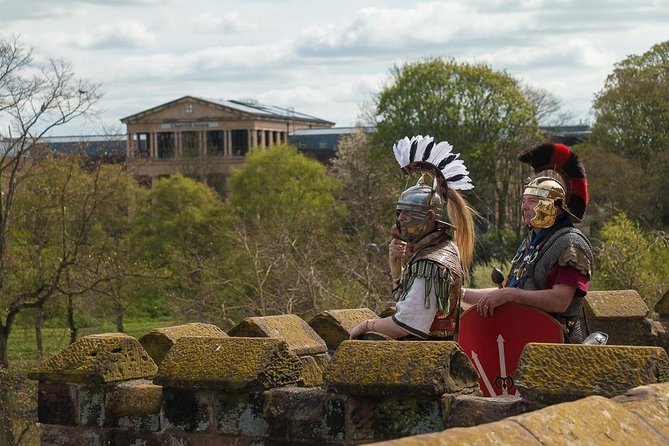
The best feature of this walk is its sense of connection. Chester can look like a handsome English city of shops, cafés, and old streets, but the Roman military settlement is still visible in pieces. Your guide helps you link those pieces into one place: a fortified base, a military community, and a busy center of life in Roman Britain.
The costumed guide helps with that shift in perspective. You are not simply shown a wall and told that it is old. You can hear about the soldier’s uniform, training, wages, rank, trade, living quarters, and personal hygiene. Some guides also bring reproduction items and real artifacts, giving you something more concrete than a spoken lecture.
The role-play is lively rather than theatrical in the information provided. Guides such as Marcus and Julius are praised for answering questions, while Gaius, Tiberius, Faustus, and female guides such as Hippolyta have each brought their own style. That variety matters. A strong guide can make the same stones feel fresh, especially for children.
The walk is conducted in English and lasts about an hour and a half. With a maximum of 15 people, it has the feel of a small walking group rather than a large procession. You should still expect to walk and remain outside for much of the time, so sensible footwear and a weatherproof layer are practical choices.
More walking tours in England:
- Oxford University Walking Tour With University Alumni Guide
★ 5.0 · 6,905 reviews - Tour for Muggles The Ultimate Harry Potter Walking Tour in London
★ 5.0 · 4,684 reviews - London Jack The Ripper Guided Walking Tour
★ 5.0 · 3,131 reviews
Starting at Chester Town Hall
The stated meeting point is Chester Town Hall on Northgate Street, Chester CH1 2HJ. This is a useful central location for a tour because you can reach it by public transport, and the activity is close to the city’s main sights.
From there, the guide leads you through the Roman story rather than presenting a single isolated monument. The exact presentation can vary by guide, but the main themes remain consistent: Chester as a Roman fortress, the people who lived and served there, and the archaeological traces left behind.
I would arrive a little early. The group limit is 15, and the guide needs to gather everyone before setting off. Confirmation is provided when you book, and the experience is offered in English.
One point needs care when planning the rest of your day. The information gives an end address of 23 Little St John Street, but also says tours terminate at the Roman Amphitheater and that the guide will direct you to your next destination. Treat the amphitheater as the practical finish point, and ask the guide at the start if you need to connect with another booking.
The Roman Amphitheater: Chester’s most powerful stop
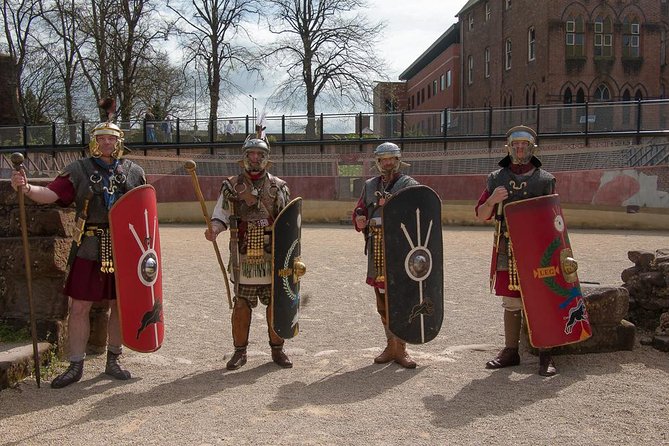
The Roman Amphitheater is the headline sight. It is described as Britain’s largest Roman amphitheater, and the walk uses the remains to discuss the people who fought and died there.
You will not see a complete arena like the Colosseum in Rome. What you get instead is the outline and surviving archaeology, which is enough to suggest the scale and purpose of the site. A guide in Roman military dress can add the human detail that bare masonry cannot: who used the arena, how public spectacles fitted into Roman life, and what the evidence can and cannot tell us.
The scheduled visit here is about 15 minutes. That is enough for a focused explanation and a chance to look around, but not enough for a long independent study of every stone. If you are especially interested in Roman entertainment, you may want to return later with more time.
The amphitheater also gives the tour a strong anchor. After hearing about pay, rank, equipment, and discipline, you can consider the less orderly side of Roman life: public combat, risk, and spectacle. That contrast helps keep the walk from becoming a list of dates and building names.
Fortress walls rising above modern Chester
Another stop focuses on Chester’s Roman fortress walls. The present structures were built on the foundations of the walls of Britain’s largest Roman fortress, and some original sections survive to more than 5 meters high.
This is one of the most useful parts of the tour for anyone who has walked Chester without noticing its Roman plan. You may pass sections of wall and see only weathered stone. The guide explains what those remains belonged to and how they fitted into the wider fortress.
The walk is especially helpful here because the remains are not always presented as one grand monument. Roman Chester is spread through the modern city. The guide points out what is genuine, what has been reconstructed, and where later buildings have covered or reused ancient material.
That is also where archaeology becomes more than background decoration. The tour focuses on evidence found in the area, allowing you to think about how historians build a picture from fragments. You are not asked to accept a romantic story without question. The wall, the layout, and the excavated objects all matter.
Same base, a different kind of day:
- Stonehenge, Windsor Castle, and Bath from London
★ 4.5 · 18,662 reviews - London Big Bus Hop-On Hop-Off Tour with Optional River Cruise
★ 3.5 · 10,803 reviews - London Small Group Tour of Historical Pubs
★ 5.0 · 10,422 reviews - Beatles Magical Mystery Tour
★ 5.0 · 9,266 reviews
Roman Gardens and the hypocaust lesson
The Roman Gardens provide a more technical stop, but the explanation is practical. Here you see a reconstructed Roman hypocaust system using original pila stones, along with reconstructed or mosaic flooring found during excavations of the Roman military baths.
A hypocaust was an underfloor heating system. The pila stones supported a floor above a space where hot air could circulate. Seeing the stones set out in a reconstructed example makes the system easier to understand than a written description alone.
The guide explains how the system worked and why these pieces were relocated to the gardens. That last point is important. Archaeological material is often moved so it can be protected, interpreted, or displayed in a place where you can see how it fitted together.
The gardens also point to the scale and quality of the military baths. One especially sobering detail from the tour’s historical discussion is that Chester once had Roman baths larger and grander than those at Bath, but they were bulldozed for a shopping development after only four days of minimal archaeological exploration. That loss gives the surviving stones added weight. You are seeing not just what remains, but a small part of what was lost.
The café basement and other unexpected remains
One of the most memorable parts of the walk is the chance to see Roman remains beneath a modern café. The exact access may depend on the route and conditions, but the basement is repeatedly singled out as an unexpected part of the experience.
This is the kind of stop that makes a city walk worthwhile. A Roman column or foundation beneath a popular modern business shows how much of Chester’s past is still mixed into daily life. You do not have to travel to a remote archaeological park to find ancient remains. They may be under the place where you stop for coffee.
There is also mention of Principia columns beneath the café. The principia was the headquarters building of a Roman fortress, so columns associated with it help show the importance of Chester as a military center.
Access can be limited in places. One person using an electric wheelchair was able to take part but missed a single section while the group went into a cellar. The tour is near public transport, service animals are allowed, and most people can participate, but the basement or cellar portion may not suit every mobility need. Contact the provider in advance if step-free access is essential.
What the Roman soldier-guide adds
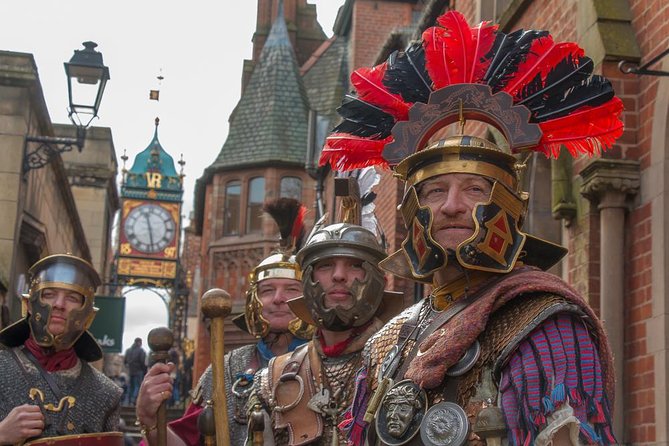
The costumed guide is not just a photo opportunity. The best part of the format is the chance to ask practical questions about life in the Roman army.
You may hear about:
- Ranks and pay, including what a soldier earned
- Training and trade, and the work a soldier was taught
- Uniform and equipment, including custom-made legionary kit
- Living quarters and hygiene
- Risks of military service
- The role of women in Roman communities
One striking point discussed on the walk is that some Roman soldiers came from areas now associated with Ukraine and Russia. The tour also addresses women in Roman Chester, including the claim that women, whether soldiers or not, had to sleep outside the fortress walls. These details complicate the usual picture of Roman Britain as a place filled only with male soldiers from Italy.
The guides use humor as well as facts. Puns, jokes, and personal enthusiasm help keep the pace comfortable during the 90 minutes. That style works particularly well with families. Children may not remember every date, but they are more likely to remember a Roman soldier explaining a uniform or pointing to a column under a café.
The approach also suits serious history fans. One person with a PhD in ancient history found the tour entertaining and still learned something new. That is a good sign that the walk is not only aimed at first-time visitors.
How good is the value at $16.64?
At $16.64 per person, this is a fairly priced introduction to Roman Chester. You are paying for a guide, a planned route, historical interpretation, and access to several remains that would be easy to miss alone.
The value is strongest if you are new to Chester or have only a short time in the city. In 90 minutes, you get a framework for understanding the fortress, amphitheater, baths, walls, and modern streets. Afterward, you can return to the sites that caught your interest.
The walk is less suitable if you want a long, quiet archaeological visit at each location. The amphitheater stop is about 15 minutes, and the tour has a fixed pace. You are buying interpretation and access to a connected story, not an all-day excavation visit.
The small group limit also adds value. Fifteen people is still enough for a lively group, but it should allow the guide to answer questions without the crowd becoming unwieldy. A particularly assertive participant can sometimes interrupt a presentation, so if you want a quiet, highly controlled lecture, this informal style may not be ideal.
Weather, cancellation, and practical planning
This experience requires good weather. If poor conditions force cancellation, you are offered another date or a full refund. You can also cancel for a full refund up to 24 hours before the start time. Changes or cancellations made less than 24 hours before the start time are not accepted for a refund.
Because the tour is outdoors, check the forecast before setting out. Rain did not prevent one group from enjoying the experience, but wet weather can make walking and standing less pleasant, especially around uneven historic surfaces.
Wear shoes suitable for city walking and bring a waterproof layer. The tour is in English, and confirmation arrives at booking. Most people can participate, and service animals are allowed.
Who should book this Chester walk?
I would recommend it to anyone who wants to understand Chester quickly rather than simply photograph its old stones. It suits first-time visitors, families, history fans, and local residents who have never looked closely at the Roman remains around them.
It is also a good choice if you enjoy guides with personality. The Roman soldier format is playful, but the content reaches beyond costume and jokes. You can ask about military structure, daily routines, archaeology, and the difficult decisions that shaped what remains in the city today.
You may want to skip it if you dislike outdoor walking, prefer a self-guided pace, or need every part of a tour to be step-free. The cellar section may not work for all mobility needs, and the weather policy means your plans need some flexibility.
Should you book Fascinating Walking Tours of Roman Chester?
Yes, if you want a compact, well-priced way to make sense of Roman Chester. The amphitheater, fortress walls, Roman Gardens, hypocaust, and basement remains form a varied route, while the soldier-guide format keeps the history human.
Book it early if your schedule is tight, since it averages about 14 days of advance booking. Choose it for the guide’s stories and archaeological context, not just the costume. If you can accept an outdoor walk and a brisk 90-minute route, this is an effective first look at the Roman city beneath modern Chester.
FAQ
How long does the Roman Chester walking tour last?
The tour lasts approximately 1 hour and 30 minutes.
Where does the tour begin?
The stated meeting point is Chester Town Hall, Northgate Street, Chester CH1 2HJ, UK.
Where does the tour finish?
Tours terminate at the Roman Amphitheater. The guide will direct you to your next destination. The supplied end address is 23 Little St John Street, Chester CH1 1RF.
What language is the tour offered in?
The tour is offered in English.
How many people can join the tour?
The maximum group size is 15 people.
What happens if the weather is poor?
The experience requires good weather. If it is canceled because of poor weather, you will be offered a different date or a full refund.
Just added in England
- Exceptional Bath tour guide making your visit splendidly memorable.★ 4.5 · 69 reviews
- Full-Day Private Tour of Stonehenge and Bath with Pickup★ 5.0 · 6 reviews
- One Way or Round Trip Private Transfer: Heathrow Airport to Bath★ 5.0 · 3 reviews
- Quintessential Cotswolds Half-Day tour from Bath (for 2-8 guests)★ 5.0 · 27 reviews
- Stonehenge Half-Day luxury guided tour from Bath for 2-8★ 5.0 · 15 reviews
- Private Guided Tour of Jane Austen’s Bath★ 5.0 · 7 reviews
- Cotswolds and Oxford Small-Group Tour from Bath★ 5.0 · 51 reviews
- British Wine and Cheese Tasting Experience in City of Bath★ 5.0 · 18 reviews
Walking Tours, compared.

Oxford University Walking Tour With University Alumni Guide
Read our review →
Tour for Muggles The Ultimate Harry Potter Walking Tour in London
Read our review →

Cambridge University Walking Tour by Alumni™ Kings College Option
Read our review →
Blackbeard to Banksy – The Ultimate Walking Tour of Bristol
Read our review →
Air Raid Shelter + St. Nicholas Market Walking Tour
Read our review →
Walking Tour of Bath with Blue Badge Tourist Guide
Read our review →
Changing of the Guard Guided Walking Tour in London
Read our review →Browse the lists this tour appears in