
Reviewed · WALKING TOURS
Birmingham Walking Tour: Canals, Victorians & Today (1:30pm)
Birmingham’s story is written in canals, civic buildings, Victorian stonework, and bold modern architecture, and this two-hour walk puts those layers side by side. You move from the Library of Birmingham to Gas Street Basin, then through grand squares, former industrial sites, and newer developments that show how the city keeps changing.
I like the clear city-center route and the way guides such as Jonathan and Michael connect buildings to everyday Birmingham life. I also like the live audio receiver, when used, because you can hear the guide without crowding around him. The main consideration is that the tour covers a lot in two hours, so the canal section is fairly short rather than a long waterside walk.
Key points at a glance
- Gas Street Basin in 15 minutes: See the atmospheric meeting point of Birmingham’s canal network and learn why waterways mattered to the city.
- Two engaging guide styles: Jonathan is known for high energy, humor, local stories, and personal research, while Michael brings experience explaining Birmingham to university students.
- A useful first-day orientation: The route links the Library, ICC, Brindleyplace, Victoria Square, Town Hall, the Mailbox, and other central sights.
- Old and new Birmingham together: Victorian civic buildings sit beside the Mailbox, The Cube, modern public art, and changing city squares.
- Audio support when available: Bring earphones with a standard 3.5mm socket, or use a new pair provided by the operator.
- Good value at $20.80: For a small admission-free walking tour with local interpretation, the price is modest, though you should not expect entry into most buildings.
A useful first look at England’s second city
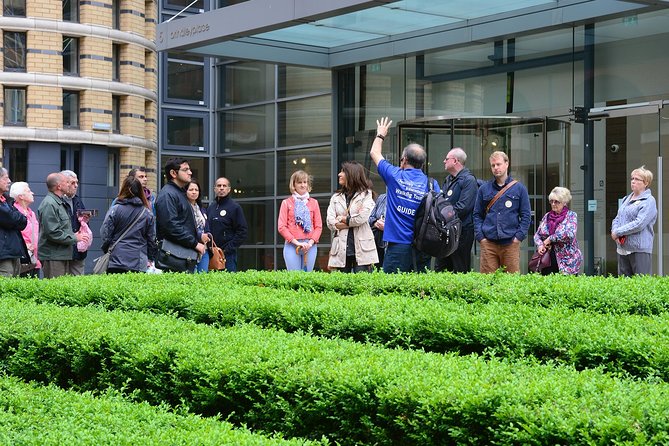
Birmingham can be hard to read at first. Its center has grand Victorian buildings, broad public squares, canals, concrete walkways, restored industrial sites, and shiny new developments. This walk helps you connect those pieces instead of seeing them as unrelated sights.
The tour starts and finishes at the Library of Birmingham in Centenary Square at 1:30 p.m. That location is practical. The library is easy to identify, sits near the ICC and Symphony Hall, and gives you an immediate sense of modern Birmingham before the walk turns toward older civic landmarks.
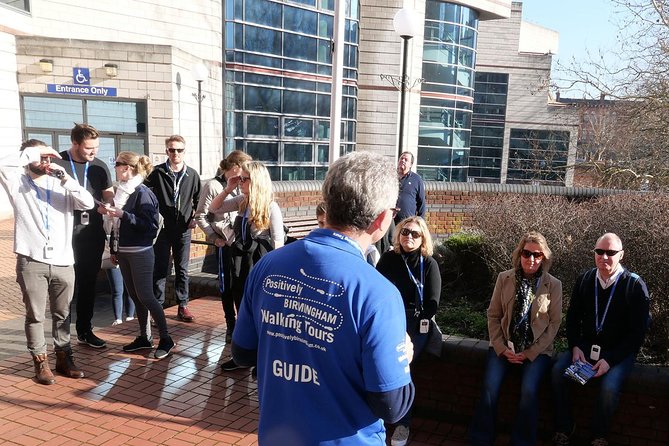
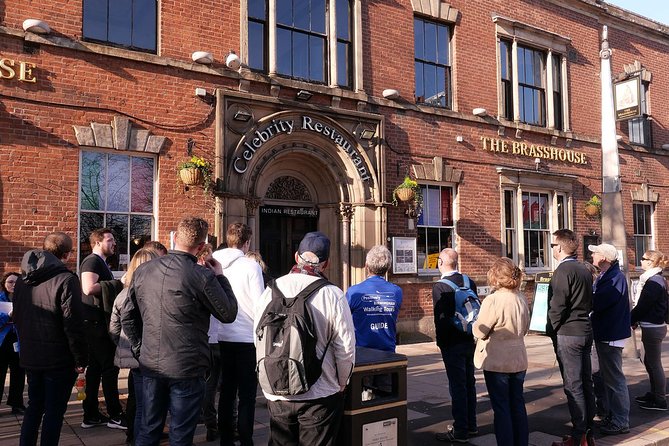
You spend about two hours on foot. The group can include up to 35 people, so this is not a private stroll, but the route is still designed for close listening and regular stops. The steady pace suits most people with moderate physical fitness. You will be standing often, walking between stops, and pausing outdoors.
Jonathan and Michael are among the guides used for this experience. Jonathan brings a lively delivery, local research, personal memories, humor, and plenty of side facts. Michael has spent much of his working life explaining Birmingham to students at Birmingham City University, so his approach is likely to appeal if you enjoy clear historical context and thoughtful answers.
More walking tours in England:
- Discovering Birmingham 2 hour Walking Tour to the Jewellery Quarter
★ 5.0 · 333 reviews - Birmingham Slogging Gangs Walking Tour with Edward Shelby
★ 4.5 · 306 reviews - Birmingham City Centre Daily Walking Tour (10:30am & 2pm)
★ 5.0 · 265 reviews
Starting with the Library of Birmingham
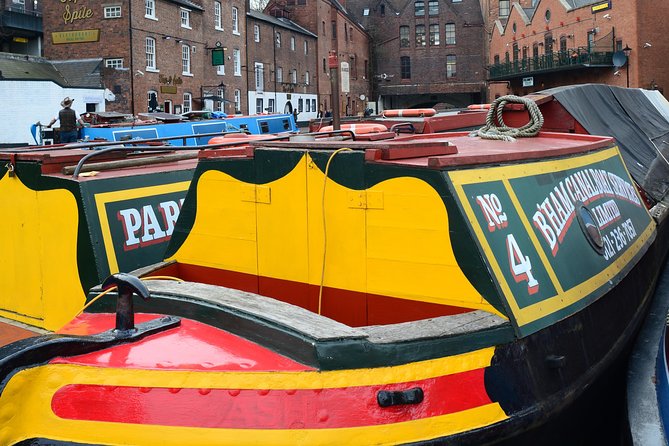
The Library of Birmingham is more than a meeting point. It is one of the city’s major modern attractions and an effective opening to the tour because it represents Birmingham’s current civic identity.
The guide begins here and returns here at the end. You get around ten minutes at the library, with no admission charge. The stop is short, so do not expect an interior visit or a long architectural lecture. Instead, it sets the tone for the city’s recent development and gives you a fixed point at both ends of the route.
The building is also a practical place to meet if your party needs to use facilities or gather before the 1:30 p.m. start. Arrive with enough time to locate the meeting point in Centenary Square, especially if you are unfamiliar with the city center.
Symphony Hall, the ICC, and Brindleyplace
From the library, the walk moves toward the International Convention Centre and Symphony Hall. The stop lasts about ten minutes and focuses on the role these buildings play in Birmingham today.
This is a useful contrast with the Victorian sights later in the walk. The ICC area shows a city built for conferences, music, public events, and large gatherings. You will not be attending a concert as part of the tour, and admission is not included, but the guide explains how the complex fits into the modern center.
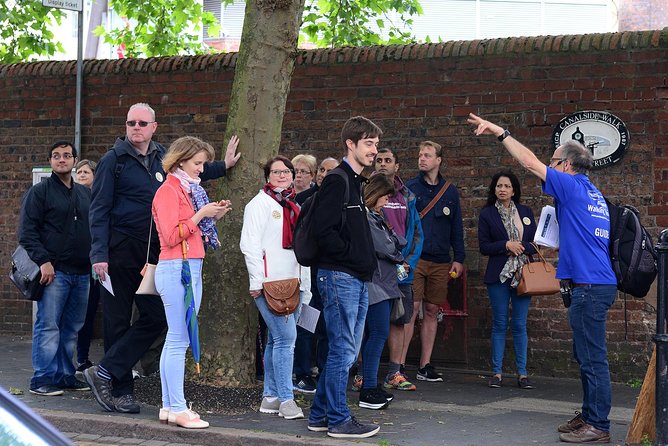
The next stop is Brindleyplace, also for about ten minutes. Here, the focus shifts to the area’s past and present. The value of this stop is not simply looking at attractive buildings. You begin to see how Birmingham has reused former working areas and reshaped them for offices, restaurants, public space, and leisure.
I find this part especially helpful if you are trying to understand Birmingham’s pattern of renewal. The city is not presented as an untouched historic center. Instead, you see how old uses gave way to newer ones, often within a short walk.
Gas Street Basin and the canal story
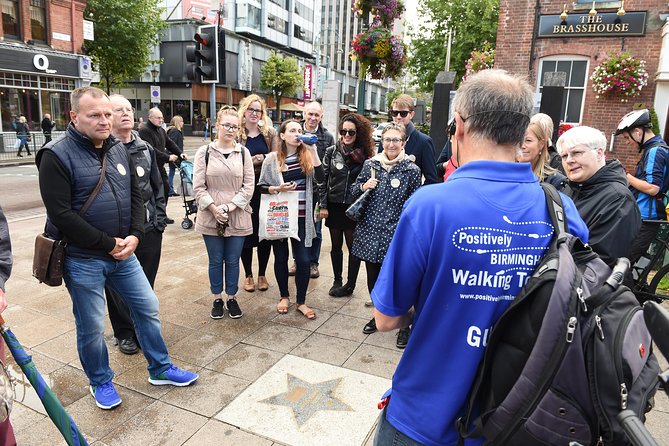
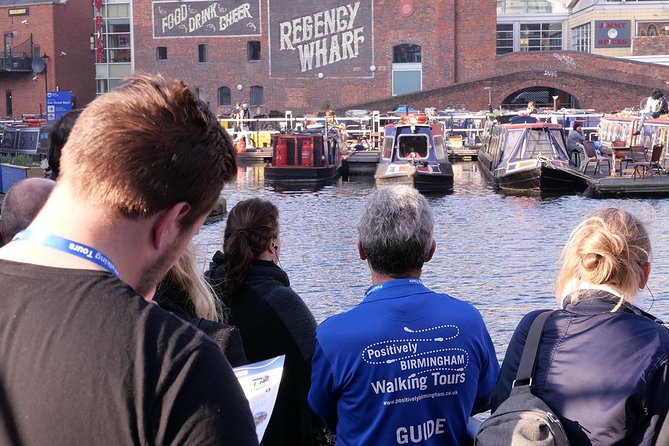
Gas Street Basin receives the longest stop, about 15 minutes, and it is the clearest link to the tour’s canal theme. This is an atmospheric center of Birmingham’s canal network, with water, bridges, towpaths, and a very different mood from the open civic squares.
The guide explains the arrival and importance of the canals. That context matters because Birmingham’s growth was tied to transport, trade, manufacturing, and the movement of goods. The basin helps you picture the working city behind the grand public buildings.
Keep your expectations in check. The tour does not spend most of its time walking beside the water. One person looking for a longer canal walk found the canal content shorter than expected, and that is a fair way to understand the route. Gas Street Basin is a substantial stop, but the whole experience also covers civic architecture, public art, memorials, and modern redevelopment.
If canals are your main reason for booking, you may want to treat this as a city orientation with a canal chapter, not as a dedicated waterways tour. If you want the canals in context, the balance works well.
Same base, a different kind of day:
- Stonehenge, Windsor Castle, and Bath from London
★ 4.5 · 18,662 reviews - London Big Bus Hop-On Hop-Off Tour with Optional River Cruise
★ 3.5 · 10,803 reviews - London Small Group Tour of Historical Pubs
★ 5.0 · 10,422 reviews - Beatles Magical Mystery Tour
★ 5.0 · 9,266 reviews
Victoria Square and Birmingham’s Victorian character
The walk then turns to Victoria Square, where the guide discusses public art and Birmingham’s growth during the Victorian period. This is one of the best places to understand how the city expressed its confidence through civic buildings and public spaces.
The stop lasts around ten minutes. You will also hear about changes in the present-day city, so the discussion does not stay locked in the nineteenth century. That mix is one of the tour’s strengths. Birmingham is shown as a place that keeps rewriting itself, sometimes preserving older buildings and sometimes replacing or adapting them.
Birmingham Town Hall is covered later in the route. Dating from 1834, it is the oldest building in Victoria Square. The guide gives it about five minutes, enough to place it within the city’s civic story without turning the walk into a formal architectural lecture.
This is a good place to pay attention to how the guide explains function. Town Hall is not just a handsome facade. It represents public life, performance, administration, and the ambitions of a growing industrial city.
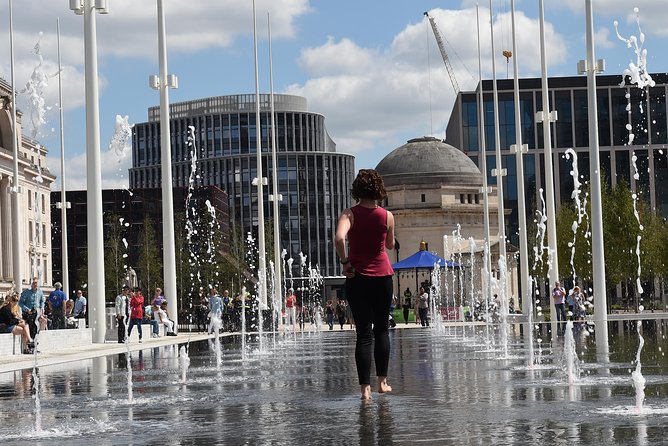
Chamberlain Square and the city’s next chapter
Chamberlain Square offers another look at how Birmingham is moving into the future. You spend about ten minutes here, considering the way the city has reshaped its public spaces and continues to plan for change.
The stop pairs well with Victoria Square. One gives you Victorian confidence and public art, while the other points toward newer ideas about how the center should work. The walk does not ask you to choose between old Birmingham and new Birmingham. It shows the friction and connection between both.
This part will appeal to you if you enjoy urban planning and public architecture. It is less rewarding if you want a long series of interior visits. Most of the tour is outdoors, and several buildings are viewed from the street.
Birmingham Museum and Art Gallery, then the Ikon Gallery
The route passes Birmingham Museum & Art Gallery, allowing about two minutes to see the entrance and its remarkable 1880s double portico. Admission is included in the itinerary description, but the tour does not take you inside for a museum visit.
That distinction matters. You are getting an exterior overview, not time to see the collections. If the museum interests you, plan a separate visit rather than assuming the walk covers it.
The Ikon Gallery appears elsewhere along the route. Its building was originally a school and is one of more than 40 schools designed by the architects Martin & Chamberlain. This is the sort of detail that gives the walk its local character. The building is not treated simply as a gallery. Its earlier purpose becomes part of the story of Birmingham’s public architecture and education.
The tour is at its best when it makes these connections. You learn to look at a building not only for its current use, but also for what it was built to do in an earlier Birmingham.
The Mailbox and The Cube
The Mailbox is a former post office sorting office converted into a mixed-use development. The stop lasts about five minutes and includes the Birmingham headquarters of the BBC.
This is another clear example of adaptation. A large working building has been given a new role, and the guide uses it to explain the city’s recent changes. You will see the outside and hear about the conversion rather than take a full interior tour.
The Cube sits toward the rear of the Mailbox development. The stop is listed as only about one minute, so expect a quick look and a brief explanation. The upper floors have some of the best views in Birmingham, but those views are not part of the walking tour unless access happens to be available separately. Do not book this experience expecting to go up The Cube.
Still, the pairing is useful. The Mailbox shows reuse of an older structure, while The Cube represents a newer, more visually assertive development. Together they reinforce the tour’s central idea: Birmingham is a city of layers.
The Hall of Memory and Birmingham’s civic memory
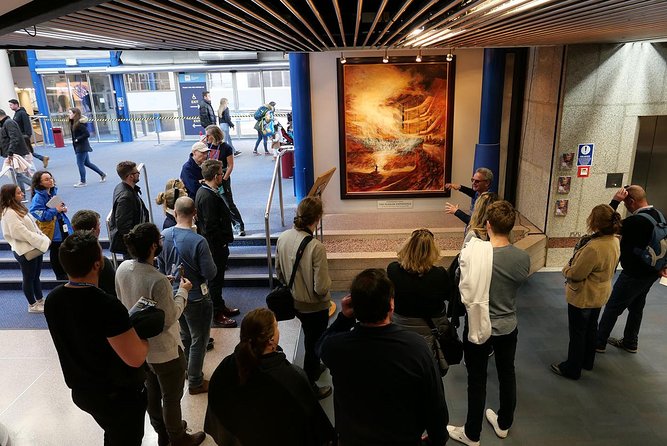
The Hall of Memory is an Art Deco memorial built in 1925 to remember those who died in the First World War. It now includes later conflicts, including the Second World War and more recent wars.
The stop lasts about five minutes. Inside are Art Deco features, including tablets by William Bloye. The tour presents the building as a place of remembrance, not merely another attractive structure on the route.
This is one of the quieter sections of the walk. After canals, traffic, public art, and modern developments, the memorial offers a pause. You can consider how Birmingham remembers its residents and how public buildings carry emotional as well as practical meaning.
The tour does not appear to include a long interior visit, so the guide’s explanation is important. Listen for the details that help you understand why the building was created and how its purpose has broadened over time.
The route back through the ICC and Town Hall
The ICC Mall is described as the main route from Centenary Square to the canalside, and the walk gives it about ten minutes. This section links the early canal area with the civic heart of the city.
You see how the route functions as a connector rather than a single landmark. It is a reminder that a city center is made from movement as much as monuments. The walk keeps you oriented as it returns toward Victoria Square and Town Hall.
The final stop at Birmingham Town Hall gives the Victorian center another look before you finish back at the Library of Birmingham. That loop is convenient. You do not need to arrange transport from a different endpoint, and you finish close to the place where you began.
Guides, group size, and the audio system
The guide is a major part of the value here. Jonathan is described as energetic, quick-moving, funny, and full of local detail. His style suits you if you like a lively walk with stories, current city facts, and the occasional Dad joke.
Michael offers a different strength. His experience explaining Birmingham to students suggests a more measured teaching style, with clear context and room for questions. The exact guide is not guaranteed, so book the route for the experience rather than for one named person.
A live audio system may be used, though it is not used every time. When it is in operation, each person receives a receiver and hears the guide through earphones. Bring your own earphones with a 3.5mm plug if you have them. A new pair can be provided.
The system is especially useful in a city center where traffic, pedestrians, and open spaces can make listening difficult. If no audio equipment is used on your date, you may need to stay closer to the guide.
The maximum group size is 35. That is large enough to feel like a public walking tour rather than a private outing, but the radio system helps keep the commentary audible. Some departures may feel smaller, and a small group makes it easier to ask questions.
Is $20.80 good value?
At $20.80 per person, I consider this a fair price for a two-hour introduction to central Birmingham. There are no major admission fees built into the route, so you are paying mainly for the guide’s time, local research, organization, and interpretation.
The value is strongest if this is your first visit or your first afternoon in the city. You get a map in your head, a list of buildings to revisit, and useful ideas for exploring beyond the tour. The walk also helps you decide which places deserve a longer visit, such as the Library, Birmingham Museum & Art Gallery, or the canal area.
It is less compelling if you want paid entry to museums, extended time inside historic buildings, or a specialist canal excursion. This is an outdoor orientation walk with many short stops.
The tour is recommended by 98 percent of customers and has a 4.9 rating from 346 ratings. Those figures suggest consistently strong satisfaction, especially with the guides, the pace, and the way the city’s story is explained. The recurring strengths are the friendly delivery, the humor, the clear local knowledge, and the amount covered in two hours.
Who should book this walk?
I would choose this tour for a first visit, a short Birmingham weekend, or an arrival day when you want to get your bearings quickly. It also suits people who have visited before but want to understand why the center looks the way it does.
You should have moderate physical fitness. The route involves walking and standing, but the supplied information does not describe strenuous terrain. Service animals are allowed, and the meeting point is near public transportation.
This tour is also a good fit for people who enjoy stories more than silent sightseeing. Jonathan and Michael are both associated with an engaging, conversational approach, and the guide is encouraged to answer questions.
Families, older visitors, and international visitors can all consider it, though English is the only listed language. One Japanese-speaking group received slower, clear English on a small departure, but that should not be treated as a guaranteed language service.
The experience requires good weather. If poor weather causes cancellation, you are offered another date or a full refund. You can cancel for a full refund up to 24 hours before the 1:30 p.m. start time. Within 24 hours, refunds and changes are not accepted.
Should you book Birmingham Walking Tour: Canals, Victorians & Today?
Book it if you want a friendly, fast-moving introduction to central Birmingham that links the canals, Victorian civic center, memorials, public art, and modern redevelopment. The strongest reason to go is the guide-led interpretation, especially if Jonathan or Michael is leading your departure.
Skip it if your main goal is a long canal walk, museum interiors, or extended time inside landmark buildings. For most people seeking a well-priced first look at Birmingham, though, the route gives you a useful foundation and plenty of ideas for the rest of your stay.
FAQ
Where does the Birmingham walking tour start and finish?
The tour starts at the Library of Birmingham in Centenary Square, Birmingham B1 2ND. It finishes back at the same meeting point.
What time does the tour begin?
The scheduled start time is 1:30 p.m.
How long does the walking tour last?
The experience lasts approximately two hours.
Is the tour offered in English?
Yes. English is the listed tour language.
Is an audio system provided?
A live audio system may be used, but not on every departure. When it is used, you receive a receiver and can use your own earphones with a 3.5mm socket. A new pair can also be provided.
What happens if I need to cancel?
You can receive a full refund if you cancel at least 24 hours before the start time. Cancellations or changes made within 24 hours are not accepted for a refund. If poor weather causes the operator to cancel, you are offered another date or a full refund.
Just added in England
- Exceptional Bath tour guide making your visit splendidly memorable.★ 4.5 · 69 reviews
- Full-Day Private Tour of Stonehenge and Bath with Pickup★ 5.0 · 6 reviews
- One Way or Round Trip Private Transfer: Heathrow Airport to Bath★ 5.0 · 3 reviews
- Quintessential Cotswolds Half-Day tour from Bath (for 2-8 guests)★ 5.0 · 27 reviews
- Stonehenge Half-Day luxury guided tour from Bath for 2-8★ 5.0 · 15 reviews
- Private Guided Tour of Jane Austen’s Bath★ 5.0 · 7 reviews
- Cotswolds and Oxford Small-Group Tour from Bath★ 5.0 · 51 reviews
- British Wine and Cheese Tasting Experience in City of Bath★ 5.0 · 18 reviews
Walking Tours, compared.
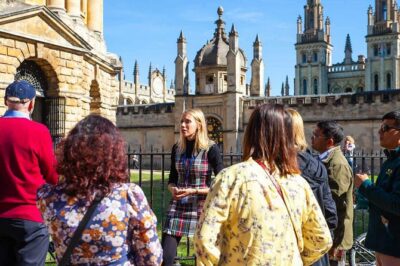
Oxford University Walking Tour With University Alumni Guide
Read our review →
Tour for Muggles The Ultimate Harry Potter Walking Tour in London
Read our review →
Cambridge University Walking Tour by Alumni™ Kings College Option
Read our review →
Blackbeard to Banksy – The Ultimate Walking Tour of Bristol
Read our review →
Air Raid Shelter + St. Nicholas Market Walking Tour
Read our review →
Walking Tour of Bath with Blue Badge Tourist Guide
Read our review →
Changing of the Guard Guided Walking Tour in London
Read our review →Browse the lists this tour appears in