
Reviewed · WALKING TOURS
Best of Bath Walking Tours – Georgian Tour
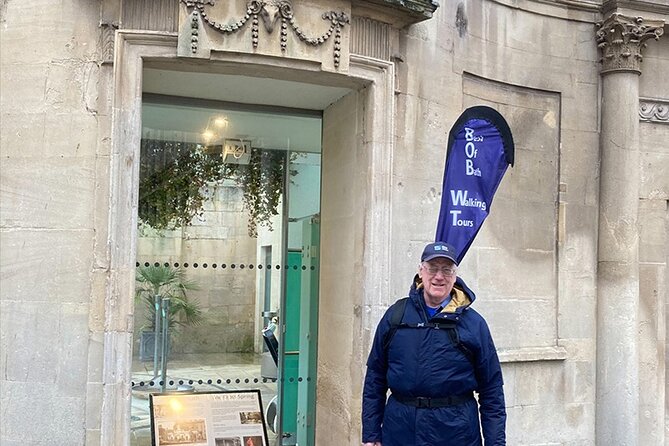
Bath’s Georgian architecture is much easier to understand when someone shows you how the pieces fit together. On this walk, Bob leads you from Bath Abbey through the old city, across Queen Square, around the Circus, and up to the Royal Crescent, explaining not just what each building looks like, but who designed it and how Bath’s fashionable image took shape.
I like the small maximum group of 15, which should make it easier to hear, ask questions, and keep close to the guide. I also like the balance between famous sights and overlooked details, including old city walls, a medieval path, the mineral hospital, and filming locations associated with Bridgerton. The main consideration is that this is a walking tour rather than an admission tour, so entry to places such as the Roman Baths, Assembly Rooms, and No. 1 Royal Crescent is not included.
Key points to know before booking
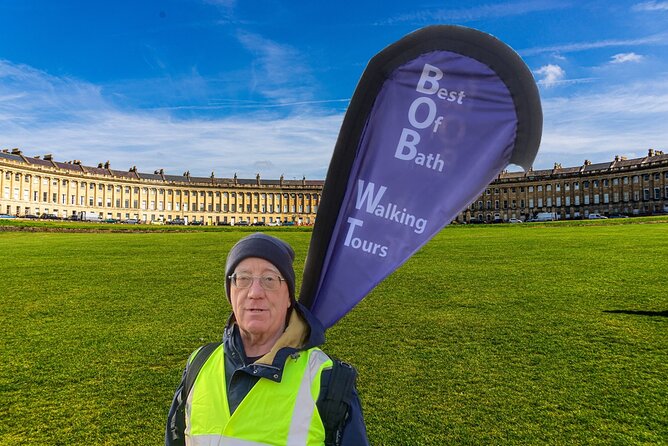
- Bob is the guide: Expect a friendly local guide with a witty style and a strong grasp of Bath’s architecture, people, and past.
- The route covers the main Georgian sights: Queen Square, the Circus, Royal Crescent, Pulteney Bridge, the Guildhall Market, and more are included.
- The tour usually lasts about two hours: The stated duration is two to three hours, and questions can extend the walk.
- Admission fees are separate: The walk passes important attractions, but tickets for several interiors are not included.
- Start and finish in the same place: Meet in Abbey Churchyard at 1:00 pm and return there at the end.
- Good value for an introduction: At $27.73 per person, you get a focused city orientation without paying for museum admission you may not want.
Why Georgian Bath makes sense on foot
Bath can feel like a collection of handsome streets until you understand the plan behind them. The Georgian builders were not placing grand houses at random. Queen Square, the Circus, and the Royal Crescent form a connected architectural sequence, and this tour helps you see that progression as you walk.
The route also gives you a useful time frame. Bath’s famous Georgian expansion took place in the 18th century, when visitors came for the mineral waters, social life, balls, concerts, and gambling. The buildings were designed to impress, but they also reveal how status, health, fashion, and business shaped the city.
Bob’s approach appears to suit people who want history explained in plain language. He covers the major facts, but also talks about the people who built and lived in Bath. That human focus matters. A row of pale stone houses is easier to remember when you know why it was built, who commissioned it, and how the city’s social life worked.
The tour is offered in English, and the group limit of 15 is a useful middle ground. You get more personal attention than on a large coach tour, while still having the company of other people as you walk.
More walking tours in Bath:
- Walking Tour of Bath with Blue Badge Tourist Guide
★ 5.0 · 1,877 reviews - Roman Baths and Bath City Walking Tour
★ 4.5 · 762 reviews - Bad of Bath fun Walking Tour of Bath
★ 5.0 · 402 reviews
Starting beneath Bath Abbey
The meeting point is Abbey Churchyard, in front of Bath Abbey. This is a practical place to begin because it puts you in the center of Bath’s oldest and most important area.
Bath Abbey began as a church in the 7th century, was reorganized in the 10th century, and was rebuilt in the 12th and 16th centuries. Bob uses the churchyard as the opening point before leading you into the wider story of the city.
The walk returns here at the end, so the route is easy to understand from a transport point of view. You are not dropped in an unfamiliar neighborhood at the finish. You can also stay afterward to ask Bob more questions about Bath, nearby sights, or anything that caught your attention.
The start time is 1:00 pm. That makes the tour useful as an afternoon activity, especially if you have already arrived in Bath in the morning or are fitting the walk between other plans.
Roman Baths, hot springs, and the city’s healing trade
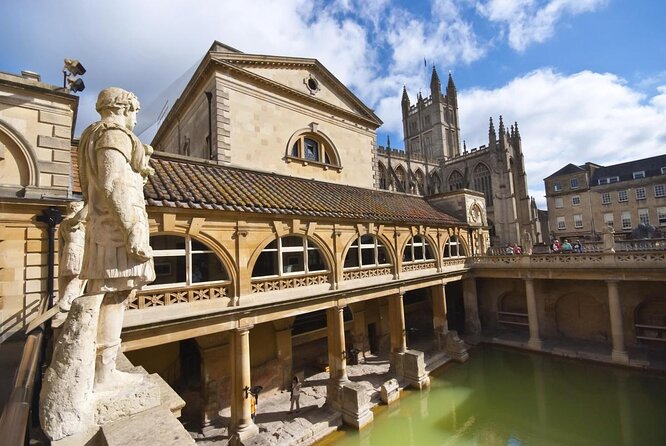
The Roman Baths are one of the essential landmarks on the route. The natural hot springs drew attention long before Georgian society made Bath fashionable, and a temple was built here between roughly 60 and 70 AD during the early years of Roman Britain.
The tour includes a short stop at the Roman Baths, but admission is not included. That distinction matters if you want to see the museum and the preserved bathing complex from inside. You can book the walking tour for the wider city context, then decide separately if the Roman Baths are worth your time and budget.
The walk also includes the Royal Mineral Water Hospital. Construction began in 1737, at a time when faith in the healing qualities of Bath’s mineral water was joined by growing interest in scientific treatment. This gives the spa story a useful human angle. Bath was not simply a pretty resort. Its economy and identity were tied to illness, treatment, hope, and the belief that water could improve health.
You should not expect long interior visits at these stops. They are points along a city walk, with the emphasis on explanation and connection rather than extended museum time.
Queen Square and the Georgian plan
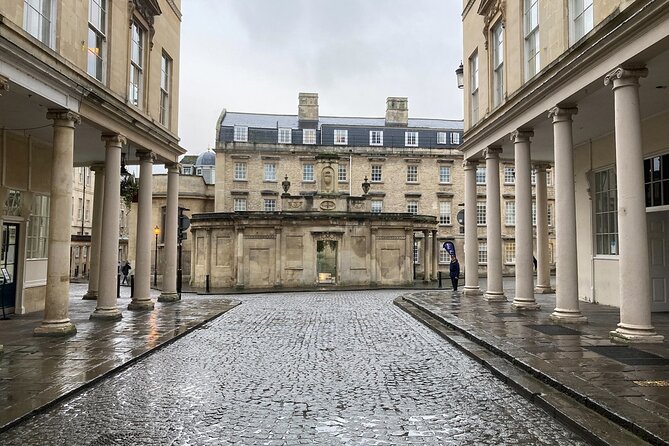
Queen Square is one of the most important architectural stops because it begins the sequence that continues through the Circus and Royal Crescent. Its buildings are Grade I listed, and the square helps you see how Georgian Bath used repeated façades, ordered proportions, and carefully planned public spaces.
This is where the tour’s architectural focus becomes especially useful. You can look at the houses yourself, but it takes a guide to point out why the square matters and how it relates to the larger plan of the city.
The walk does not treat architecture as a dry list of dates. Bob explains the people behind the buildings and invites questions, which gives the stop a conversational feel. If you are curious about why one street looks different from another, this is the kind of tour where you can ask rather than simply keep moving.
Same base, a different kind of day:
- Stonehenge, Avebury & the Cotswolds from Bath (Small group)
★ 5.0 · 798 reviews - Fully Guided Bath Ghost Tours
★ 5.0 · 539 reviews - Basingstoke iFLY Indoor Skydiving Experience – 2 Flights & Certificate
★ 4.5 · 459 reviews - The Cotswolds Tour From Bath (Small group)
★ 5.0 · 349 reviews
Assembly Rooms and Bath’s social season
The Assembly Rooms represent the social side of Georgian Bath. The city became fashionable, and new spaces were built for balls, concerts, gambling, and meeting the right people.
The upper Assembly Rooms opened with a grand ball in 1771. Jane Austen and Charles Dickens were among the well-known figures connected with Bath’s social world, along with members of the nobility. Bob’s explanation helps you picture the city as a place of performance and social rules, not just a spa town.
Again, admission is not included. The stop is best understood as an exterior introduction to the building and its place in Bath’s social life. If you later choose to go inside, you will have more context for what the rooms were designed to do.
The Circus, an elegant architectural trick
The Circus is one of Bath’s most memorable spaces. It is a circular group of large townhouses built between 1754 and 1768, with three entrances and classical façades arranged so that an impressive view appears ahead as you enter.
John Wood the Elder designed the Circus. Its shape is more than a visual flourish. The layout creates a sense of order and ceremony, while the repeated fronts give the entire circle a unified appearance.
This is a good place to slow down and look up. The details are easy to miss if you simply pass through on the way to the Royal Crescent. Bob’s role is to direct your attention to the design choices and explain how the space fits into the wider Georgian plan.
The stop is short, around 10 minutes, but that is enough for an explanation and a close look. You will have time to take photographs, though the guide’s commentary is the real reason for stopping here.
Royal Crescent and No. 1 Royal Crescent
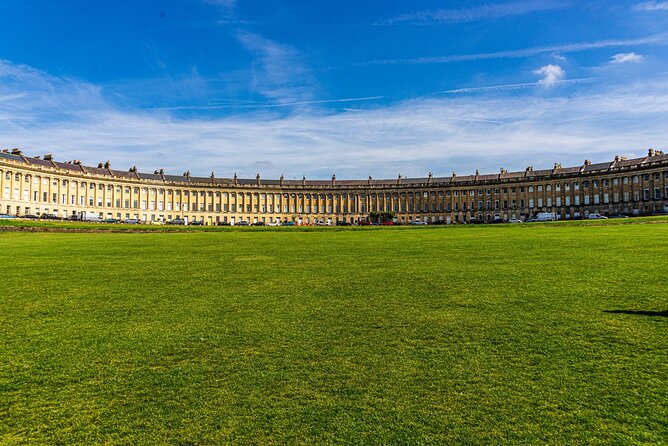
The Royal Crescent is probably Bath’s most famous Georgian view. Thirty terraced houses curve across the city in a wide sweep, designed by John Wood the Younger and built between 1767 and 1774.
The architecture is impressive because the front presents a grand, unified image, while the individual houses behind it served private residents and visitors. That contrast between public appearance and private life is part of what makes Georgian Bath interesting.
The tour pauses at No. 1 Royal Crescent, but the admission charge is not included. If you want to see the interior, treat that as a separate visit. The walking tour gives you the setting and the story, while a museum visit can show how one of these houses functioned inside.
The route may also include Gravel Walk, a quieter connection near the Royal Crescent. This is one of the places where the walk can feel more revealing than a quick sightseeing circuit. You are not limited to the most photographed frontages. Bob points out features and routes that you might otherwise pass without noticing.
Pulteney Bridge and the River Avon
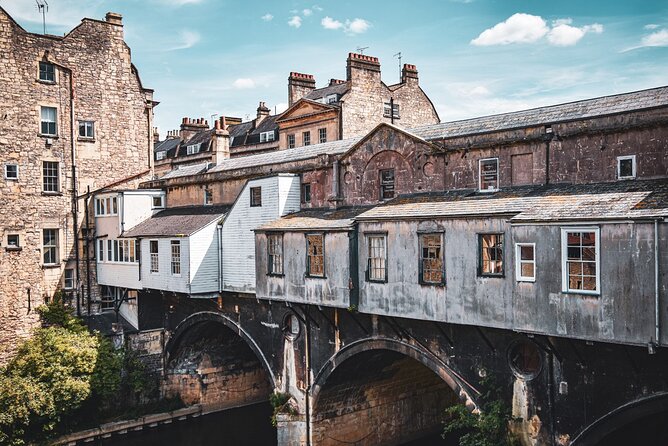
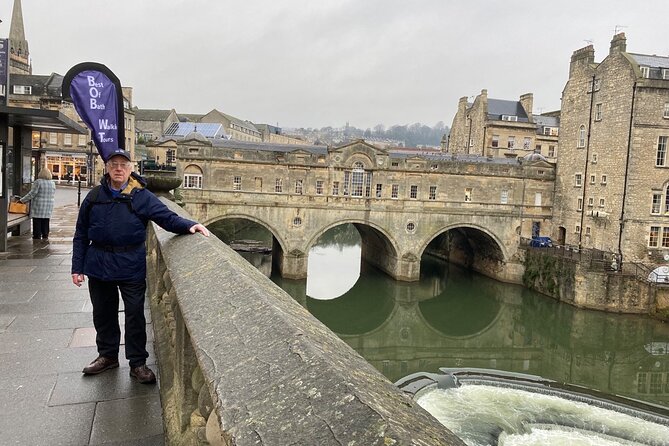
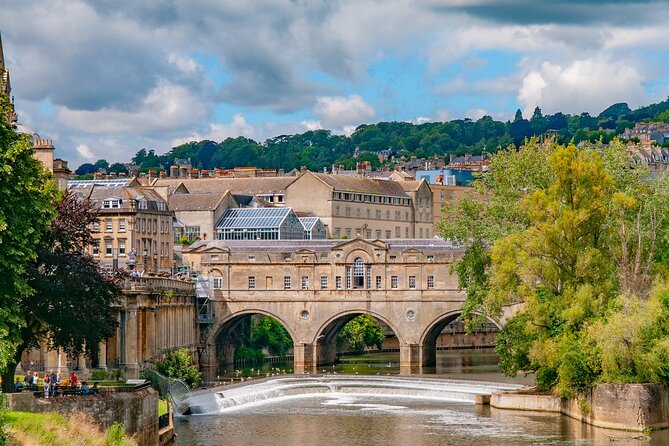
Pulteney Bridge brings the walk back toward the river and offers a change from the grand residential terraces. Completed by 1774, the bridge connects Bath with land associated with the Pulteney family, who wanted to develop the area.
Its most unusual feature is the row of shops built across the full span on both sides. Robert Adam designed the bridge in a Palladian style, giving it a formal appearance while allowing it to function as a commercial street.
This is a short stop, but it adds an important piece to the city story. Bath’s beauty was not only about private houses and fashionable assemblies. Development, property, trade, and movement across the River Avon also shaped the city.
Guildhall Market and the old city
The Guildhall Market is an indoor market housed in a handsome building. The market has existed since 1284, giving you a link to Bath’s commercial past that reaches well beyond the Georgian period.
You can wander around the stalls during the short stop. The visit is not presented as a major shopping session, but it gives the tour a useful everyday note after so much monumental architecture.
The broader route also includes the old city wall and other points of interest around Bath. One especially memorable detail described by the guide is a medieval path below street level, running toward the river alongside the ancient walls. Details like this help you see that modern Bath sits on top of several older layers.
That is one of the tour’s strengths. You are not only shown the postcard version of Bath. You are encouraged to look beneath, behind, and between the grand façades.
Bob’s guiding style and the pace of the walk
Bob is the central part of this experience. His style is described as friendly, witty, and informal, with plenty of room for questions. He also appears comfortable admitting when he does not know something, which makes the conversation feel more natural than a nonstop speech.
The pace is gentle rather than rushed. One walk lasted about two hours and 10 minutes, and the route can run beyond the basic two-hour estimate when people keep asking questions. That is helpful if you enjoy conversation, but less ideal if you need to reach a train or reservation at a precise time.
You should plan for moderate physical activity. The experience involves walking through the city for two to three hours, so comfortable shoes are sensible. The tour is not described as strenuous, but it is still a walking tour, not a seated overview.
The guide also makes an effort to check in with the group and keep the talk accessible. That matters in a small group, where different ages, interests, and walking speeds can affect the experience.
What the $27.73 price delivers
At $27.73 per person, the value comes from interpretation rather than admission. You are paying for a guided route through many of Bath’s key areas, plus the chance to ask questions and notice details you could easily miss alone.
The tour does not include entry to the Roman Baths, the Royal Mineral Water Hospital, the Assembly Rooms, or No. 1 Royal Crescent. That can be a drawback if you want an all-inclusive sightseeing package. It can also be an advantage because you are not paying for attractions you may already have visited or do not plan to enter.
A self-guided walk costs less, of course. But you would need to research the architectural sequence, find the old paths and walls, and connect the buildings to Bath’s social history yourself. For a first visit, the guide’s explanations make the price reasonable.
The tour is also highly regarded, with a five-star rating from 449 reviews and 100 percent recommendation. Those figures do not guarantee that every person will enjoy the same style, but they do support the idea that Bob’s personal approach is a major part of the value.
Who should book this Bath walk?
I would choose this tour if you are visiting Bath for the first time and want a clear introduction before exploring museums on your own. It is also a good fit if you have already walked around the city but feel you are missing the meaning behind the buildings.
Architecture fans will get plenty from Queen Square, the Circus, and the Royal Crescent. History lovers will appreciate the Roman, medieval, Georgian, and modern layers. Fans of Bridgerton may enjoy the filming locations, though the tour is broader than a television-themed walk.
You may want another option if you need step-free access confirmed in advance, dislike walking for several hours, or want to spend most of your time inside attractions. The provided information calls for a moderate fitness level and does not promise admission to the major sites.
Weather can also affect the experience. The tour requires good weather, and if poor conditions force cancellation, you are offered another date or a full refund. Free cancellation is available up to 24 hours before the 1:00 pm start time.
Should you book the Best of Bath Georgian Tour?
Book it if you want Bath explained by a person who clearly enjoys the city, rather than simply photographed from the outside. Bob’s humor, patience, and focus on the people behind the buildings make this more than a route between famous façades.
At $27.73, it is a sensible introduction to Georgian Bath, especially for a first afternoon in the city. Just remember that it is an outdoor walking tour, admission fees are separate, and the relaxed question-and-answer style may take you past the two-hour mark.
FAQ
Where does the Best of Bath Georgian Tour start?
The tour starts in Abbey Churchyard, Bath BA1, in front of Bath Abbey.
What time does the tour begin?
The stated start time is 1:00 pm.
Where does the tour finish?
The walk returns to Abbey Churchyard, the same place where it begins.
How long does the tour last?
The stated duration is approximately two to three hours. The route is generally about two hours, though questions can make it last longer.
How much does the tour cost?
The listed price is $27.73 per person.
Is the tour offered in English?
Yes. The tour is offered in English.
What sights are included?
The route includes Bath Abbey, the hot springs, the old city wall, the Royal Mineral Water Hospital, Queen Square, the Roman Baths, the Assembly Rooms, the Circus, the Royal Crescent, Gravel Walk, Pulteney Bridge, the Guildhall and Market, and other points around Bath.
Are admission tickets included?
No. Admission is not included for the Roman Baths, Royal Mineral Water Hospital, Assembly Rooms, or No. 1 Royal Crescent. Several outdoor stops are free to view.
How large is the group?
The tour has a maximum of 15 people.
Can I cancel for a refund?
Yes. You can cancel at least 24 hours before the start time for a full refund. Cancellations or changes made less than 24 hours before the tour are not accepted for a refund.
Just added in Bath
- Full-Day Private Tour of Stonehenge and Bath with Pickup★ 5.0 · 6 reviews
- One Way or Round Trip Private Transfer: Heathrow Airport to Bath★ 5.0 · 3 reviews
- Exceptional Bath tour guide making your visit splendidly memorable.★ 4.5 · 69 reviews
- Quintessential Cotswolds Half-Day tour from Bath (for 2-8 guests)★ 5.0 · 27 reviews
- Stonehenge Half-Day luxury guided tour from Bath for 2-8★ 5.0 · 15 reviews
- Private Guided Tour of Jane Austen’s Bath★ 5.0 · 7 reviews
- British Wine and Cheese Tasting Experience in City of Bath★ 5.0 · 18 reviews
- Cotswold Village Private Day Trip from Bath★ 5.0 · 24 reviews
Walking Tours, compared.
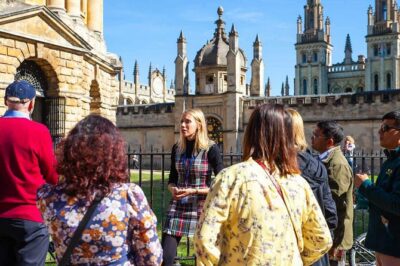
Oxford University Walking Tour With University Alumni Guide
Read our review →
Tour for Muggles The Ultimate Harry Potter Walking Tour in London
Read our review →

Cambridge University Walking Tour by Alumni™ Kings College Option
Read our review →
Blackbeard to Banksy – The Ultimate Walking Tour of Bristol
Read our review →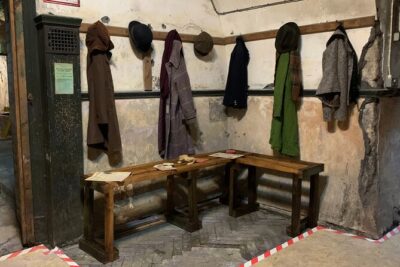
Air Raid Shelter + St. Nicholas Market Walking Tour
Read our review →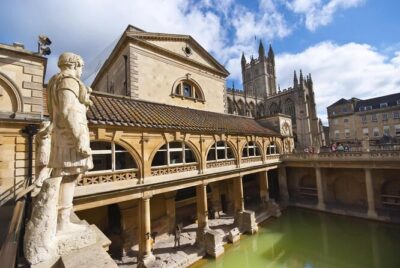
Walking Tour of Bath with Blue Badge Tourist Guide
Read our review →
Changing of the Guard Guided Walking Tour in London
Read our review →Browse the lists this tour appears in