Reviewed · TOURS IN DEVON
Coasteering
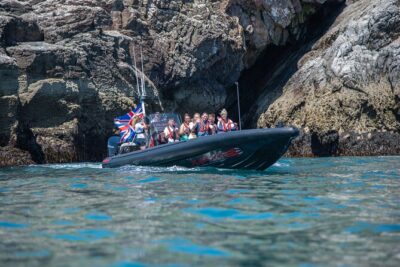
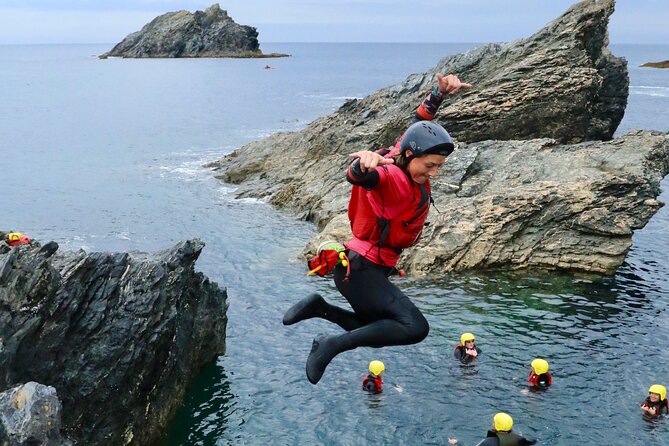
The best part of this Devon adventure is the variety. In one session, you may swim through gullies, scramble across sea-level rocks, squeeze into caves, and leap from ledges into the Atlantic. It feels less like a standard beach activity and more like using the coast as a natural playground.
I like the private format, which lets your group settle into its own pace, and I like the thoughtful build-up of the jumps. Guides such as Zac, Alex, Matt, Jess, and Andy have helped first-timers grow from nervous first leaps to much bigger jumps. The main consideration is simple: this is a physical activity in open water, so you need moderate fitness and a willingness to get wet, climb, and swim.
Key points to know before you book
- A bespoke North Devon route: The exact coastal section can be shaped around conditions and your group, with stops linked to Ilfracombe, Hele Bay, and Croyde.
- A full 2.5 hours outside: This is not just a quick jump from a rock. Expect swimming, scrambling, cave exploration, and time at the cliff base.
- Jumps build in size: Small options help you find your nerve before you choose something higher, with past sessions including jumps of roughly 4.5 and 9 metres.
- Safety kit is provided: You receive a wetsuit, helmet, footwear, and buoyancy aid before entering the water.
- Good for mixed-age groups: Families, teenagers, adults, and organized groups have all taken part, with children as young as 8 and older adults included in past outings.
- A private experience with a limit of 16: Your booking is designed for your own group, though the stated maximum is 16 people.
What coasteering in North Devon is really like
Coasteering is a hands-on way to meet the coast. You are not simply swimming along it, and you are not following a dry footpath above it. You move through the edge zone where water, rock, gullies, caves, and cliff bases meet.
The session combines several skills. You may swim from one rock platform to another, scramble over uneven surfaces, traverse along the base of a cliff, and enter caves where the sea has cut into the rock. At other points, the guide may line you up for a jump, starting with something manageable before offering a higher option.
That progression matters. The experience is exciting, but the best sessions do not force everyone into the same challenge. You can begin with a small leap, learn how the water feels, and decide how far you want to go. Past sessions have included jumps around 4.5 metres and even one close to 9 metres, but those heights are not presented as a requirement for everyone.
You should also expect movement rather than a fixed sightseeing stop. The sea may be choppy, and the rocks can make each section feel different. A moderate fitness level is required because you will swim, climb, balance, and stay active for much of the session.
Other trips people book in England:
- Stonehenge, Windsor Castle, and Bath from London
★ 4.5 · 18,662 reviews - London Big Bus Hop-On Hop-Off Tour with Optional River Cruise
★ 3.5 · 10,803 reviews - London Small Group Tour of Historical Pubs
★ 5.0 · 10,422 reviews
Meeting in Ilfracombe and getting ready
The meeting point is 23 Beach Road, Ilfracombe, EX34 9QZ. The activity ends back at the same meeting point, which keeps the day straightforward if you are exploring Ilfracombe before or after the session.
The team provides the main protective equipment: wetsuit, helmet, footwear, and buoyancy aid. This is a useful saving in both money and effort. You do not need to assemble a specialist kit collection before your holiday, and the equipment gives you protection from cold water, knocks against the rocks, and the demands of open-water swimming.
A safety briefing comes before the action. That is especially important for a first attempt, since coasteering has its own simple but unfamiliar habits. You need to understand how to move over the rocks, how to enter the water, where to swim, and how to judge a jump.
The guides have been praised for being calm, clear, and encouraging. Zac, for example, has led first-time participants through choppy water and rock sections with patience. Alex and Matt have also guided family sessions where the children gained confidence after the first few jumps. Jess, Eli, and Andy have been named as guides on other outings.
The exact guide on your date is not specified, so you should not book expecting one particular person. Still, the pattern is clear: instruction and encouragement are central to the experience rather than an afterthought.
The Verity Statue and Ilfracombe’s coastal setting
Verity Statue is listed as one of the itinerary stops. The statue sits in Ilfracombe Harbour and is one of the town’s most recognizable modern landmarks. It provides a useful point of reference at the start of a coastal outing, linking the adventure to Ilfracombe rather than treating the town as just a place to park.
The statue itself is not the main event. The value here is orientation. You begin from a well-known part of Ilfracombe before moving toward the rocky coast and the water. If you arrive early, the harbour area gives you somewhere recognizable to get your bearings before meeting the team.
Do not expect this stop to function like a long guided art visit. The available information points to a coasteering day, not a town tour. The focus quickly shifts to preparation, equipment, and the coastal activity.
That is a good trade for most people booking this experience. You are paying for active time in and beside the sea, not a string of formal sightseeing stops. The statue marks the setting, while the real route unfolds along the shore.
Croyde and the changing coastal route
Croyde is the second named itinerary stop. It is known for its sandy bay, strong coastal character, and access to sections of North Devon shore that suit outdoor activities. Here, the appeal is not simply looking at the beach. You get to experience the waterline from inside it, moving through the rocks and gullies instead of viewing them from a distance.
The route is described as bespoke, which is important. Coasteering depends on sea conditions, tide, and the abilities of the group. A flexible route gives the guides room to choose suitable sections rather than forcing every booking into one rigid course.
The experience may also take place around Hele Bay, which appears in several past sessions. Hele Bay offers a different feel from a broad sandy beach, with rocky coastal sections that work well for traversing, swimming, and jumps. Since the exact route is not fixed in the information provided, you should treat Croyde and Hele Bay as possible coastal areas rather than assume both are guaranteed stops in one outing.
That flexibility is a benefit, but it means you should not book this expecting a precise sequence of landmarks. The coast itself is the main setting, and the guide chooses how to use it safely on the day.
Same base, a different kind of day:
- Beatles Magical Mystery Tour
★ 5.0 · 9,266 reviews - Liverpool: “Blue Route” – City & Beatles Tour
★ 5.0 · 8,562 reviews - Stonehenge, Windsor Castle and Bath with Pub Lunch in Lacock
★ 4.5 · 7,402 reviews - Oxford University Walking Tour With University Alumni Guide
★ 5.0 · 6,905 reviews
Swimming, scrambling, caves, and cliff-base travel
The activity’s strongest feature is its mix of movement. Some adventure outings offer one headline moment, such as a zip line or a single large jump. This one gives you several different ways to travel.
Swimming through gullies can feel more demanding than an ordinary sea swim because you are moving between rocks and around the shape of the coast. The buoyancy aid helps, but you still need to be comfortable in the water and able to follow instructions.
Scrambling across the rocks adds another layer. You are using hands and feet, finding stable places to step, and moving carefully over uneven surfaces. The provided footwear should help with grip, but you should still expect wet, slippery conditions and take your time.
Cave exploration adds atmosphere without turning the activity into a separate cave tour. You may enter coastal spaces carved by the sea, then return to open water and rock platforms. The variety keeps the session moving and gives less confident participants more than one way to enjoy it.
Traversing at the cliff base is also valuable because it slows the pace. You can look up at the rock face, out across the water, and along the coast while staying active. North Devon’s views are part of the reward, but you will experience them from unusual angles, close to sea level.
How the jumps build your confidence
The jumps are likely to be the moment you think about most before booking. It is natural to wonder how high they are, and the useful answer is that the experience can include a range rather than one fixed jump.
The guides build from smaller leaps to bigger choices. This lets you test your confidence gradually. You may find the first jump easy, or you may need a few moments before stepping off. The point is not to prove yourself against someone else. It is to choose a challenge you can handle.
Past sessions have included a final jump close to 4.5 metres, around 15 feet, and another reported jump of about 9 metres. Those details show the possible range, but they do not mean every person will be asked to make the highest jump. Your guide should help you understand the choices available on the day.
A jump can also be psychologically harder than it looks. One small final leap was enough to make participants question their decision, even after completing the larger parts of the route. That is normal. Coasteering gives you a controlled way to face that hesitation, with the group and guide nearby.
If you dislike heights or do not want to jump, ask the team about alternatives before booking. The supplied information confirms a range of jump sizes, but it does not promise a way around every jump on every route.
Who will enjoy this most
This experience suits families with active children, teenagers looking for something more memorable than a standard beach day, and adults who want a short burst of outdoor adventure. Past groups have included ages from 8 to 76, as well as a family with children aged 10 and 12 and a teenager who returned the next day for bigger jumps.
That range does not mean the activity is easy for everyone. Children need enough confidence to follow instructions, swim, scramble, and handle the physical demands of the coast. Adults should be prepared to take part rather than supervise from dry land.
It also works well for organized groups. A scout group of nine young people and three leaders used the session as a shared challenge, with the company handling communication and preparation carefully from the first inquiry through the activity.
I would choose this over a passive boat trip if your group enjoys doing things together. The shared jumps, swims, and small moments of nerves create a common story. It is less suitable if you want a calm coastal walk, a dry activity, or a tightly scheduled sightseeing tour.
Price, group size, and practical value
The listed price is $83.34 per person for roughly two hours and 30 minutes. That is not a bargain beach attraction, but the price includes the main safety equipment and a guided coastal session with several activities packed into one outing.
The value improves if you would otherwise need to rent a wetsuit, helmet, buoyancy aid, and footwear separately. You are also paying for route planning, safety supervision, and a guide who can adjust the session to the group and conditions.
A private booking is useful for families and friends because you can share the experience without being placed with unrelated people. The stated maximum is 16 participants, and group discounts are available. Ask about the discount if you are booking for a larger family, club, school, or scout group.
The session lasts long enough to feel like a real activity, but it does not consume an entire holiday day. That makes it easy to pair with time in Ilfracombe, Croyde, or elsewhere in North Devon.
Weather, cancellations, and what to bring
The activity requires good weather. If poor weather causes a cancellation, you can choose another date or receive a full refund. A minimum number of participants is also required, and if that minimum is not reached, the provider offers a different date or experience, or a full refund.
You can cancel for a full refund up to 24 hours before the start time. Changes or cancellations inside that period are not accepted for a refund, so keep an eye on the local time and the forecast.
Wear practical clothing for arriving and leaving the activity. The provided wetsuit and footwear cover the main in-water needs, but you will want something comfortable and dry for before and after. Since the session ends at the original meeting point, you can plan around that without arranging a separate return transfer.
Bookings are often made around 18 days ahead, which gives you a useful planning guide for busy holiday periods. I would reserve early if you have a fixed family date or a larger group, while still checking the weather policy before your session.
Should you book this Devon coasteering trip?
Book it if you want a physical coastal adventure with several levels of challenge, not just a scenic walk with an occasional photo stop. The supplied kit, clear briefing, private format, and gradual jump system make it a sensible introduction for active beginners.
Families should pay close attention to the age and confidence of every child. The past age range is wide, but the sea, rocks, and jumps still demand focus. If everyone can manage moderate physical activity and accept that conditions may feel lively, this could become the most memorable part of your Devon holiday.
I would skip it if you want guaranteed calm water, a fixed route, or a dry afternoon. For everyone else, the combination of swimming, caves, rock movement, and optional jumps offers strong value for a two-and-a-half-hour session. You get to meet North Devon at water level, which is exactly what makes this outing special.
FAQ
Where does the coasteering experience start?
It starts at 23 Beach Road, Ilfracombe, EX34 9QZ, United Kingdom.
Where does the activity finish?
The activity finishes back at the original meeting point in Ilfracombe.
How long does the coasteering session last?
The experience lasts approximately two hours and 30 minutes.
What equipment is provided?
A wetsuit, helmet, footwear, and buoyancy aid are provided.
How many people can join?
The maximum stated group size is 16 people. Group discounts are available.
Do I need to be physically fit?
You should have a moderate level of physical fitness. The session includes swimming, rock scrambling, traversing, cave exploration, and jumping from rocks.
Is the route always the same?
The route is described as bespoke. The named itinerary locations are the Verity Statue and Croyde, while past sessions have also taken place around Hele Bay.
What happens if the weather is poor?
If poor weather causes the activity to be canceled, you can choose a different date or receive a full refund. If the minimum number of participants is not met, the same type of alternative or refund is offered.
Just added in England
- Exceptional Bath tour guide making your visit splendidly memorable.★ 4.5 · 69 reviews
- Full-Day Private Tour of Stonehenge and Bath with Pickup★ 5.0 · 6 reviews
- One Way or Round Trip Private Transfer: Heathrow Airport to Bath★ 5.0 · 3 reviews
- Quintessential Cotswolds Half-Day tour from Bath (for 2-8 guests)★ 5.0 · 27 reviews
- Stonehenge Half-Day luxury guided tour from Bath for 2-8★ 5.0 · 15 reviews
- Private Guided Tour of Jane Austen’s Bath★ 5.0 · 7 reviews
- British Wine and Cheese Tasting Experience in City of Bath★ 5.0 · 18 reviews
- Cotswold Village Private Day Trip from Bath★ 5.0 · 24 reviews
Tours in Devon, compared.
The story of Agatha Christie’s extraordinary life
Read our review →