
Reviewed · WALKING TOURS
J & M York City Walking Tours
York’s long story is packed into a small walk. In about two hours, J & M York City Walking Tours takes you from Roman emperors and Viking York to medieval guilds, prison history, the Shambles, and a short section of the city walls. The guide, often Nick or James, keeps the route moving while explaining why each corner matters.
I like the way this tour gets beyond the Minster and Shambles to places many first-time visitors would pass without a glance. I also like its broad sweep through 2,000 years of York history, with useful details about guilds, women’s work, Jewish York, Roman defenses, and the real story of Dick Turpin.
The main consideration is pace. You cover many stops, but some receive only a few minutes, and the walk includes only part of the walls. If you want long visits inside the Minster or museums, you will need extra time and admission money afterward.
Key things to know before you book
- York’s history arrives in layers: Roman, Saxon, Viking, medieval, Georgian, Victorian, and modern stories all appear along the route.
- Nick and James are named guides: Expect a clear, engaging style, understated humor, and plenty of answers to questions.
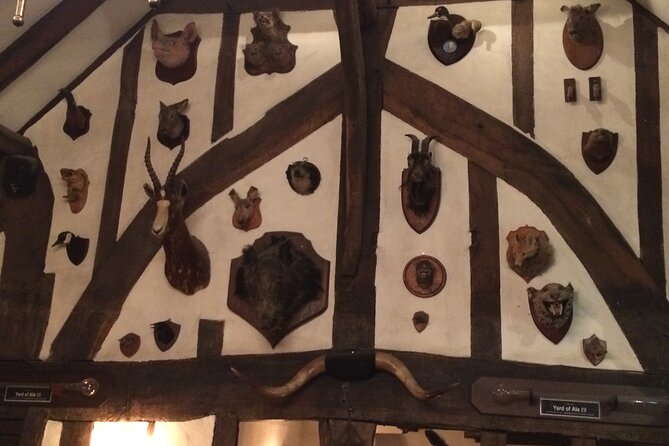
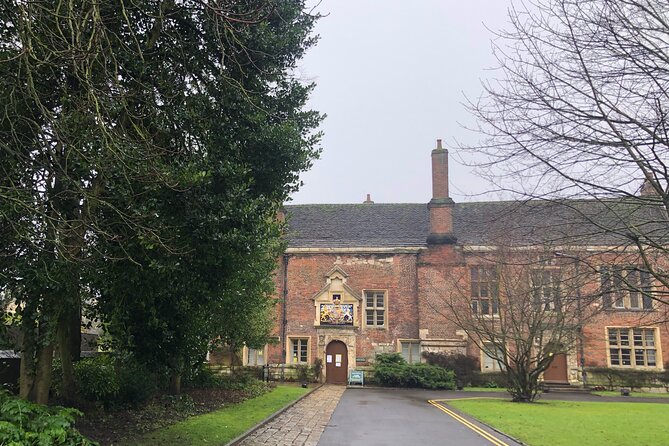
- The tour visits often-missed corners: St Cuthbert’s Church, Ogleforth, the Black Swan, and Merchant Taylors’ Hall add depth beyond the standard sights.
- The walk is well suited to a first morning: It ends close to the Shambles, Jorvik Viking Centre, York Castle Museum, Clifford’s Tower, and the river.
- Most sights are viewed from outside: The Minster and York Castle Museum require separate admission if you want to go in.
- The group can reach 30 people: That is still manageable for a city walk, though a smaller group will feel more personal.
Starting beside York Minster
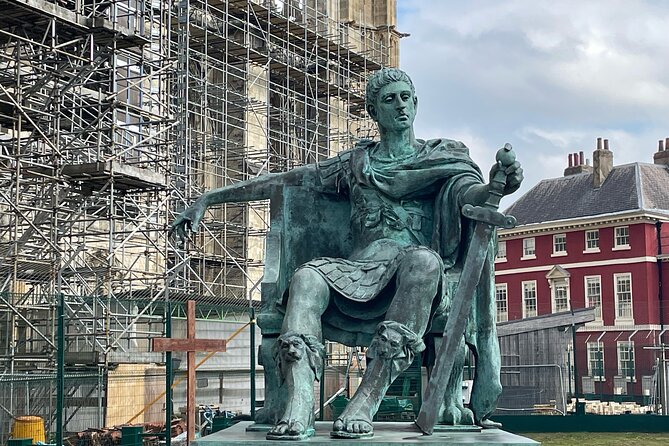
The walk begins at Constantine the Great in Minster Yard, beside York Minster. This is a sensible meeting point because the statue introduces one of York’s most important Roman connections before you move into the city’s later chapters.
Constantine was proclaimed emperor at York, and the guide uses that story to explain how this northern settlement gained wider importance. You also hear about York’s visiting emperors and the connection between Constantine and the growth of Christianity.
The opening stop gives you useful bearings. The tour finishes near All Saints Church on Pavement, only about a six-minute walk from the starting area, though the end point can vary. From there, you are close to the Shambles, the Jorvik Viking Centre, York Castle Museum, Clifford’s Tower, and a riverside walk.
That location makes the tour especially useful early in a short stay. You can listen for two hours, then continue exploring without losing time crossing town.
More city tours in York:
- Daytime Sightseeing Boat Cruise in York
★ 4.5 · 1,256 reviews - City Sightseeing York Hop-On Hop-Off Bus Tour
★ 4.5 · 545 reviews - York City Pass: Access 35+ Attractions for One Great Price
★ 4.5 · 122 reviews
York Minster, best understood before you enter
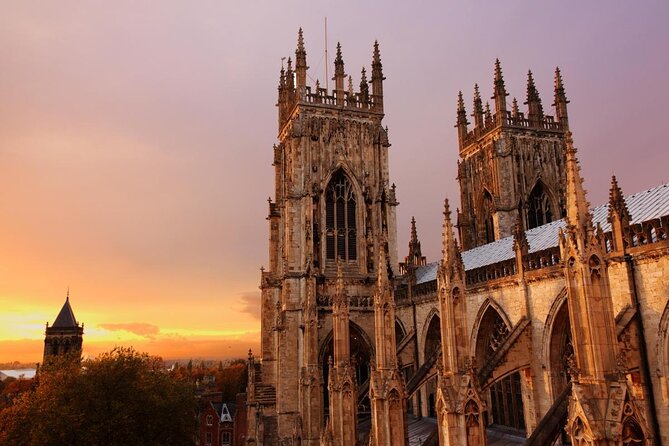
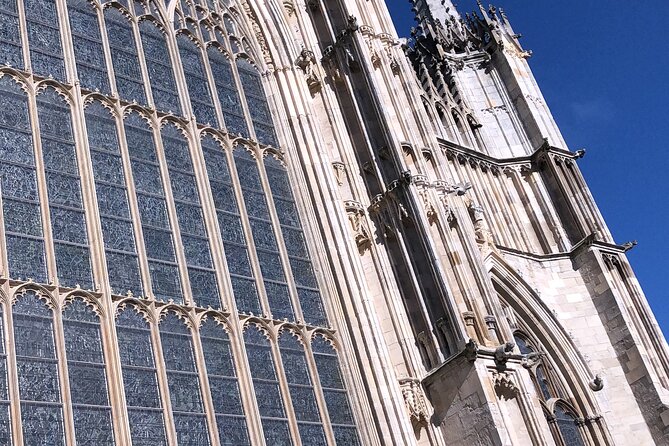
York Minster receives about 20 minutes of attention. You will learn that this is the largest Gothic cathedral in Northern Europe and that construction took 252 years.
That is enough time to understand the building’s place in York, but not enough for an interior visit. Admission is not included, and Minster-led tours inside last about an hour. If the cathedral is high on your list, treat this walk as preparation rather than a substitute.
I like this arrangement because the guide can point out the Minster’s role in the city story without forcing the entire tour into a cathedral visit. You can return later when you have time for the interior, tower, or a formal Minster tour.
Castle earthworks and the darker side of York
The route then reaches the motte of the castle built in 1069. From the grounds, the guide brings out the castle’s violent and sometimes grim past.
You are not taking a full indoor castle tour here. Instead, you walk around the earthwork and hear how this site fitted into York’s defenses and power struggles. The short visit works well because the castle is not treated as an isolated monument. It becomes part of a larger story about conquest, authority, punishment, and survival.
This is one of the tour’s strengths: familiar places receive context. You do not simply check off a castle mound. You learn why it was built and what kind of city needed such defenses.
Guilds, traders, and York’s medieval economy
One of the more unusual sections takes you down into the medieval levels of the city. Here, the guide explains the guild that became York’s wealthiest and the part traders played in the city’s prosperity.
The tour also gives women a place in this story. That matters because medieval city history is often reduced to kings, battles, and churchmen. Guilds shaped daily work, money, trade, and social status, and the guide explains how women fit into that system.
This section helps you read York’s buildings and streets with more care. A handsome hall or narrow lane was not merely picturesque. It could reflect who controlled money, who worked there, and how the city organized its trades.
More walking tours in York:
- Shadows of York: Ghost Walk and Horrible History.
★ 5.0 · 1,403 reviews - Private Historical Walking Tour of York
★ 5.0 · 1,324 reviews - Wizard Walk of York – WINNER Best Tour & Best of York Award
★ 5.0 · 918 reviews - Shared Walking Tour in York
★ 5.0 · 480 reviews
The Shambles and the shrine of St Margaret Clitheroe

The Shambles gets about 10 minutes. This crooked medieval street was once the street of butchers, and its close-set buildings still give you a strong sense of the old city.
The guide takes you to the shrine of St Margaret Clitheroe and adds stories that are easy to miss if you only photograph the street and move on. The stop is brief, which is sensible in a lane that can become crowded, but you should not expect a long architectural lecture.
For me, the value here is the contrast between appearance and use. The Shambles is now one of York’s best-known sights, but the tour helps you picture it as a working street rather than a charming backdrop.
St Cuthbert’s Church and the Devil’s Door
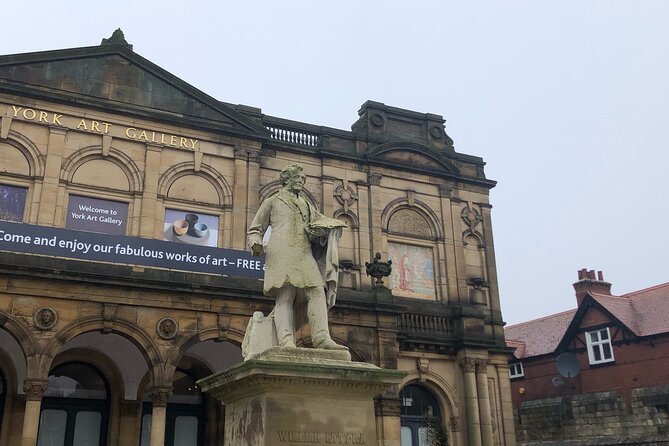
At St Cuthbert’s Church, you spend roughly six minutes examining a medieval church built partly with Roman brickwork. Saxon and Norman features also appear in the building, giving you a compact lesson in how York reused and reshaped older structures.
The church’s unusual feature is its Devil’s Door. The guide separates the myth from the likely truth, which gives this short stop a pleasant bit of folklore without letting the story take over.
You may not have time for a full look inside, but the exterior is worthwhile because it shows how different periods can sit in one small building. York often works this way: Roman material, Saxon traditions, Norman construction, and later changes all occupy the same few yards.
A short walk on the medieval city walls
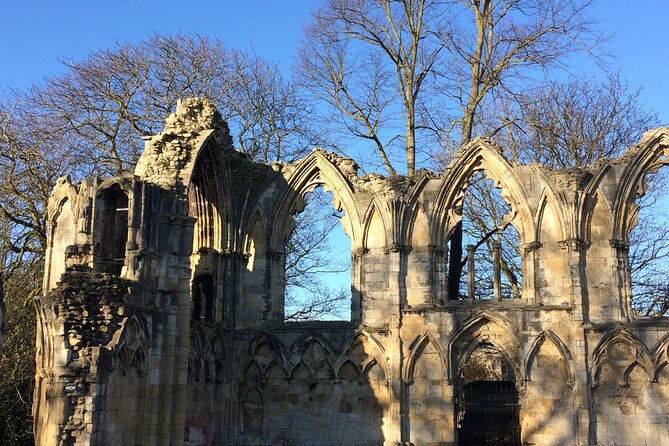
The city walls section lasts about 15 minutes. You see part of York’s Roman defenses, Danish earthworks, medieval siege history, and Victorian alterations. The route also passes the old Jewish quarter.
This is a useful introduction to the walls, but set your expectations correctly. You do not walk the full circuit, and the route does not spend most of the tour on top of the walls. One guide explains that covering more wall would take the walk too far from the center and leave less time for the city’s 1,900 or 2,000 years of stories.
That trade-off makes sense, though it may disappoint you if a wall walk is your main goal. An evening tour may cover a different section when available. For the daytime route, think of the walls as one chapter among many, not the main event.
The Black Swan and old Hungate
The Black Swan appears during a five-minute look at the old Hungate parish. The guide connects the building with famous residents and the Battle of Quebec, then points out nearby architecture shaped by the area’s Irish heritage.
There is also a chance to spot one of York’s famous black cats. It is a small detail, but it shows the tour’s tone. You are not receiving a list of dates alone. The guide mixes major history with local oddities that make the streets easier to remember.
Short stops like this reward attention. You might otherwise walk past the Black Swan without knowing why it matters.
Merchant Taylors’ Hall and the power of guilds
Merchant Taylors’ Hall receives about four minutes. From the city walls, you learn how guilds became economic centers in cities such as York and why the tailors mattered to local life.
The stop is quick, yet it reinforces an important idea from the medieval-level section: York’s prosperity depended on organized trades, merchants, and civic institutions, not only on royal visits or cathedral building.
If you enjoy social and economic history, this is one of the tour’s most useful threads. It gives you a better way to interpret York’s grand halls, market spaces, and narrow working streets.
Shambles Market and Monk Bar
At Shambles Market, the guide spends about five minutes explaining the market’s role in York’s economic growth. You get a connection between the food, goods, and trading activity of the city and the guilds discussed earlier.
Monk Bar follows, with another five-minute stop. This is one of York’s six gates, and the guide explains its defensive role, the legend of the Wild Men of York, and the bar’s more unpleasant uses.
The pairing works well. The market shows the city’s commercial side, while Monk Bar shows how the city protected itself and controlled movement. You see two basic needs of medieval York: trade and defense.
Ogleforth and the Great Fire of London
Ogleforth is described as a Saxon street, and the walk here takes about five minutes. The guide points out the Dutch House and explains how architectural changes after the Great Fire of London helped lead to the growth of insurance policies.
This is a good example of the tour’s wider reach. You are not only hearing about York’s local past. You are also learning how events elsewhere changed building methods, risk, and urban life.
The stop is short, so do not expect a detailed study of the house. Its value comes from the link between one street, changing architecture, and the practical systems that followed disaster.
King’s Square and Jorvik
King’s Square brings the route back to York’s Viking past. In about five minutes, you learn the meaning behind local street names and more about the Viking heritage of Jorvik, the name used for Viking York.
The square helps you understand the city center as a place with older layers beneath its modern appearance. It also ties together the route’s Roman, Saxon, Danish, and medieval strands.
If you plan to visit the Jorvik Viking Centre afterward, this is a useful lead-in. The tour does not replace the attraction, but it gives you a clearer sense of why Viking York is so central to the city’s identity.
Dick Turpin and York Castle Museum
The final listed stop is York Castle Museum, seen from outside for about seven minutes. The guide discusses the older buildings, prison reform, and the changing uses of the site.
The Dick Turpin story gets special attention. York’s connection with this notorious highwayman is more complicated than a simple grave-side legend, and the guide sorts out the person, the myth, and the city’s role in the story.
Admission to the museum is not included. If you want its period streets, social history, and prison displays, plan a separate visit. The walking tour gives you a useful introduction, then leaves you free to decide how much more time to spend inside.
How the guide shapes the experience
The strongest part of this walk is the guide’s delivery. Nick is described as clear, witty, patient, and easy to understand, with a strong voice and a good sense of pace. James is also praised for being friendly and informative.
That matters in York, where narrow streets, passing groups, and busy public areas can make a wandering lecture hard to follow. A clear voice and firm timing keep the group together without turning the walk into a rushed march.
The style is informative but not heavy. You get dates, names, and political context, along with odd details and understated humor. There is room for questions, and the guide can suggest what to see next after the walk.
Price, group size, and practical value
At $18.02 per person, this is a reasonable price for a two-hour introduction to York. You are paying mainly for interpretation and route planning, not for admission to major attractions.
The value is strongest if you are visiting for one day or arriving without a clear plan. The tour connects the Minster, walls, castle area, Shambles, market, guild history, and museum district in a route you could spend hours researching on your own.
The group can include up to 30 people. That is not a private walk, and you should not expect every stop to feel intimate. Still, the guides’ clear delivery and the short distances between stops make the format workable.
Wear shoes suited to old streets and uneven surfaces. The tour is offered in English, confirmation arrives when you book, service animals are allowed, and it is near public transportation. Most people can take part, but the walk requires good weather.
You can cancel for a full refund up to 24 hours before the start time. If bad weather or too few bookings cancels the tour, you are offered another date or a full refund.
Who should book this York walk?
I would choose this tour for a first visit, especially if you have only a day in York. It gives you a map in your head, a timeline for the city, and a useful list of places to revisit at your own speed.
It also suits anyone who likes history beyond royal names and famous buildings. The sections on guilds, women’s work, Jewish York, architecture, trade, and prison reform add substance to the usual sightseeing route.
You may want something else if your priority is a long walk on the walls, a full Minster visit, or extended museum time. Those require separate visits. This tour is best understood as a lively orientation with stories attached, not as an all-access ticket to York’s attractions.
Should you book J & M York City Walking Tours?
Book it if you want a well-paced introduction to York that combines major sights with smaller stories. Nick and James bring the city’s layers into focus, and the route reaches corners you might miss on your own.
The best plan is to take it near the start of your stay, then use the finishing location to continue to the Shambles, Jorvik Viking Centre, York Castle Museum, Clifford’s Tower, or the river. At $18.02, it offers solid value for a broad, story-led look at York.
Skip it only if you want a specialist tour focused almost entirely on the Minster or the city walls. For most first-time visitors, this is a practical way to get oriented and make the rest of York easier to understand.
FAQ
How long does the walking tour last?
The tour lasts approximately two hours.
Where does the tour begin?
It begins at Constantine the Great in Minster Yard, York YO1 7JB, beside York Minster.
Where does the tour end?
It ends at the Parish of All Saints on Pavement, High Ousegate, though the end point may vary. The stated location is about a six-minute walk from the starting area.
Is admission to York Minster included?
No. The tour spends about 20 minutes at York Minster, but admission is not included. Minster guides offer separate tours inside.
Does the tour enter York Castle Museum?
The guide looks at York Castle Museum from outside. Admission is not included.
Is the tour offered in English?
Yes. The tour is offered in English.
How many people can join the tour?
The maximum group size is 30 people.
What is the cancellation policy?
You can cancel at least 24 hours before the start time for a full refund. Changes or cancellations made less than 24 hours before the start are not accepted for a refund. If poor weather or too few bookings cancels the experience, you are offered another date or a full refund.
Just added in York
- Immersive Treasure Hunt Adventure in York – Outdoor Escape Room★ 4.5 · 6 reviews
- Immersive Murder Mystery in York, A City Treasure Hunt Experience★ 4.5 · 54 reviews
- The Treasures of Bloodaxe – A Fun Viking Treasure Hunt in York★ 4.5 · 21 reviews
- Christmas Guided Walking Tour in York★ 5.0 · 106 reviews
- York City Pass: Access 35+ Attractions for One Great Price★ 4.5 · 122 reviews
- Chocolate Bar Making Workshop – York Cocoa Works★ 4.5 · 170 reviews
- Fun, Flexible Treasure Hunt Around York with Cryptic Clues & Hidden Gems★ 5.0 · 248 reviews
- Evening ‘Happy Hour’ Boat Cruise For All Ages In York★ 4.0 · 243 reviews
Walking Tours, compared.

Oxford University Walking Tour With University Alumni Guide
Read our review →
Tour for Muggles The Ultimate Harry Potter Walking Tour in London
Read our review →

Cambridge University Walking Tour by Alumni™ Kings College Option
Read our review →
Blackbeard to Banksy – The Ultimate Walking Tour of Bristol
Read our review →
Air Raid Shelter + St. Nicholas Market Walking Tour
Read our review →
Walking Tour of Bath with Blue Badge Tourist Guide
Read our review →
Changing of the Guard Guided Walking Tour in London
Read our review →Browse the lists this tour appears in