

Reviewed · SHAKESPEARE TOURS
Shakespeare’s Schoolroom & Guildhall Entry Ticket and Tour
Young William Shakespeare studied Latin in the very room you can enter today. That simple fact gives this visit its spark: you are not just looking at a display about Tudor schooling, you are sitting in the classroom where Shakespeare’s early education took place in the 1570s. Master Jenkins’ Tudor lesson adds the fun, with Latin, quill-and-ink writing, and schoolroom rules.
I like the chance to see the Council Chamber where Shakespeare’s father served as Bailiff, or mayor, and I like how much the visit asks you to do rather than simply read. You can dress in Tudor clothing, play period games, and examine medieval wall paintings. The main consideration is pace: the venue is small, and parts of the visit can feel rushed when school groups arrive.
Key points to know before you go

- Sit in Shakespeare’s actual schoolroom: Take part in a Tudor lesson in the room where the young Shakespeare studied Latin.
- Meet the schoolmaster: Master Jenkins leads the period lesson, while guides such as Regina add stories about Shakespeare and Tudor Stratford.
- Use a quill and ink: You get a hands-on chance to write as a Tudor pupil, with the inevitable risk of inky fingers.
- See Stratford’s civic center: The Guildhall dates from 1420 and includes the Council Chamber where Shakespeare’s father was Bailiff.
- Expect more than a quick photo stop: Films, wall paintings, Tudor games, costumes, and guided interpretation fill out the visit.
- Allow roughly 30 minutes to an hour: Some visits run longer, especially when the schoolroom lesson and questions take their natural course.
Why this small Guildhall matters

Stratford-upon-Avon is packed with Shakespeare associations, but this building connects the playwright to both school and public life. The Guildhall was built in 1420, making it one of the few remaining medieval Guildhalls in England. It was not built as a Shakespeare museum. It was part of the town’s civic life long before William was born.
That distinction matters. You are seeing the place as a working medieval building first, then as a Shakespeare site. The Guildhall links local government, education, religion, and entertainment under one roof. It helps you picture Stratford as a real town, not simply a stage set created around one famous writer.
The Shakespeare family’s connection to the building adds another layer. John Shakespeare, William’s father, served as Bailiff, the town’s leading civic official, in the Council Chamber. That role helps explain why the young William had access to a serious education and why his family was involved in town affairs.
The building also hosted performances. Shakespeare saw some of the country’s leading actors here when he was young. That detail gives the Guildhall a direct connection to the theatrical world he later entered. You are looking at a schoolroom, but you are also standing in a place where civic business and live performance shared the same setting.
More Shakespeare trips from England:
- Shakespeare Distillery Tour – 1pm Ticket
★ 5.0 · 598 reviews - Shakespeare’s Globe Guided Tour
★ 4.5 · 481 reviews - From London: Shakespeare’s Stratford-upon-Avon Day Trip by Coach
★ 4.5 · 352 reviews
Entering Shakespeare’s schoolroom
The schoolroom is the heart of the experience. This is where you sit, look around, and consider what education meant in Tudor England. Shakespeare studied Latin here, and the visit uses that subject to show how demanding school could be.
A guide explains the setting before the lesson begins. Films provide extra background on Shakespeare’s school days and on the Guildhall’s role in Stratford. The presentation is designed for a mixed audience, so you do not need to arrive with a Shakespeare degree or a working knowledge of Tudor history.
I like this part because the room does not need much decoration to make its point. The setting itself does the work. The schoolroom is compact, and that keeps the lesson close and personal. It also means you may be aware of every other person in the room, especially if a school group is present.
The most popular part is the Tudor lesson with Master Jenkins. He introduces Latin and the behavior expected of pupils in Shakespeare’s time. The tone is playful, but the lesson still gives you a useful sense of how memorization, discipline, and classical language shaped a young student’s education.
Children usually get the most from this section, but adults should not dismiss it as a children-only activity. The period teaching style gives the visit its character, and adults can take part in the writing, questions, dressing up, and games. One practical tip is to stay engaged during the first part of the building tour, even if you are mainly waiting for the schoolroom. The Guildhall background explains why the classroom matters.
Quill writing, Tudor clothes, and Latin
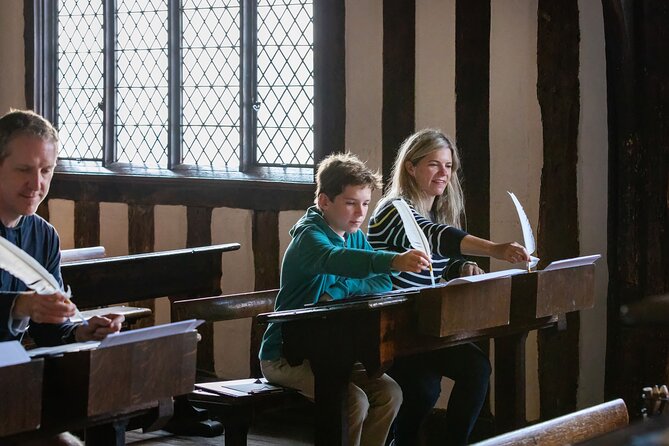
The hands-on activities make this visit more memorable than a standard historic-room tour. You can use a quill pen and ink, which sounds simple until you try to control the ink and form a steady line. It is a small activity, but it gives you a physical connection to the period.
You can also dress in Tudor-style clothing for a photograph. This is a lighthearted feature, yet it works well for families and anyone who enjoys a little theatrical silliness. The costume moment does not replace the history, it breaks up the information and gives younger children a reason to stay interested.
Tudor games are also part of the experience. The activities help you picture the period through ordinary actions rather than only through dates and names. You write, sit, play, and listen. That combination makes the visit feel active without turning it into a theme-park performance.
The quill station can become a bottleneck when the building is busy. A school group or several families may all want a turn, and you could feel hurried through the writing portion. If using the quill matters to you, pay attention when the guide introduces it and take your turn promptly.
The Council Chamber and Shakespeare’s family
The Council Chamber gives the visit its civic weight. This is where John Shakespeare served as Bailiff, or mayor. Seeing the room helps place William’s childhood within his family’s public standing in Stratford.
The chamber is also important because it shows how a town’s official spaces could serve several purposes. Government business took place here, but performances were also held in the Guildhall. The young Shakespeare therefore encountered both civic authority and theater in the same building.
Guides bring out the connection between the Shakespeare family and the Guildhall. Their role is especially useful here because an empty historic room can be hard to read without context. A good explanation turns the chamber from an old room into a place where Shakespeare’s family actually worked and where the young William encountered public life.
The first portion of the visit may feel slower for children. It contains background information, films, and exhibits before the schoolmaster lesson begins. If you are visiting with children, explain that the quill, costumes, and lesson are coming, then use the early rooms to build the story rather than treating them as something to rush past.
A few more things to do in England worth a look
- Tower of London and Crown Jewels Exhibition Ticket
★ 4.5 · 6,677 reviews - Thorpe Park Admission Ticket
★ 4.0 · 5,915 reviews - Alton Towers Resort 1 Day Admission Ticket
★ 3.5 · 5,501 reviews - The London Eye Entry Ticket
★ 4.0 · 3,498 reviews
Medieval wall paintings and the Guildhall’s older story
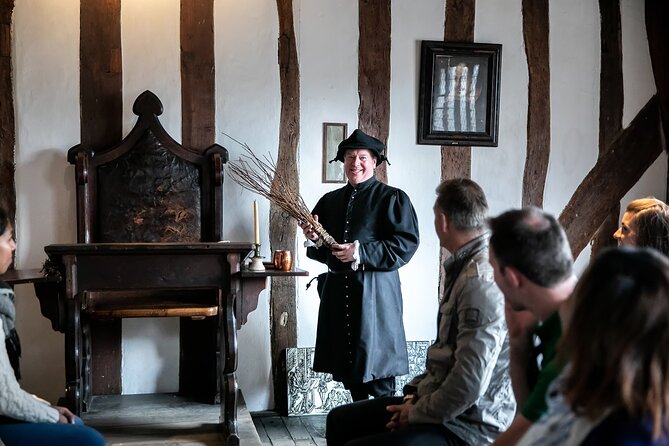
The medieval wall paintings are among the details worth slowing down for. They remind you that the Guildhall was already an old building when Shakespeare attended school there. The paintings give the room a visual link to the centuries before him.
Films help explain the historic role of the Guildhall and Shakespeare’s school days. This is useful if you want more than the standard Shakespeare facts. The visit is not only about where the playwright studied. It is also about how a medieval town organized education, government, and public entertainment.
The building is small, so you will not spend hours wandering through a large museum collection. That is a strength if you prefer a focused stop. It can be a weakness if you expect a major museum with many galleries and extensive objects.
I would treat the Guildhall as a concentrated experience. Look carefully at the structure, the paintings, and the rooms. Listen to the guides, since much of the value comes through their storytelling rather than through a large number of exhibits.
How long to allow and how the visit feels

The stated duration is about 30 minutes to one hour. That is a sensible planning range for the formal experience. The lesson, questions, activity stations, and time spent looking at the rooms can stretch your visit, and some people have spent close to two hours enjoying the full experience.
I would allow at least an hour if you want to take part rather than simply walk through. A quick visit may cover the films and rooms, but it could leave little time for the quill, costume, or questions.
Opening hours are 11:00 a.m. to 4:30 p.m., every day, for the published periods from April 1, 2024 through March 31, 2027. Check your booked date carefully, since the practical value of the ticket depends on arriving with enough time before closing.
The experience is offered in English. The ticket is mobile, and confirmation is provided when you book. Children must be accompanied by an adult, and service animals are allowed. The site is near public transportation, and most people can take part.
When school groups are present

This attraction welcomes school groups, and that can change the feel of your visit. A busy session may mean more noise, less room around the activities, or a shorter turn with the quill. On the other hand, the schoolmaster lesson can feel especially lively when the room has an audience ready to join in.
Staff try to keep an eye on people who are not part of a large group. If the building is busy, ask a guide what you have not yet seen. The venue includes films and exhibits in different parts of the Guildhall, so it is easy to miss a section while waiting for the lesson.
A practical approach is to remain flexible. You may find the opening explanation moves slowly, then the schoolroom session becomes the highlight. Or you may prefer to see the exhibits first and return to the activity area later. The staff can help you understand the order of the visit.
The experience is not designed as a private tour. If you need a quiet, unhurried examination of every room, a busy school visit may disappoint. If you enjoy shared activities and a bit of Tudor classroom noise, the same situation can add energy.
Is the $18.02 ticket good value?
At about $18.02 per person, the ticket is fairly priced for a historic site with a guide and a hands-on lesson. You are paying for more than entry into an old building. The price includes the guided interpretation, the Tudor lesson, access to the schoolroom and Guildhall, and the interactive activities.
The value is strongest if you take part. Sit in the schoolroom, try the Latin, use the quill, and ask questions. If you only want a quick look at the interior, the short duration may make the price feel less compelling.
The visit also works well as a break between larger Stratford attractions. It does not require a full day, and it gives you a different angle on Shakespeare. Instead of focusing mainly on his later career and plays, it shows the education and family setting that came first.
I would not compare it with a large museum ticket on the amount of material displayed. Compare it with a focused historic-room experience that includes a live lesson. For families, the activities add real value. For dedicated Shakespeare readers, the links to his early schooling, his father’s public role, and local theater make the ticket worthwhile.
Who will enjoy it most
Families with school-age children are the clearest match. The costume, quill, games, and schoolmaster keep the visit active. Children must have an adult with them, and the adults can take part instead of standing at the edge.
Shakespeare fans will also find plenty here. The visit adds background to the plays without pretending that every room reveals a secret about the writer. You get a grounded look at school, family, civic life, and performance in the town where he grew up.
Adults without children can enjoy it too, especially if you like historic buildings and guided interpretation. The Tudor lesson is not merely a children’s show. It gives you a quick, practical sense of the education Shakespeare received.
You might want to choose another attraction if you prefer silent galleries, a large collection of artifacts, or a long, self-guided visit. This is a compact and social experience. Its best moments come from the guide, the schoolmaster, and your willingness to join in.
Booking flexibility and a useful cancellation note
The experience is often booked about 17 days ahead, so planning in advance is sensible if your Stratford schedule is fixed. The ticket offers free cancellation up to 24 hours before the experience start time for a full refund.
Cancellations made less than 24 hours before the start time are not refunded, and changes within that period are not accepted. The cut-off follows local time. Keep that in mind if your plans depend on transport or several timed attractions.
Should you book Shakespeare’s Schoolroom and Guildhall?
Book it if you want a short, active look at Shakespeare’s early world. The strongest reasons are the real schoolroom, the Council Chamber linked to his father, the medieval wall paintings, and the chance to write with a quill under a Tudor schoolmaster.
I would especially recommend it for families and Shakespeare fans who like history with participation. Master Jenkins and guides such as Regina give the visit personality, and the staff are generally praised for being friendly and well prepared.
Go with realistic expectations. This is a small venue, not a full-scale museum, and the pace can feel hurried when large groups arrive. But at about $18.02, it offers a lot of substance in a compact stop. If you are in Stratford-upon-Avon and want more than another view of Shakespeare’s name on a sign, this is a sound choice.
FAQ
Where is Shakespeare’s Schoolroom and Guildhall?
It is in Stratford-upon-Avon, England.
How long does the experience last?
The approximate duration is 30 minutes to one hour. The visit can take longer if you spend extra time with the activities, questions, and exhibits.
What language is the experience offered in?
The experience is offered in English.
What activities are included?
You can take part in a Tudor lesson, practice some Latin, write with a quill and ink, dress in Tudor-style clothing for a photograph, and play Tudor games.
Can children take part?
Yes. Most people can participate, but children must be accompanied by an adult.
Can I cancel for a full refund?
Yes, if you cancel at least 24 hours before the experience start time. Cancellations made less than 24 hours in advance are not refunded.
Just added in England
- Exceptional Bath tour guide making your visit splendidly memorable.★ 4.5 · 69 reviews
- Full-Day Private Tour of Stonehenge and Bath with Pickup★ 5.0 · 6 reviews
- One Way or Round Trip Private Transfer: Heathrow Airport to Bath★ 5.0 · 3 reviews
- Quintessential Cotswolds Half-Day tour from Bath (for 2-8 guests)★ 5.0 · 27 reviews
- Stonehenge Half-Day luxury guided tour from Bath for 2-8★ 5.0 · 15 reviews
- Private Guided Tour of Jane Austen’s Bath★ 5.0 · 7 reviews
- British Wine and Cheese Tasting Experience in City of Bath★ 5.0 · 18 reviews
- Cotswold Village Private Day Trip from Bath★ 5.0 · 24 reviews
Shakespeare Tours, compared.



Shakespeare’s Stratford-upon-Avon Day Trip by Coach
Read our review →
The Sinister Side of Shakespeare’s Stratford Walking Tour
Read our review →
Full Day Cotswolds Tour & Shakespeare’s Stratford From London
Read our review →Browse the lists this tour appears in