
Reviewed · SHAKESPEARE TOURS
Shakespeare in the City Walk – In Shakespeare’s footsteps North of the Thames
Shakespeare in London is not just about the Globe. This walk takes you north of the Thames, through lanes, churches, plaques, statues, and odd little monuments tied to the playwright’s life. Along the way, guide Declan, a former professional actor, performs complete Shakespeare speeches, turning a city walk into a small live show.
I like the unusual route, which reaches places you would almost certainly miss on your own. I also like the way the tour connects Shakespeare to money, marriage, religion, family, and daily London life instead of treating him like a marble statue. The main drawback is pace: two hours covers many stops, so some explanations are brief, and the tour operates in all weather.
Key points at a glance
- Start at Blackfriars Underground: Meet outside the Circle and District line station, north of the river, not at Blackfriars railway station.
- Actor-led storytelling: Declan uses his professional stage experience to perform full speeches, including a closing passage about saying goodbye.
- Fourteen compact stops: The route links Shakespeare’s houses, theatres, churches, pubs, family connections, and memorials.
- A small-group feel: Bookings are capped at 15 people, with the overall activity limited to 45.
- Good value at $20.83: You get about two hours of guiding and live performance without extra admission charges.
- A one-way city walk: The tour finishes at Barbican Underground, on the Circle, Metropolitan, and Hammersmith & City lines.
Why this Shakespeare walk feels different
The best thing about this experience is its sense of place. You are not simply hearing that Shakespeare lived in London. You are taken to the locations tied to his work, family, business, religion, and reputation.
The route begins at Blackfriars and ends near the Barbican. In between, it passes through parts of the City of London that can feel formal and modern at first glance, yet still hold fragments of the world Shakespeare knew. A church wall, a plaque, a statue most people pass, and a narrow lane all become useful clues.
That approach suits me far more than a tour built around famous names alone. Shakespeare’s life here includes success, property, family troubles, loneliness, social connections, and questions about faith. You get the human figure behind the plays.
The live performance matters, too. Declan does not merely identify a famous line and move on. He performs complete speeches, including one from Shakespeare’s final play at the last stop. This gives the words room to work, especially when the subject is farewell. The result is part walking tour, part outdoor theatre.
More city tours in London:
- Westminster to Greenwich Sightseeing Thames Cruise in London
★ 4.5 · 2,969 reviews - London Sightseeing Tour: Guard Change with Tower of London Option
★ 4.5 · 2,672 reviews - Hop-On Hop-Off Sightseeing River Cruise on the Thames
★ 4.0 · 1,256 reviews
Meeting Declan at Blackfriars
The meeting point is outside Blackfriars Underground station at 11:00 a.m. Use the station on the Circle and District lines. Do not go south of the river to Blackfriars railway station. The instructions note that the Underground station has one exit, and Declan waits nearby with a rucksack carrying a sign with Shakespeare’s face.
That detail makes the start easier, but give yourself enough time to identify the correct station. London has several places with Blackfriars in the name, and arriving at the wrong one could create a stressful start.
The walk lasts about two hours. It requires a moderate level of physical fitness and runs in all weather, so sensible shoes and weatherproof clothing are practical choices. There is no admission fee at the listed stops, but this is still a walking tour, not a vehicle-based sightseeing trip.
Children must be with an adult, and the recommended age is 10 and above. That sounds right to me. The material includes marriage, religion, death, sexuality, money, and literary interpretation, so older children with an interest in Shakespeare should get more from it than very young ones.
Blackfriars, money, and the theatre Shakespeare knew
The opening stops establish an important point: Shakespeare’s London was a working city shaped by money and rank.
Near EC4Y 0JP, you see a Shakespeare statue that most people miss. The stop also deals with the playwright’s popularity and the familiar conspiracy theories about who really wrote the plays. This is a useful early correction to the tour’s tone. Shakespeare is treated as a historical person with evidence around him, not as a blank screen for endless speculation.
Next comes the site of the original Blackfriars Theatre. The talk here explains why attending was expensive and how wealthy Shakespeare himself became. That financial angle is one of the tour’s strengths. It reminds you that theatre was not only art. It was also property, investment, status, and business.
At Ireland Yard, a remaining fragment of the Blackfriars Monastery introduces another side of Shakespeare’s world. The stop connects the physical remains to recurring themes in his writing. You get a glimpse of how old religious and civic spaces continued to shape the city around him.
Carter Lane then provides a quieter pause. This attractive lane links Shakespeare with King James. It is the sort of place that benefits from a guide because the importance is not obvious from the street itself.
Saint Andrew’s Hill and Shakespeare’s London home
Saint Andrew’s Hill is one of the fuller stops, and it brings several strands together.
You hear about the site of a Shakespeare house in London and what eventually happened to it. The talk also considers the play likely written there. The stop then adds a church with a concealed sculpture of Shakespeare praying and an important document connected with an American researcher.
The details may appeal most to people who enjoy literary detective work. Shakespeare’s London is presented through traces, documents, buildings, and later discoveries rather than through a perfectly complete record. You are encouraged to think about how much can be learned from scraps that survived.
Richard III also enters the story here, with connections to the area. That helps place individual plays back into their civic setting. The title is not treated as an isolated work of genius, but as part of a city full of politics, churches, businesses, and competing memories.
More walking tours in London:
- Tour for Muggles The Ultimate Harry Potter Walking Tour in London
★ 5.0 · 4,684 reviews - London Jack The Ripper Guided Walking Tour
★ 5.0 · 3,131 reviews - Changing of the Guard Guided Walking Tour in London
★ 5.0 · 1,793 reviews - The Great British Rock and Roll Walking Tour
★ 5.0 · 1,371 reviews
The speech carved into a strange monument
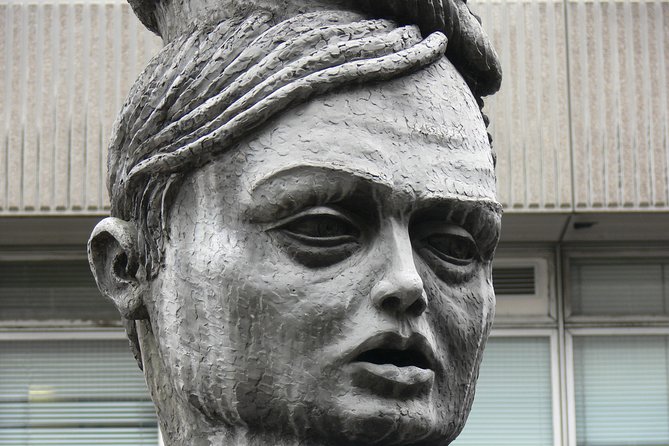
Queen Victoria Street offers one of the walk’s most unexpected sights: a totem pole made from a famous speech by William Shakespeare.
This is exactly the kind of object you would probably walk past without a guide. Declan performs the entire speech, which gives the monument a purpose beyond its odd appearance. The experience works best if you let the words and the object share your attention rather than rushing to take a photograph.
The same stop then shifts to the College of Arms and Shakespeare’s family coat of arms. You learn why the honour came two months too late, hear about Ben Jonson’s joke at Shakespeare’s expense, and get more about Shakespeare’s children.
That mix is typical of the tour. A grand public institution leads to a joke, then to family details. The playwright becomes more approachable because he is surrounded by practical and sometimes awkward human concerns.
Plaques, daughters, and the family Shakespeare left behind
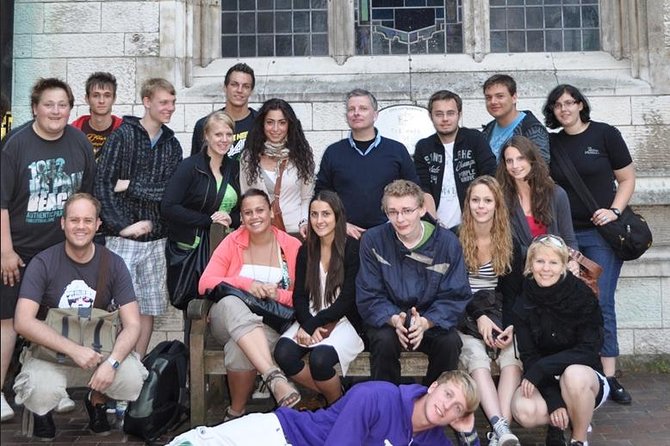
Back on Carter Lane, a plaque reveals something about Shakespeare’s generosity. The story also makes the case for keeping an eye on dusty attics, where documents and objects can sometimes change what we know.
The focus then turns to Shakespeare’s two daughters and their very different fortunes. This is valuable because many Shakespeare walks stop when the author’s own story ends. Here, family life continues to matter. You see how his success and decisions affected the people closest to him.
The tour does not promise a complete family biography, and the stop is short. Still, it gives useful balance. Shakespeare was not only a playwright moving between theatres and patrons. He was also a father whose family had separate lives and outcomes.
St Paul’s Cathedral without going inside

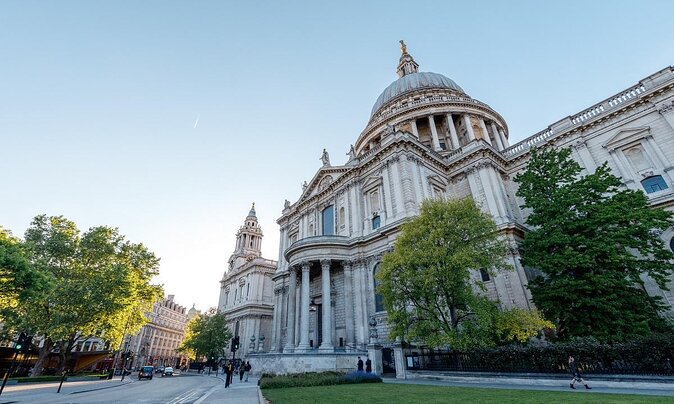
The route reaches St Paul’s Cathedral, one of London’s great visual landmarks. The tour does not enter the cathedral, so you should not book this expecting an interior visit.
Instead, the stop offers a major revelation about the building, Shakespeare’s best-selling work, his sonnets, and a reasonable reading of his sexuality. The tone here is interpretive rather than dogmatic. You are given a way to think about the sonnets without being told that every question has a final answer.
Declan also shares his favourite four words by Shakespeare, described as cosmic. The precise impact depends on how the speech is delivered, but this is where his stage background adds real value. A short line can sound very different when spoken aloud by someone used to performance.
If St Paul’s is high on your London list, you can visit it separately before or after the walk. The tour’s treatment is about Shakespeare’s relationship with the city and its ideas, not a cathedral visit.
Cheapside, a pub, and the problem of Shakespeare’s vocabulary
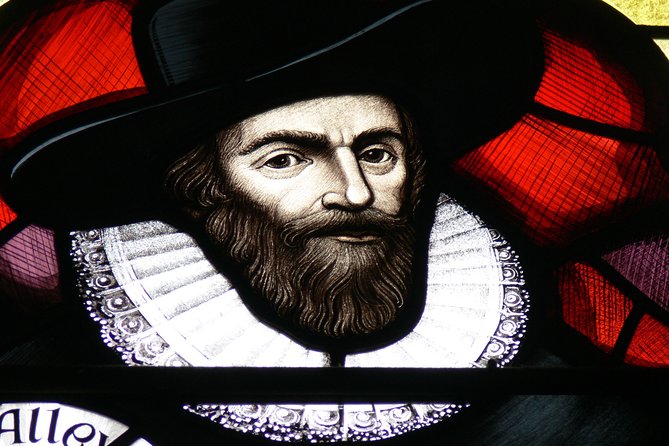
At Cheapside, the subject widens to Shakespeare’s vocabulary and why even his remarkable command of words was not enough for every purpose.
You also hear about a pub where Shakespeare drank and who else drank there. This sort of detail helps put him in a social setting. The playwright becomes someone connected to places where people gathered, talked, argued, and drank, not only someone alone at a desk.
The stop also considers Shakespeare’s religion and why he may have been lonely and reclusive. These are serious ideas, but the route keeps them connected to the streets around you. That is one reason the walk works for people who want more than a list of famous quotations.
You should expect interpretation here. The tour presents a reasonable understanding of Shakespeare’s life and beliefs, rather than pretending that every private thought can be recovered with certainty.
Love Lane and the people who kept the plays alive
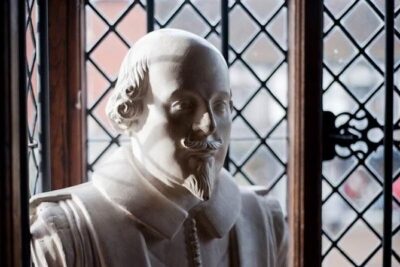
Love Lane brings you to a bust of Shakespeare and the men who honoured him. The discussion covers which plays we might lack without them and explains more about Shakespeare’s writing style.
This stop also includes a warning not to become too starry-eyed about the name Love Lane. The joke is useful. Literary walks can sometimes turn every location into a romantic symbol, but London’s street names often have less poetic origins than visitors hope.
The focus on Shakespeare’s supporters is especially important. Plays do not survive by magic. People performed them, printed them, preserved them, praised them, and sometimes helped shape the reputation attached to them. This part gives you a better sense of how a writer’s work reaches later generations.
London Wall and a marriage Shakespeare regretted
At London Wall, the route reaches the location of Shakespeare’s second London house and considers why he ended up in this part of the city.
The stop also tells the full story of a marriage he later regretted. That personal detail adds an edge to the portrait. Shakespeare is not presented as an untouchable genius whose life followed a neat plan. He made choices, lived with them, and carried private complications alongside public success.
The walk’s short stop format means you will not get a long lecture on marriage law or domestic life. Instead, you get a focused story tied to a real location. That keeps the pace moving, though anyone wanting a detailed academic treatment may find the time limited.
St Giles Cripplegate and a final farewell
The final major stop is St Giles Cripplegate, a church Shakespeare knew. Here you learn about the two best-known actors of his age and the sad story of his brother Edmund.
The closing performance is from Shakespeare’s last play. It is described as haunting and concerned with saying goodbye, which makes it a fitting end to a route about memory, survival, and loss.
This finale is a clear reason to choose this tour over a standard literary sightseeing walk. The performance is not an extra tacked onto the end. It gives the route an emotional shape. You begin with theatres, money, and public success, then finish with family, absence, and farewell.
From St Giles Cripplegate, Declan walks to Barbican Underground station if you want to continue with him. Barbican connects with the Circle, Metropolitan, and Hammersmith & City lines, making the finish practical for the rest of your day.
Price, group size, and what you get
At $20.83 per person, the tour offers solid value for London. You receive a professional guide, pickup and drop-off at the designated points, and live entertainment. Since the stops are free, you are paying for the route, research, storytelling, and performance rather than entrance tickets.
The booking limit is 15 people, while the activity has a maximum of 45 people overall. That distinction is worth noting. Your particular booking is capped at 15, but the total group size for a departure can be larger. The small-booking limit should still allow more interaction than a large coach tour.
The tour is commonly booked about 25 days ahead. That is a useful planning clue if your London dates are fixed. I would reserve early for a specific morning, especially if Shakespeare is a major reason for choosing the experience.
Free cancellation is available up to 24 hours before the start time. Changes or cancellations made less than 24 hours before 11:00 a.m. are not accepted for a refund.
Who should book this walk?
I would choose this for:
- Readers who want Shakespeare connected to actual London places.
- First-time visitors seeking a different side of the City of London.
- London locals who already know the main landmarks.
- People who enjoy spoken performance as much as historical facts.
- Families with children aged 10 and above who already have some interest in literature.
- Visitors who prefer a focused two-hour activity rather than a full-day tour.
I would be more cautious if you dislike walking in poor weather, need frequent long breaks, or want to enter St Paul’s Cathedral. This tour stays outside and moves through many stops in a relatively short time.
It is also not the best choice if you want only Shakespeare quotations. You will hear speeches, but the tour spends plenty of time on property, money, family, religion, marriage, documents, and London institutions.
Should you book Shakespeare in the City?
Book it if you want Shakespeare treated as a person shaped by London, not just as a famous name on a theatre sign. The combination of overlooked locations, family stories, city history, and Declan’s performed speeches gives the walk a clear identity.
The strongest reasons to go are the places you would not find alone and the actor-led delivery. The main tradeoff is the compact format. Two hours cannot give every stop equal depth, and the weather is part of the deal.
For a modest price, you get a purposeful route from Blackfriars to Barbican, a guide with stage experience, and a more personal look at Shakespeare’s London. If that sounds like your kind of morning, book ahead and arrive at the correct Blackfriars station.
FAQ
Where does the Shakespeare in the City Walk begin?
It begins outside Blackfriars Underground station in London at 11:00 a.m. Use the Blackfriars station on the Circle and District lines, not Blackfriars railway station south of the river.
Where does the walk finish?
The tour finishes at Barbican Underground station. Barbican is served by the Circle, Metropolitan, and Hammersmith & City lines.
How long does the tour last?
The walk lasts approximately two hours.
Is the tour suitable for children?
Children must be accompanied by an adult. The recommended age is 10 and above.
Does the tour enter St Paul’s Cathedral?
No. The route visits St Paul’s Cathedral from outside, but admission inside is not included.
Can I cancel for a full refund?
Yes. You can cancel up to 24 hours before the experience start time for a full refund. Changes or cancellations made less than 24 hours before the start time are not accepted.
More river cruises from London
- London Big Bus Hop-On Hop-Off Tour with Optional River Cruise
★ 3.5 · 10,803 reviews - High-Speed Thames River Speedboat in London
★ 5.0 · 3,971 reviews - London Tootbus Hop on Hop off Bus Tour and Thames River Cruise
★ 4.0 · 3,834 reviews - London Dinner Cruise on the Thames River
★ 4.0 · 1,772 reviews
More Shakespeare trips from London
- Shakespeare’s Globe Guided Tour
★ 4.5 · 481 reviews - From London: Shakespeare’s Stratford-upon-Avon Day Trip by Coach
★ 4.5 · 352 reviews - Full Day Cotswolds Tour & Shakespeare’s Stratford From London
★ 5.0 · 204 reviews - Private Tour: The London of Shakespeare, the Beatles, James Bond and Sherlock Holmes by Traditional Black Cab
★ 4.5 · 28 reviews
Just added in London
- The Beatles and a Secret pub★ 4.5 · 36 reviews
- The Beatles & Liverpool Magical Mystery Tour from London★ 4.5 · 80 reviews
- Airport Coach Service from Heathrow to Oxford★ 3.5 · 67 reviews
- The Beatles Magical History Black Taxi Tour London★ 5.0 · 51 reviews
- The Beatles London walking tour. From Abbey Road to the Roof Top★ 5.0 · 61 reviews
- Private The Beatles Taxi Tour in London★ 5.0 · 12 reviews
- The Beatles London Walk★ 4.5 · 120 reviews
- The Authentic London Food and History Tour★ 5.0 · 53 reviews
Shakespeare Tours, compared.


Shakespeare’s Stratford-upon-Avon Day Trip by Coach
Read our review →
The Sinister Side of Shakespeare’s Stratford Walking Tour
Read our review →
Shakespeare’s Schoolroom & Guildhall Entry Ticket and Tour
Read our review →
Full Day Cotswolds Tour & Shakespeare’s Stratford From London
Read our review →
Browse the lists this tour appears in