
Reviewed · WALKING TOURS
Roman London Private Walking Tour
Roman London is easiest to miss when you are standing right on top of it. This private walk takes you from the shadow of St. Paul’s Cathedral through alleys, churches, market buildings, underground rooms, and scraps of wall that reveal the city beneath modern London. The prize is not one grand ruin, but the way Roman Londinium keeps appearing in unexpected places.
I like the personal route and flexible conversation. Guides Kevin and Stephen Liddell bring in Roman, medieval, Norman, Victorian, wartime, and modern London as the streets change around you. I also like the access to places many people would never find alone, including the Roman amphitheater and the underground Temple of Mithras.
The main caution is the amount of walking. You should be ready for three solid hours on foot, and some people have covered more than seven miles with detours and alleys. The $254.93 per-person price is high for a walk, so this makes the most sense if you value a private guide and want far more context than a self-guided route can provide.
Key points to know before booking
- Roman ruins hide beneath ordinary London: Look for remains under churches, markets, offices, streets, and even less obvious modern buildings.
- The private format changes the pace: Your guide can answer questions, adjust the route, and focus on the periods that interest you.
- The walk links major and minor sights: You see the Roman wall, amphitheater, baths, bridge area, Mithraeum, and lesser-known remains in one morning.
- Kevin and Stephen Liddell lead the experience: Both are praised for lively storytelling and broad knowledge of London history.
- Expect serious walking: Comfortable shoes, water, and weather-ready clothing are essential.
- The Mithraeum needs planning at busy times: Advance booking is required to guarantee access during peak periods.
Why Roman London works best as a guided walk
London does not offer a single Roman district with clear streets and standing temples. Londinium is scattered across the City of London, often under later buildings or marked by small plaques and partial walls. Without context, a short stretch of stone can look like just another old foundation.
A good guide solves that problem. Kevin and Stephen Liddell are not simply pointing out isolated remains. They explain how the Roman city was arranged, how later London grew over it, and why modern streets still follow ancient lines. The result is a connected story rather than a list of ruins.
The private format is especially useful here. You can stop to ask about Roman engineering, London’s medieval development, the Blitz, or an odd architectural detail without holding up a large group. Several reviews describe the guides as warm, funny, and passionate about the subject. That matters on a route where the most important evidence may be a wall fragment or an underground chamber rather than a dramatic monument.
The tour begins at 9:30 a.m. and lasts about three to four hours. A guide can meet you at a central London hotel and take public transport to the starting point, but transportation to and from attractions is not included. The official meeting point is Panyer Alley, near St. Paul’s Cathedral, and the tour ends by the London Mithraeum near Bank Underground Station.
More walking tours in London:
- Tour for Muggles The Ultimate Harry Potter Walking Tour in London
★ 5.0 · 4,684 reviews - London Jack The Ripper Guided Walking Tour
★ 5.0 · 3,131 reviews - Changing of the Guard Guided Walking Tour in London
★ 5.0 · 1,793 reviews
From St. Paul’s to the first Roman remains
The opening stop is outside St. Paul’s Cathedral. The cathedral itself is not included in the tour price, but its location helps explain London’s long continuity. The high ground here was important before the present church existed, and the route connects the area with an earlier temple associated with the Roman goddess Diana.
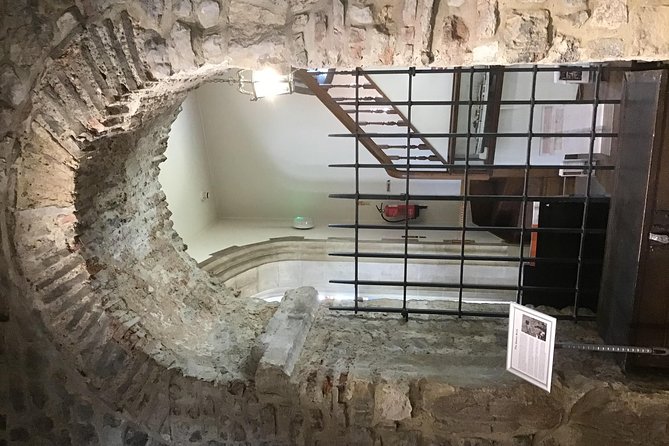
A few steps away, at the Church of St Vedast Alias Foster, the past becomes less obvious. You will see Roman remains tucked away from the street, along with evidence from an even earlier period. This is a useful introduction to the tour’s central idea: London’s oldest layers are often close to the main sights but easy to overlook.
You are not spending long inside each location. The listed stops are usually brief, often five to ten minutes, so the guide’s explanation does much of the work. If you prefer long visits inside major museums, this will feel fast. If you want to connect many scattered sites in one morning, the pace is productive.
Following the Roman wall through modern streets
The route then moves through Noble Street, Cripplegate Street, and several sections of London Wall. Noble Street is linked with a stretch of Roman wall exposed after wartime bombing. Cripplegate gives you another preserved gate area, while later sections show how the wall appears in different settings across the City.
This is one of the strongest parts of the experience because the remains do not sit in a neat archaeological park. They appear beside modern offices, along streets, and in places you might pass without stopping. The guide helps you picture the wall as part of a defensive circuit rather than a few disconnected stones.
The Roman wall also gives the walk a clear structure. You are not wandering randomly from one old building to another. You are tracing the edge of the city and seeing how Londinium’s boundary shaped later London.
At Guildhall, the old center of the City of London Corporation, the Roman connection continues. The building and square are impressive in their own right, but the guide draws your attention to the layers below and around them. Guildhall admission is not included, so the experience here is mainly about the setting and interpretation rather than a full interior visit.
The amphitheater beneath Guildhall
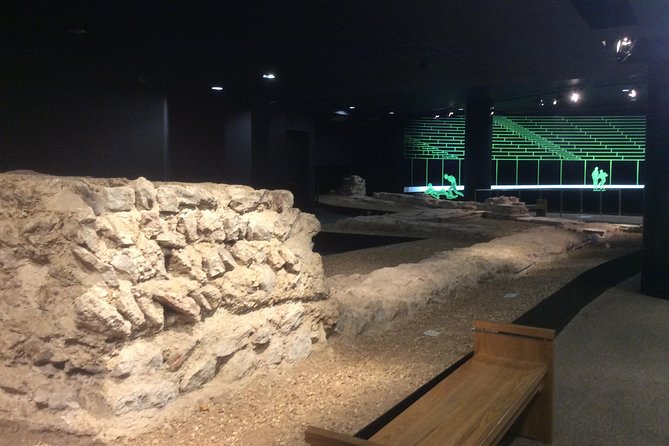
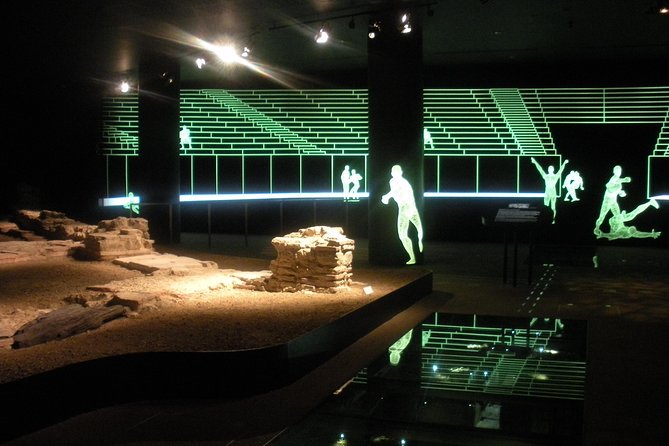
The Roman amphitheater is one of the most compelling stops. It lies beneath the modern streets, and you stand in the area where Roman public spectacles took place. The included visit lasts about 25 minutes, making it one of the longer stops on the route.
This is a good example of why a guide adds value. The remains are not as instantly legible as a complete arena in Italy or France. You need help understanding the space, its position within Londinium, and how it was discovered below later construction.
The amphitheater is also a welcome change from outdoor wall fragments. You move below street level and get a stronger sense of the city built over earlier cities. The route may also pass the old official residence of the Lord Mayor of London, adding a later civic layer to the Roman story.
Same base, a different kind of day:
- Stonehenge, Windsor Castle, and Bath from London
★ 4.5 · 18,662 reviews - London Big Bus Hop-On Hop-Off Tour with Optional River Cruise
★ 3.5 · 10,803 reviews - London Small Group Tour of Historical Pubs
★ 5.0 · 10,422 reviews - Stonehenge, Windsor Castle and Bath with Pub Lunch in Lacock
★ 4.5 · 7,402 reviews
Bank, the Royal Exchange, and Leadenhall Market
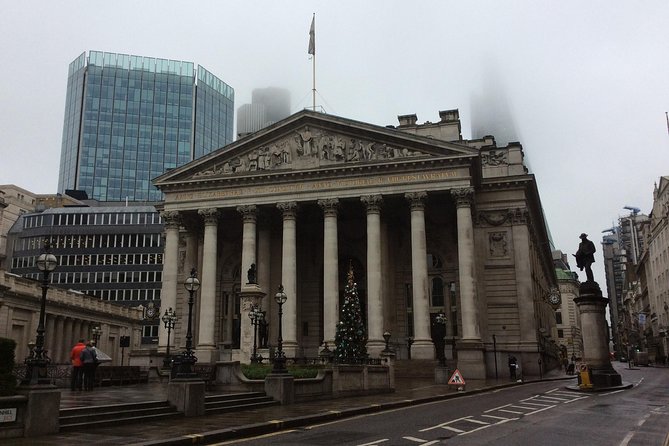
At the Bank of England, the grand stone buildings can make the Roman past seem remote. Yet this area sits at the heart of old Roman London. The guide connects the financial center of today with the commercial center of Londinium.
The Royal Exchange provides another striking contrast. Its architecture feels monumental and classically inspired, which makes it an effective place to discuss how later Londoners imagined ancient Rome. Admission is included at this stop, according to the tour details.
Leadenhall Market is a particularly enjoyable pause. The Victorian market occupies ground used by its Roman predecessor, and you may see a surviving piece of the earlier structure in an unexpected spot. The market is also a practical place to appreciate how London repeatedly rebuilt on the same footprint.
The stop takes about 15 minutes. That is enough time to see the key feature and hear the story, but not enough for a leisurely market visit or meal. If Leadenhall Market interests you as a destination in its own right, plan to return later.
A Roman memorial beneath the Gherkin
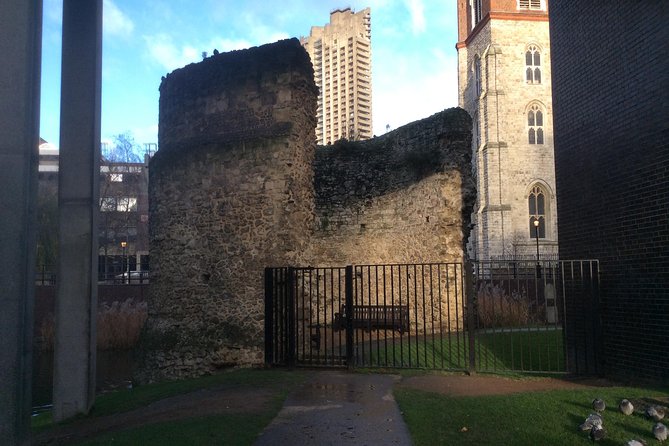
The route continues toward 30 St Mary Axe, better known as the Gherkin. The futuristic tower makes a playful backdrop for an ancient memorial nearby. In a few minutes, the tour moves from Roman London to one of the city’s most recognizable modern buildings.
Nearby is the Tomb of the Unknown Roman Girl, a memorial to one of London’s earliest known citizens. The stop is brief, but it gives the Roman past a human scale. Walls and foundations tell you how the city was built; a burial memorial reminds you that ordinary people lived, worked, and died here.
At Aldgate Square, you follow the route of another Roman gate. Much of the gate itself lies below the landscaped park, so do not expect a large exposed monument. The value is in understanding where the entrance stood and how the wall’s route shaped the district.
Vine Street and the eastern wall
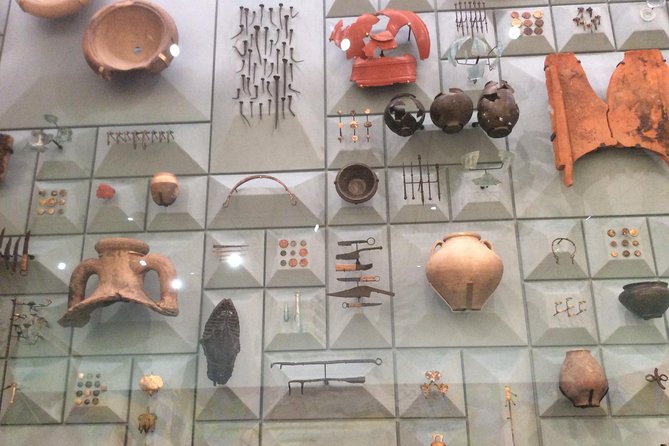
Vine Street offers newer museum displays, Roman objects, and additional wall remains. The tour details describe it as London’s newest museum, with strong Roman material. It is another included stop that gives you more than an outdoor glimpse.
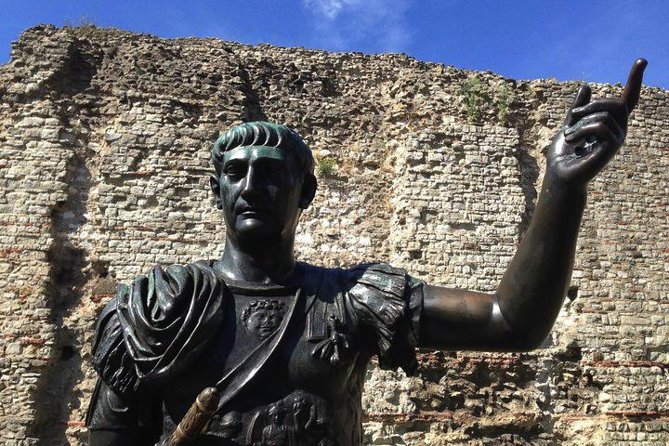
The route then reaches the statue of Emperor Trajan outside the Tower of London. Trajan is a useful figure for placing Roman London within the wider empire, and the statue provides a clear visual marker after several less obvious remains.
You will see more sections of London Wall here. The repeated wall stops may sound similar on paper, but their settings differ. One section may sit beside a street, another near modern construction, and another within a more controlled site. The guide’s job is to explain how each piece fits the larger circuit.
All Hallows by the Tower and St. Dunstan in the East
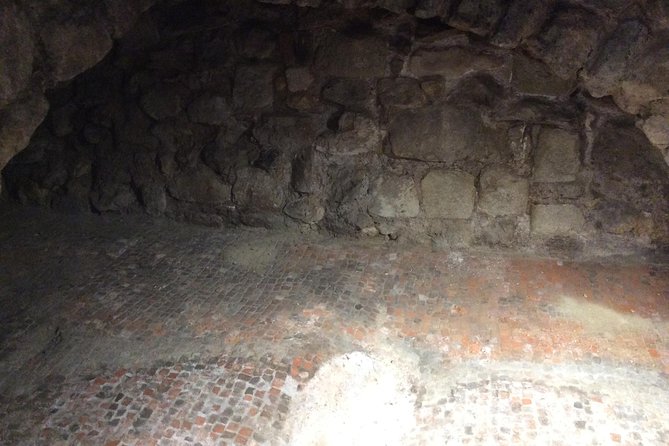
All Hallows by the Tower adds a church interior and a remarkable blend of periods. The visit includes the oldest archway in London and remains connected with a Roman house. Admission is included.
This is the kind of stop that rewards a guide who can move across centuries without losing the main thread. You are not only seeing Roman archaeology. You are seeing how later religious and civic buildings reused a site with a much older past.
St. Dunstan in the East is not strictly Roman, but it may be one of the most peaceful places on the route. The church ruins and greenery create a quiet break from the hard stone and traffic of the City. It is also a reminder that the tour is not narrowly limited to Roman objects. The broader story of London helps make the Roman remains easier to understand.
Billingsgate, the Roman bridge, and the Great Fire
At Billingsgate, the route points out the location of a Roman bath house. This is a short stop, and admission is not included. You may not get the full feel of a preserved bath complex, but the site helps map Roman public life onto the present waterfront district.
At St. Magnus the Martyr, you will see what may be the only surviving part of the original Roman London Bridge. The church is included, and the stop brings the route back to the river crossing that helped London function as a trading city.
The Monument to the Great Fire of London shifts the story forward by nearly 1,500 years. You stand near the place where the fire began and see visual material showing how Roman Londinium may have looked. This is a smart pairing: one point marks a disaster that reshaped London, while nearby evidence points to the city’s first major form.
The stop is not just a detour from Roman history. It shows how London’s appearance has repeatedly changed while key street patterns and locations endured.
The Mithraeum is the grand finale
The London Mithraeum Bloomberg SPACE is the tour’s final major archaeological stop and one of its best. You first see Roman artifacts, then go underground to the Temple of Mithras, a sacred building dedicated to a Roman mystery cult.
The included visit lasts about 20 minutes. The underground setting gives the stop real atmosphere, but the experience still depends on good explanation. The temple is not a complete ancient building standing in open air. It is a reconstructed and interpreted archaeological space below the modern city.
Plan ahead here. Guaranteed access to the temple requires advance booking during peak periods. The tour details do not promise that every busy time will have immediate access, so confirm the arrangements when booking if the Mithraeum is a main reason you are coming.
The tour ends nearby at Bank Underground Station. That is convenient for continuing around London, and it puts you only a few minutes from the starting area at St. Paul’s.
What the $254.93 price buys you
At $254.93 per person, this is not a budget sightseeing walk. You are paying for a private experience, a specialist route, and the guide’s ability to connect sites that are otherwise difficult to locate. Some included admissions help, especially the amphitheater, the church sites, the wall area, and the Mithraeum.
The value improves for a small group that can share the private guide cost. Group discounts are offered, though the exact saving is not provided. For one person or a couple, the price requires more thought. You should book it if finding obscure Roman remains and asking detailed questions matters more to you than keeping the morning inexpensive.
A self-guided route can show you some of the same public sites, but it will not easily reveal every tucked-away wall, explain what you are seeing, or adjust to your interests. The price also covers the convenience of being collected at a central hotel and guided to the start by public transport, although the transport fare itself is not included.
Who will enjoy this walk most
I would choose this tour if you like archaeology, ancient engineering, urban history, or the way old cities survive beneath new ones. It also suits repeat visitors who have already seen the Tower of London, St. Paul’s, and the main royal sights and want a different side of London.
Families with interested teenagers can enjoy it too. One review describes two adults and two teenagers having a good time, and the mix of underground rooms, gladiator-era remains, walls, churches, and modern skyscrapers gives the morning variety.
You should be comfortable walking for at least three hours. Some past routes have stretched beyond seven miles, so do not treat the three-to-four-hour estimate as a light stroll. Wear strong walking shoes, carry water, and dress for changing weather. The tour operates in all conditions and asks for smart casual clothing.
Should you book Roman London Private Walking Tour?
Book it if you want London’s Roman past explained as a living city rather than presented as a few isolated ruins. Kevin or Stephen Liddell can take you into places you would likely pass without noticing, while adding medieval, Victorian, wartime, and modern context along the way.
Skip it if you want a relaxed café morning, a short walk, or a large museum visit with plenty of time at each display. The price is substantial, the route is active, and several stops are quick.
For a history-focused visit, though, this is a strong use of a morning. Bring good shoes, protect the Mithraeum booking, and let the guide show you how much of London’s oldest city is still under your feet.
FAQ
How long does the Roman London Private Walking Tour last?
The tour lasts approximately three to four hours. You should be prepared to walk for about three solid hours, with some past routes extending farther because of alleys and extra stops.
What time does the tour start?
The scheduled start time is 9:30 a.m.
Where does the tour begin?
The listed meeting point is Panyer Alley, London EC2V 6AA, near St. Paul’s Cathedral.
Can the guide collect me from my hotel?
Yes. Pickup can be arranged at any central London hotel, not only at hotels listed in advance. The guide then goes by public transport to the starting point.
Where does the tour finish?
The tour ends at the London Mithraeum Bloomberg SPACE, 12 Walbrook, near Bank Underground Station. It is also only a few minutes from the starting area at St. Paul’s.
Is transportation included?
Transportation to and from the attractions is not included. Hotel pickup is offered, and the guide travels by public transport to the starting point.
Is the tour private?
Yes. Only your group participates in the activity.
Is admission to the London Mithraeum guaranteed?
Guaranteed access to the temple requires advance booking during peak times. Confirm this when booking if the Mithraeum is essential to your plans.
What happens if I need to cancel?
You can receive a full refund if you cancel at least 24 hours before the local start time. Cancellations or changes made less than 24 hours before the start are not accepted for a refund.
Just added in London
- The Beatles and a Secret pub★ 4.5 · 36 reviews
- The Beatles & Liverpool Magical Mystery Tour from London★ 4.5 · 80 reviews
- Airport Coach Service from Heathrow to Oxford★ 3.5 · 67 reviews
- The Beatles Magical History Black Taxi Tour London★ 5.0 · 51 reviews
- The Beatles London walking tour. From Abbey Road to the Roof Top★ 5.0 · 61 reviews
- Private The Beatles Taxi Tour in London★ 5.0 · 12 reviews
- The Beatles London Walk★ 4.5 · 120 reviews
- Dinner and Jazz Cruise on the River Thames★ 4.0 · 140 reviews
Walking Tours, compared.

Oxford University Walking Tour With University Alumni Guide
Read our review →
Tour for Muggles The Ultimate Harry Potter Walking Tour in London
Read our review →

Cambridge University Walking Tour by Alumni™ Kings College Option
Read our review →
Blackbeard to Banksy – The Ultimate Walking Tour of Bristol
Read our review →
Air Raid Shelter + St. Nicholas Market Walking Tour
Read our review →
Walking Tour of Bath with Blue Badge Tourist Guide
Read our review →
Changing of the Guard Guided Walking Tour in London
Read our review →Browse the lists this tour appears in