
Reviewed · WALKING TOURS
Medieval London Walking Tour Oxford PhD Historian Guide
London’s medieval past is easy to miss beneath office blocks, traffic, and Christopher Wren’s grand post-fire city. This private walk with Dr Geoff brings that older London into view, linking St Paul’s Cathedral with St Bartholomew the Great, Newgate, and Temple Church. I especially like the chance to enter two surviving medieval churches and the way a single guide connects architecture, religion, law, war, and the Great Fire.
I also like the small-group format. You can ask questions as they arise, and Dr Geoff’s background in medieval churches and architectural research gives the tour more substance than a standard sightseeing walk. The main drawback is the price: at $122.18 per person, it offers the best value for a group that wants private guiding and has a serious interest in history.
Key points at a glance
- St Bartholomew the Great: Spend 45 minutes inside one of London’s best-preserved Norman churches, with medieval arches, columns, and tombs.
- Dr Geoff’s academic background: The guide is an Oxford PhD historian with particular expertise in medieval churches and British history.
- A walk through several eras: The route covers medieval city walls, William Wallace, the Great Fire of 1666, the Knights Templar, the Reformation, the Civil War, and the Blitz.
- Private and question-friendly: Only your group takes part, making it easier to set the pace and ask detailed questions.
- Temple Church finale: See a 12th-century church linked to the Knights Templar and later connections with America’s Founding Fathers.
- A compact historic route: The tour lasts about two and a half hours and ends in the garden at Temple Church.
Why this short walk reveals so much of old London
The clever idea here is not simply to show you old buildings. It is to show how London changed while pieces of the earlier city survived around them.
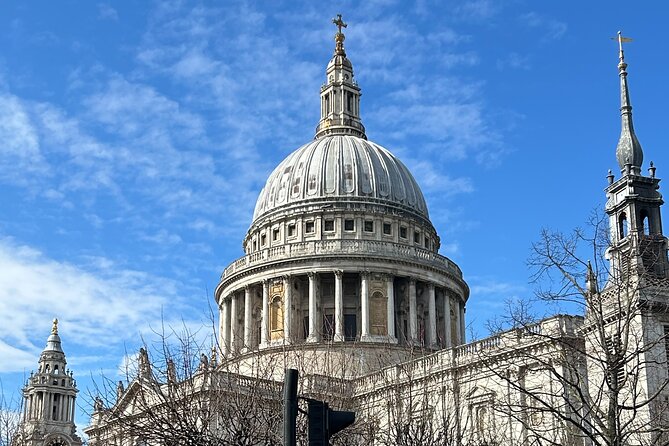
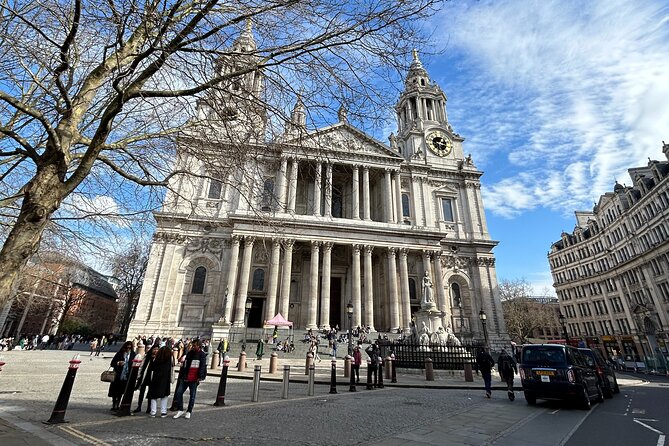
You begin at St Paul’s Cathedral, one of London’s great symbols. The present building was designed by Sir Christopher Wren after the Great Fire of 1666 destroyed much of the medieval city. That makes St Paul’s a useful starting point, even though the cathedral you see today is not medieval. Dr Geoff uses it to explain the city before the fire, Wren’s role in rebuilding it, and the older structures that escaped destruction.
From there, you walk toward St Bartholomew’s for about 18 minutes. This is a city walk rather than a series of isolated museum visits. You move through streets where modern London sits directly above, beside, and around older layers. That contrast is part of the appeal.
I would not choose this tour if you want a broad survey of every major London sight. The route is focused. It spends real time inside two churches and gives attention to medieval institutions, architecture, and religious history. For me, that narrow focus is its strength, but it will not suit anyone looking for Buckingham Palace, the Tower of London, or a general introduction to the city.
More walking tours in London:
- Tour for Muggles The Ultimate Harry Potter Walking Tour in London
★ 5.0 · 4,684 reviews - London Jack The Ripper Guided Walking Tour
★ 5.0 · 3,131 reviews - Changing of the Guard Guided Walking Tour in London
★ 5.0 · 1,793 reviews
Starting at St Paul’s and looking before 1666
Meet at the west end of St Paul’s Cathedral, near the grand stairs, at 10 a.m. Dr Geoff wears a blue lanyard marked Historic Tours of England, which should make him easier to identify in a busy part of central London.
The opening discussion matters because the Great Fire can make medieval London seem to have vanished completely. In fact, important fragments survived. The tour uses St Paul’s and Wren’s rebuilding work as a doorway into the city that came before the fire.
This is also a good point to ask questions about the route. Since the activity is private, you are not competing with a large group for the guide’s attention. If you are especially interested in church architecture, medieval law, Scottish history, or the rebuilding of London, you can steer some of the conversation in that direction.
Pickup is listed as available, but the stated meeting point is St Paul’s Cathedral. I would confirm the exact arrangement before booking if you need pickup rather than meeting at the cathedral.
William Wallace near the route to St Bartholomew’s
The first brief stop is a memorial to William Wallace, the Scottish hero who fought for Scottish independence. You spend about 10 minutes here, and there is no admission charge.
This stop adds a human figure to the walk. Medieval London was not only a city of churches and walls. It was also tied to the wider political struggles of Britain, including the conflict between Scotland and England.
The memorial is a short stop, not a full Wallace tour. That is worth keeping in mind. Its value comes from the way Dr Geoff places it within the larger route, rather than from the memorial itself taking up a large part of the morning.
Inside St Bartholomew the Great
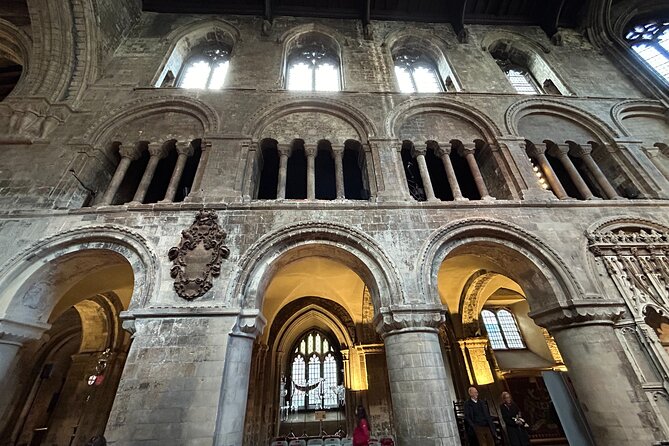
St Bartholomew the Great is the tour’s first major interior visit, and you spend about 45 minutes here. Admission is included.
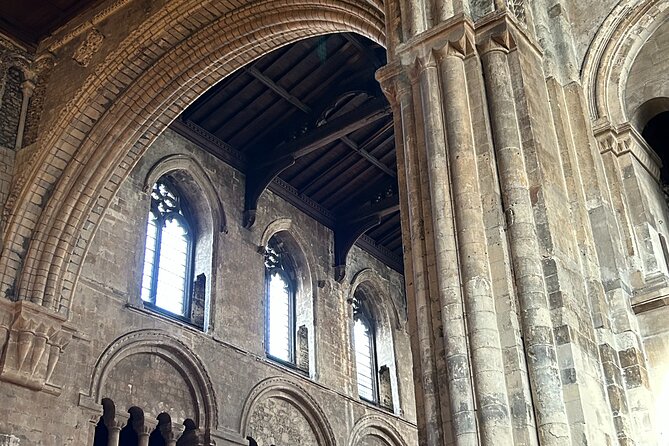
The church dates from the 12th century and retains much of its Norman character. Look for the heavy arches, solid columns, and tombs on the eastern side. These details give you a direct comparison point for later medieval buildings, especially Temple Church.
The church survived events that erased or damaged much of London’s older fabric. It came through the Great Fire, the Reformation, the Civil War, and the Blitz of the Second World War. That does not mean every stone or furnishing is untouched, but it does mean you are seeing an unusually substantial piece of medieval London.
This is where Dr Geoff’s specialist background should be most useful. A church can look simply old if you walk through it alone. With careful explanation, the shapes of arches, the weight of the columns, and the arrangement of the space begin to show how medieval builders and worshippers used the building.
I like that this stop receives enough time to feel unhurried. Forty-five minutes gives you room to look upward, examine details, and ask questions. The possible downside is that anyone who prefers quick photo stops may find the pace slow. This is an indoor history lesson with plenty of time for architecture, not a rapid checklist of sights.
Same base, a different kind of day:
- Stonehenge, Windsor Castle, and Bath from London
★ 4.5 · 18,662 reviews - London Big Bus Hop-On Hop-Off Tour with Optional River Cruise
★ 3.5 · 10,803 reviews - London Small Group Tour of Historical Pubs
★ 5.0 · 10,422 reviews - Stonehenge, Windsor Castle and Bath with Pub Lunch in Lacock
★ 4.5 · 7,402 reviews
Newgate, the city wall, and London’s criminal past
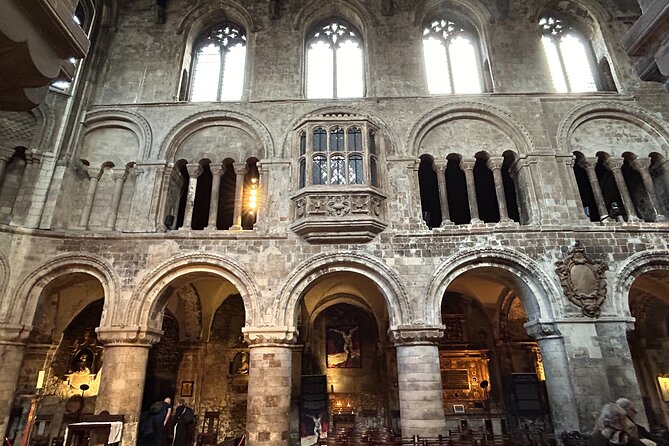
The walk continues to Newgate Street, where the focus shifts from religious buildings to the city’s defenses and legal institutions. You spend around 10 minutes here, with no admission charge.
Newgate was one of London’s old entry points through the city walls. It later became famous as a prison, and the Old Bailey, London’s criminal court, was built here and remains in use.
This short stop helps you picture London as a walled medieval city rather than the huge urban area you see today. It also shows how one location can change purpose over time. A gate built for defense became associated with imprisonment and criminal justice.
The stop is mostly explanatory, since there is no full medieval gatehouse to enter as part of the tour. I would listen closely here because the meaning of the site depends more on Dr Geoff’s interpretation than on a single dramatic surviving structure.
Temple Church and the Knights Templar
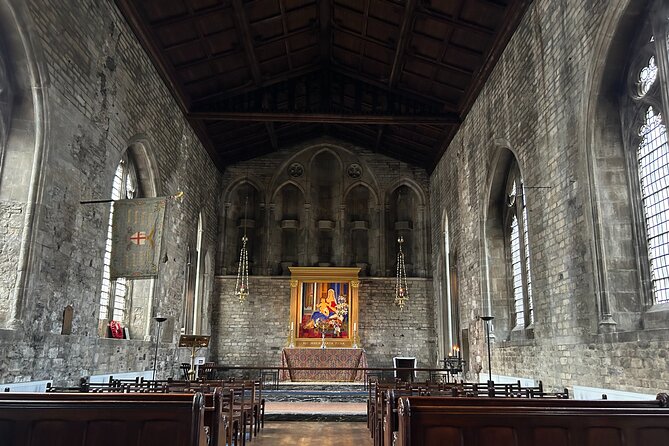
Temple Church is the final major stop, with about 45 minutes inside and admission included. The church was built in the 12th century by the Knights Templar, the wealthy monk-knights associated with the Crusades.
If you have read The Da Vinci Code, you may recognize the name. The real appeal is less about modern fiction and more about the Templars’ role as a powerful religious and financial order. Their church gives you a rare look at the kind of institution that shaped medieval Europe.
The building survived the Great Fire, though Victorian restoration changed much of what remained. That is an important caution. You are not seeing an untouched medieval interior. Still, the stone vaulted ceiling survived the Blitz, even while bombs fell around the church during the Second World War.
The church also has a connection with the Founding Fathers of the United States. Dr Geoff includes that link as part of the wider story, making this more than a stop for fans of medieval religious orders. You get a sense of how institutions and ideas moved from medieval England into later political history.
The tour ends in the garden at Temple Church. That gives you a clear finishing point, but it also means lunch is not part of the stated experience. Plan your meal separately rather than assuming one is included.
How Dr Geoff shapes the experience
The guide is central to the value of this tour. Dr Geoff is presented as an Oxford PhD historian, with specialist knowledge of medieval churches and British history. His architectural research at Oxford is especially relevant inside St Bartholomew the Great and Temple Church.
The format allows him to explain rather than simply point. You can ask why one church survived the Great Fire, how Victorian restoration affected Temple Church, or how medieval walls shaped London’s streets. That kind of exchange is difficult on a large group tour.
The tone also appears suited to people who enjoy detailed questions. Dr Geoff is described as friendly and willing to answer questions, and the private format means the experience can expand when the conversation is worthwhile. One account notes that the tour ran longer because the group had so much to discuss. I would not treat that as a guaranteed extension, but it suggests some flexibility when the discussion is engaging.
The language is English only. If you want a polished, theatrical performance, this may feel more academic. If you prefer careful explanations from someone who has spent years studying the subject, that is likely a benefit.
Is $122.18 per person a fair price?
The price is $122.18 per person. That is high for a two-and-a-half-hour walk, especially when you compare it with large public walking tours. The comparison changes if you are traveling as a small private group and care about specialist guiding.
Your fee covers a private experience, a guide with advanced academic credentials, and admission to St Bartholomew the Great and Temple Church. You are also paying for the route design and the ability to ask questions without a crowd waiting behind you.
I see the value most clearly for two to four people who would otherwise book a private historian or specialist guide separately. For a solo visitor, the per-person price may feel harder to justify. For a larger private group, the cost may become more reasonable if the rate is calculated per person rather than as a high fixed fee, though you should confirm the exact booking terms.
The tour is also efficient. In one morning, you cover two important medieval churches, a former city gate, a prison site, a memorial tied to Scottish independence, and the city’s rebuilding after 1666. You do not need a taxi or separate admission bookings for the churches.
Practical details for the walk
The experience lasts approximately two hours and 30 minutes, including the walk from St Paul’s to the final stop. Wear comfortable shoes. The route is urban, and the time inside the churches does not remove the need to walk between them.
Most people can take part, and service animals are allowed. The tour is near public transportation. The details do not specify a particular walking distance beyond the 18-minute walk to St Bartholomew’s, so anyone concerned about mobility should confirm the route before booking.
The experience requires good weather. If poor weather forces cancellation, you are offered another date or a full refund. You can also cancel for a full refund up to 24 hours before the start time. Changes or cancellations made less than 24 hours before the start time are not accepted for a refund.
I would book this for a morning when you have no tight appointment afterward. The scheduled time is compact, but a question-heavy private tour can sometimes run beyond the planned finish.
Who should book this medieval London walk?
I would recommend it most strongly to:
- People who enjoy medieval architecture and church history.
- Visitors who have already seen London’s headline sights and want a more focused route.
- Anyone who prefers private guiding to a large group.
- Students, academics, or serious amateur historians who want room for questions.
- Fans of the Knights Templar, the Great Fire, London’s walls, or British legal history.
- Families with older children who can appreciate a slower, explanation-led walk.
I would be more cautious if you have only one day in London and want a broad introduction to the city. I would also hesitate if you dislike church interiors or long historical explanations. The churches are the heart of the experience, and the tour earns its price through context rather than spectacle.
Should you book it?
Book this tour if you want London explained by a specialist rather than simply photographed. The strongest parts are the 45-minute visits to St Bartholomew the Great and Temple Church, where Dr Geoff can point out details that are easy to miss alone. The contrast between Norman stonework, Templar history, Victorian restoration, and wartime survival gives the morning a clear shape.
Skip it if you want a cheap, fast walk covering many famous landmarks. At $122.18 per person, this is a specialist private experience, not a budget introduction to London.
For the right audience, I think the focus is worthwhile. You leave with a better sense of how medieval London survived beneath the rebuilt city, and you finish in one of central London’s most unusual church settings.
FAQ
Where does the Medieval London Walking Tour begin?
It begins at the west end of St Paul’s Cathedral, near the grand stairs, at St Paul’s Churchyard, London EC4M 8AD.
What time does the tour start?
The scheduled start time is 10 a.m.
Where does the tour end?
It ends in the garden at Temple Church, Temple, London EC4Y 7BB.
How long does the tour last?
The tour lasts approximately two hours and 30 minutes, including the walk between the meeting point and the final stop.
Is this a private tour?
Yes. Only your group takes part in the private tour.
Who leads the experience?
Dr Geoff leads the tour. He is described as an Oxford PhD historian with expertise in medieval churches and British history.
What language is the tour offered in?
The tour is offered in English.
Are church admission fees included?
Admission to the Church of St Bartholomew the Great and Temple Church is included.
What happens if the weather is poor?
The experience requires good weather. If it is canceled because of poor weather, you are offered a different date or a full refund.
Just added in London
- The Beatles and a Secret pub★ 4.5 · 36 reviews
- The Beatles & Liverpool Magical Mystery Tour from London★ 4.5 · 80 reviews
- The Beatles Magical History Black Taxi Tour London★ 5.0 · 51 reviews
- The Beatles London walking tour. From Abbey Road to the Roof Top★ 5.0 · 61 reviews
- Airport Coach Service from Heathrow to Oxford★ 3.5 · 67 reviews
- Private The Beatles Taxi Tour in London★ 5.0 · 12 reviews
- The Beatles London Walk★ 4.5 · 120 reviews
- Dinner and Jazz Cruise on the River Thames★ 4.0 · 140 reviews
Walking Tours, compared.
Oxford University Walking Tour With University Alumni Guide
Read our review →
Tour for Muggles The Ultimate Harry Potter Walking Tour in London
Read our review →
Cambridge University Walking Tour by Alumni™ Kings College Option
Read our review →
Blackbeard to Banksy – The Ultimate Walking Tour of Bristol
Read our review →
Air Raid Shelter + St. Nicholas Market Walking Tour
Read our review →
Walking Tour of Bath with Blue Badge Tourist Guide
Read our review →
Changing of the Guard Guided Walking Tour in London
Read our review →Browse the lists this tour appears in