
Reviewed · JACK THE RIPPER TOURS
Jack the Ripper Walking Tour with Expert Ripperologist
Jack the Ripper’s story becomes far more unsettling when you walk the same narrow streets where the murders happened. This 2.5-hour Whitechapel walk moves from Aldgate through Mitre Square, Brick Lane, Hanbury Street, and Spitalfields, mixing police history with the lives of the women who were killed.
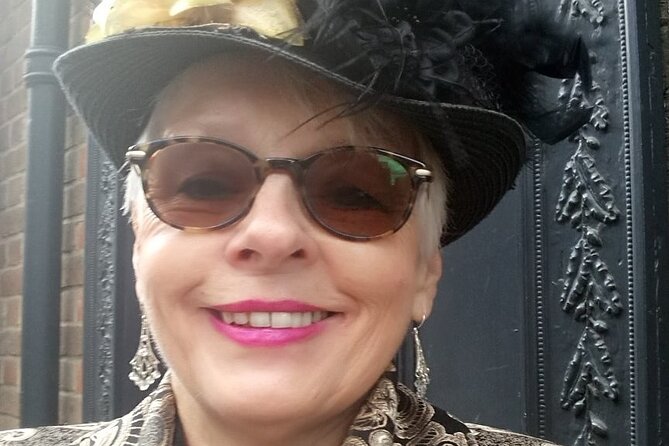
I especially like the old street views and archival images shown on a large backlit tablet. The costumed guides, including Lindsay, Jenny, and Paul, also bring a touch of theater without turning the subject into a joke. The main caution is simple: you walk and stand for most of the tour, and a group of up to 30 can feel crowded at the smaller stops.
Key points to know before you book

- See the actual murder locations: Mitre Square, Hanbury Street, Buck’s Row, and the site linked with Mary Kelly all feature in the route.
- Get the Victorian setting: The guide explains poverty, overcrowding, policing, crime, and daily life in Whitechapel in 1888.
- Use clear visual aids: Photographs, maps, and images of the victims and locations are shown on a 14-inch backlit tablet.
- Hear about the evidence: The route includes the Goulston Street clue, the Dear Boss letter, and the letter sent to George Lusk.
- Expect a walking tour, not a museum visit: There are very few toilets, and you need a moderate level of fitness.
- Know the age limit: Children under 15 are not allowed. Those aged 16 or 17 must be with an adult.
Why this walk works better than a simple ghost story
Many Jack the Ripper tours lean hard on mystery and fright. This one gives you more than a parade of grisly crime scenes. The guide places the murders in the poverty-stricken East End of 1888, where overcrowding, unstable work, poor housing, and limited policing shaped daily life.
That context matters. It helps explain why women such as Mary Ann Nichols and Annie Chapman were vulnerable, why the police struggled, and why rumors spread so quickly. The strongest parts of the walk focus on the victims as people, not just names in a murder case.
The guides also use visuals to bridge the gap between modern London and Victorian Whitechapel. You may be standing beside a modern street, then looking at an image of the same area as it appeared in the late 1800s. That makes the setting easier to picture than a spoken description alone.
Lindsay has been especially praised for her research, clear presentation, and sensitivity toward the women who died. Jenny is described as punctual and informative, while Paul has received strong marks for his command of the period. Guides can vary, but the tour’s format gives each one useful tools for telling the story.
More walking tours in London:
- Tour for Muggles The Ultimate Harry Potter Walking Tour in London
★ 5.0 · 4,684 reviews - London Jack The Ripper Guided Walking Tour
★ 5.0 · 3,131 reviews - Changing of the Guard Guided Walking Tour in London
★ 5.0 · 1,793 reviews
Starting at St Botolph’s Church and Aldgate Square
Meet outside St Botolph’s Church at Aldgate Station. The church provides a practical starting point because it sits near the old boundary between the City of London and Whitechapel.
The guide begins with the church’s local connection to prostitutes, who were said to solicit on the island where it stood. This opening introduces the social setting without immediately rushing into the murders.
A short move takes you to Aldgate Square. Here, the focus shifts to Whitechapel itself: crowded housing, poverty, crime, and people living close to the breadline. You begin to understand the area as a working neighborhood under pressure, rather than a stage set for a crime legend.
This part lasts only around 15 minutes, but it is important. Without it, the later stops can feel like disconnected locations. With it, the route has a clearer human and social context.
Mitre Square and the double event
Mitre Street and Mitre Square are among the most important stops. This is where Elizabeth Stride, known as Long Liz, was killed on the night often called the double event.
The guide then moves only a short distance to discuss Catherine Eddowes, murdered about 45 minutes later. Hearing about both killings in one area gives you a sharper sense of the panic that gripped London that night.
The route also explains the City of London and Metropolitan police boundary. That division is not just a technical detail. Separate police forces worked on either side of the boundary, creating complications as officers followed evidence across district lines.
Mitre Square is also one of the places where the modern city can make the past feel surprisingly close. You are not entering a preserved crime scene. The setting has changed, and the tour works best when you treat it as a historical location rather than expect a frozen Victorian street.
Petticoat Lane, Goulston Street, and the police trail
The walk continues toward Petticoat Lane Market, now called Middlesex Street. This marks the boundary between the City of London and the Metropolitan Police area.
From there, you reach Goulston Street, where the only clue found on the route that night became part of the case. The guide explains the doorway and the path taken by police officers who were pursuing the killer.
This is one of the better sections for people interested in police procedure. The story is not only about where bodies were found. It is also about decisions made under pressure, incomplete information, and the difficulty of controlling a frightened district with two police forces.
The stops are short, usually around five to ten minutes. That keeps the route moving, though you will need to listen closely. In a group of 20 to 30 people, it can be harder to hear at a busy corner. The guide uses a microphone, which helps.
Other Ripper walks in London:
- London Jack the Ripper Guided Tour with Ripper-Vision
★ 4.5 · 4,840 reviews - Ultimate Jack the Ripper : Guided Tour of London
★ 5.0 · 1,495 reviews - The Original Jack the Ripper : Guided Tour
★ 5.0 · 1,264 reviews - London Jack The Ripper Small-Group Walking Tour
★ 5.0 · 1,013 reviews
Gunthorpe Street and Martha Tabram
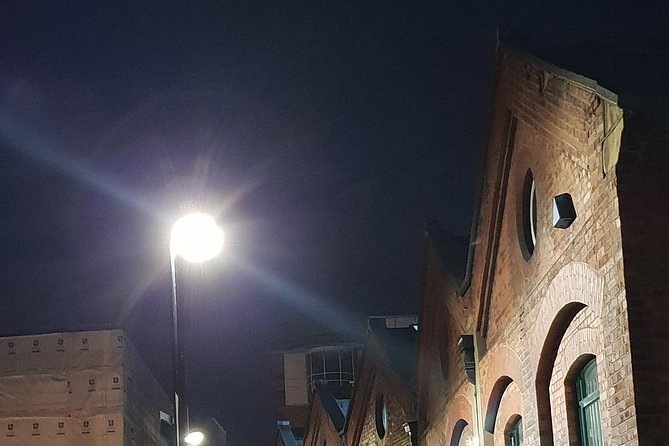
At Gunthorpe Street, viewed from Wentworth Street, the guide discusses the murder of Martha Tabram. She was found dead on August 7, 1888, in George Yard Buildings.
Tabram is now often considered the most likely first victim connected with Jack the Ripper. The wording matters: this is part of the case’s uncertainty, not a proven fact.
This stop shows how the tour handles disputed points. The guide can explain what is established, what is suspected, and what remains unknown. That is more useful than presenting every theory as settled truth.
The stop is brief, about ten minutes, and takes place outdoors. You are looking toward the location rather than entering a preserved building, so the value comes from the explanation and the surrounding streets.
Thrawl Street, the Frying Pan Pub, and Mary Ann Nichols
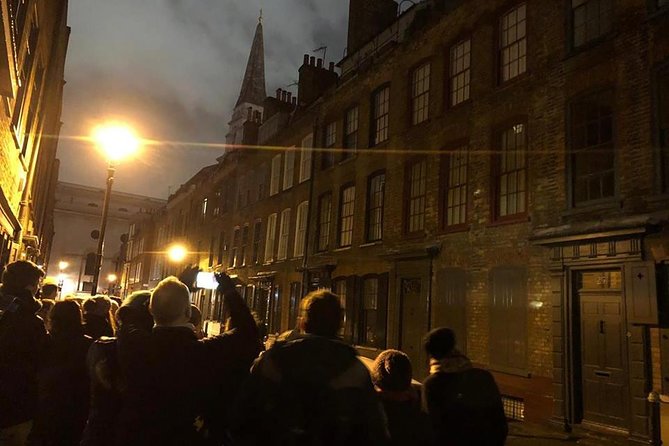
Near Brick Lane, the group stops opposite the Frying Pan Pub at the corner of Thrawl Street. This is associated with Mary Ann Nichols, who had her last drink there before walking toward Whitechapel Road.
Nichols was later murdered in Buck’s Row, behind what is now Whitechapel Station. The route connects her last known movements with the wider neighborhood, showing how close together many of these places were.
Brick Lane gives this part of the tour a strong sense of place. The area is still a major East End thoroughfare, but the modern shops and restaurants can make it difficult to picture the 1888 setting. The visual material helps fill that gap.
This is also where the tour’s treatment of the victims becomes important. The most effective guides do not treat Nichols as a plot point. They explain the circumstances of her life and death, giving the case a more human focus.
Hanbury Street and the most powerful stop
Hanbury Street is home to the location where Annie Chapman was murdered in the backyard of 29 Hanbury Street.
For many people, this is one of the most affecting stops because the route brings you close to an address tied to a specific victim and a specific setting. The guide explains what happened while using images to show how the area looked in the late 19th century.
The visit does not turn the location into a spectacle. That restraint is welcome. This is a difficult subject, and the strongest delivery comes from explaining the evidence and circumstances plainly.
Expect roughly 12 minutes here. You will be outdoors and standing, so comfortable shoes matter. The entire walk is not a strenuous hike, but the steady pace and repeated stops can be tiring if you have mobility concerns.
Wilkes Street, Puma Court, and the famous letters
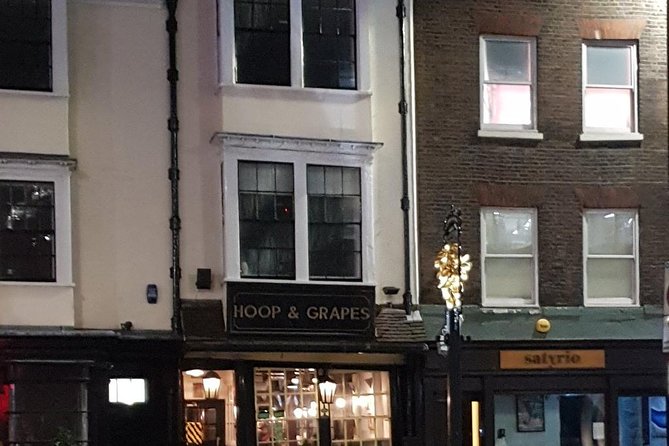
The route turns onto Wilkes Street, described as one of the streets that has changed little since the 1800s. From there, you continue toward Puma Court and hear about the Dear Boss letter.
Wilkes Street is useful because it gives you a better physical sense of old Whitechapel. Instead of seeing only isolated modern corners, you get a stretch of streets that helps explain the tight spaces, passageways, and poor visibility that shaped the investigation.
The Dear Boss letter is one of the case’s most famous pieces of evidence, though its authenticity and connection to the killer have long been questioned. The guide uses it to explain how newspapers, police, and the public became caught up in the case.
This is a good point to keep your expectations grounded. The tour offers historical interpretation, not a final answer to the Ripper’s identity. The mystery remains unresolved, and the guide discusses suspects mainly near the end.
The Ten Bells and Itchy Park
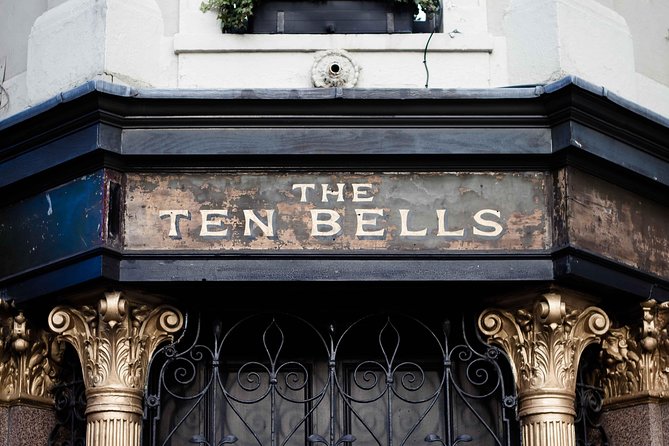
Opposite the Ten Bells, you hear about Mary Kelly’s favorite pub. The route also looks toward Christ Church Graveyard, known as Itchy Park, where homeless people would sleep during the day.
The Ten Bells is one of the better-known Ripper-related locations in London, but the pub’s connection to the case is tangled with later storytelling. A good guide can separate what is documented from what has been added by popular culture.
This stop also returns the focus to the neighborhood’s poorest residents. Itchy Park was not just a spooky backdrop. It was a place used by people with nowhere else to go, which adds another layer to the social history of the area.
The stop lasts about five minutes. You do not need to enter the pub, so the value is in the explanation and the view from the street.
Spitalfields, George Lusk, and Mary Kelly
Near Old Spitalfields Market, the route pauses at the entrance to the London Fruit and Wool Exchange. Here, the guide discusses the letter sent to George Lusk, head of the Whitechapel Vigilance Group.
Lusk’s group was formed by local people who wanted to help protect the area and respond to the police failure to catch the killer. The letter is another example of how the murders drew ordinary residents into the investigation.
The final section takes place in the square behind the Fruit and Wool Exchange. The tour ends with Mary Kelly, described as Jack the Ripper’s last victim, killed on November 9, 1888.
The ending is practical as well as dramatic. From the finish on Bell Lane, it is about a five-minute walk to Liverpool Street Station, and the guide directs you there. That makes it easy to continue sightseeing or connect with other Underground lines.
What the price includes, and what it is worth
At $23.61 per person, this is a reasonable price for a 2.5-hour guided walk in central London. You are paying for a specialist guide, route planning, historical narration, and visual material that would be difficult to assemble on your own.
The 14-inch backlit tablet is particularly useful. It shows photographs of the victims, locations, and surrounding area, giving you something concrete to look at while standing on the modern street.
The price is less attractive if you want a small, private group. The maximum is 30 people, and a typical departure may include 20 to 25. One person specifically found that size too large and wanted more attention on suspects.
For most people, the microphone should make the group manageable. If you want a slower pace, more questions, or a custom focus on suspects, a private tour is available, but it will cost more.
Practical details for a comfortable walk
The tour is offered in English and uses a mobile ticket. It begins at Aldgate Station, Aldgate High Street, and ends at 66 to 68 Bell Lane, inside the square of the London Fruit and Wool Exchange.
Wear comfortable shoes and plan to remain outdoors for most of the 2.5 hours. There are very limited toilets along the route, so use one before meeting the guide.
The walk suits anyone with moderate physical fitness. It is not recommended if you cannot walk and stand for more than two hours. Rain does not automatically ruin the experience, but proper weather protection will make it much easier to concentrate.
The activity is for ages 15 and up. Children under 15 cannot join, and anyone aged 16 or 17 must be accompanied by an adult.
The tour is often booked around 40 days ahead, so reserve early if your London dates are fixed. Free cancellation is available up to 24 hours before the start time. If the minimum number is not reached and the tour is canceled, you are offered another date or a full refund.
Who should book this Whitechapel walk?
You should book it if you enjoy dark history, unsolved crimes, old city streets, and social context. It is especially useful if your knowledge of Jack the Ripper comes mostly from films or popular culture, since the guide explains how the real case differs from the Hollywood version.
I would also recommend it to anyone who wants to see a less polished side of London. The route moves through the City, Whitechapel, Brick Lane, and Spitalfields, with the murder case serving as a way into the area’s past.
You may want another tour if you dislike graphic subject matter, standing outdoors, or stories that leave major questions unanswered. It is also not the best choice if your main interest is a long list of suspects, since more time is given to the victims, the police, and the local setting.
At 4.8 out of 5, with 97 percent of customers recommending it, the tour has a strong record. The praise centers on the guides’ preparation, the tablet images, the period background, and the respectful treatment of the women who were killed. The main weakness is group size, not the route or subject matter.
FAQ
How long does the Jack the Ripper walking tour last?
The tour lasts approximately 2 hours and 30 minutes.
Where does the tour begin?
It begins outside St Botolph’s Church at Aldgate Station, Aldgate High Street, London EC3N 1AH.
Where does the tour end?
It ends at 66 to 68 Bell Lane, inside the square of the London Fruit and Wool Exchange. Liverpool Street Station is about a five-minute walk away.
What language is the tour offered in?
The tour is offered in English.
What locations are included?
The route includes St Botolph’s Church, Aldgate Square, Mitre Street, Mitre Square, Petticoat Lane, Goulston Street, Gunthorpe Street, Thrawl Street, Hanbury Street, Wilkes Street, the Ten Bells, Old Spitalfields Market, and the London Fruit and Wool Exchange.
Are photographs included?
Yes. The guide shows photographs of the victims, murder sites, and surrounding area on a 14-inch backlit tablet.
Can children join the tour?
Children under 15 are not allowed. Those aged 16 or 17 must be accompanied by an adult.
Can I cancel for a refund?
Yes. You can cancel at least 24 hours before the start time for a full refund. Cancellations or changes made less than 24 hours before the start time are not accepted for a refund.
Should you book it?
Book this walk if you want a serious, visual, and atmospheric look at the Jack the Ripper case, with plenty of attention paid to Whitechapel in 1888. The guide’s tablet, period setting, and careful focus on the victims give the route more substance than a simple spooky stroll.
Skip it if you need frequent seating, toilet access, or a tiny group. For everyone else, the $23.61 price buys a well-planned route through some of London’s most important Ripper locations, plus the historical context needed to understand why the case still holds attention.
Just added in London
- Private London Departure Transfer – Hotel / Accommodation to Cruise Port★ 4.5 · 77 reviews
- Private landmarks photoshoot for families and couples★ 5.0 · 92 reviews
- Professional Photoshoot in London Photographer★ 5.0 · 102 reviews
- Private Tour: Night Photography Tour in London★ 5.0 · 48 reviews
- Professional Private Photoshoot in London★ 5.0 · 63 reviews
- Shoreditch Street Art and Graffiti Tour (Private Group Booking)★ 5.0 · 108 reviews
- Transfer London to Southampton Cruise Terminal (extra luggage)★ 4.5 · 81 reviews
- London, Windsor Castle, Hampton Court Palace with Free Snack Pack★ 4.0 · 102 reviews
Jack the Ripper Tours, compared.
London Jack the Ripper Guided Tour with Ripper-Vision
Read our review →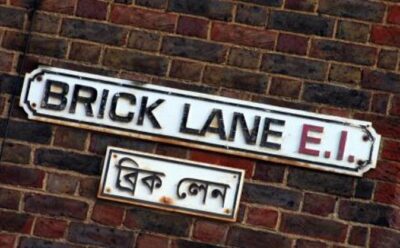
Ultimate Jack the Ripper : Guided Tour of London
Read our review →

London Jack The Ripper Small-Group Walking Tour
Read our review →
The Original Jack the Ripper Coach Tour of Haunted London
Read our review →
Jack the Ripper Tour with ‘Ripper-Vision’ in London- Afternoon
Read our review →Browse the lists this tour appears in