
Reviewed · PHOTOGRAPHY SESSIONS
History of London Photography Tour
London reveals itself especially well through a camera. This two-hour walk moves from the City’s old churches and financial landmarks to St. Paul’s, the Millennium Bridge, and Tate Modern, with a professional photographer helping you find better angles and use your settings with more purpose. Richard, one guide named for this route, is praised for patiently helping beginners and experienced photographers alike.
I like the mix of practical camera advice and London stories, especially at places such as St. Mary Woolnoth and the National Firefighters Memorial. I also like that you finish at Tate Modern after crossing some of the city’s most photogenic river views. The main drawback is that the route uses well-known sights, so anyone expecting a completely offbeat London may find parts of it familiar.
Key points before you book
- Start at a church with Roman-era traces: St. Mary Woolnoth gives the tour an unusual opening in the heart of the financial district.
- Learn by shooting real buildings: Your guide helps with composition, lighting, angles, and camera settings as you work.
- Follow a strong City-to-South-Bank route: The walk links Guildhall, St. Paul’s, the Millennium Bridge, Tower Bridge, and Tate Modern.
- Expect a relaxed mixed-ability group: The maximum is 18 people, and the guide works with both beginners and camera users who want a refresher.
- Bring your own camera or phone: Equipment is not supplied, and you will get the most from the tour by taking pictures throughout.
- Plan for a one-way walk: You begin at St. Mary Woolnoth and finish at Tate Modern, with no return to the starting point.
Why this London photography walk works
This is not a standard sightseeing walk with a few quick photo stops. The point is to look more closely at familiar London scenes and make deliberate choices about what goes into your frame.
You might work on the angle of a church tower, the shape of a façade, or the way a bridge leads your eye toward a landmark. The guide also brings in short historical notes, so you are not simply photographing buildings without knowing why they matter.
The route suits a wide range of ability. If you are new to photography, you can ask for help with basic settings and start making choices beyond automatic mode. If you already use an SLR or mirrorless camera, the walk gives you a reason to experiment again. One participant who had become too dependent on auto settings found the tour useful as a practical reset.
A phone camera is enough to take part, but dedicated camera users have more controls to explore. Bring only equipment you can carry comfortably. This is a walking experience, not a studio lesson, and the city keeps you moving.
More photography sessions in London:
- Professional Photoshoot in London Photographer
★ 5.0 · 102 reviews - Private landmarks photoshoot for families and couples
★ 5.0 · 92 reviews - Professional Private Photoshoot in London
★ 5.0 · 63 reviews
Starting beneath St. Mary Woolnoth
The meeting point is IMPRINT Church London at St. Mary Woolnoth, 10 to 13 Lombard Street. This puts you in the middle of the City of London, close to Bank station and surrounded by a striking mix of old churches, modern offices, and financial institutions.
St. Mary Woolnoth is a strong place to begin. Worship has taken place here for at least 2,000 years, and traces of Roman and pagan religious buildings were found beneath the present church. The current building was rebuilt in 1727 to a design commissioned from Nicholas Hawksmoor.
That gives you several subjects right away: the church’s stonework, its position among office buildings, and the contrast between an old place of worship and the modern City around it. Your guide can help you consider how much of the surrounding setting to include rather than treating the church as an isolated object.
The stop lasts about 10 minutes and admission is free. The tour is focused on photography and exterior views, so do not book it expecting a full interior visit at every church.
Photographing the Royal Exchange and Bank of England
From St. Mary Woolnoth, the walk turns toward the Royal Exchange. This grand building offers a chance to work with symmetry, columns, repeated shapes, and broad architectural lines.
The useful part here is not simply being told where to point your camera. Your guide helps you think about the best angle and how the building changes when you alter your position. A small shift can make a façade look more balanced, bring a foreground detail into the frame, or give the building more space around it.
The Royal Exchange stop lasts about 10 minutes. The nearby Bank of England receives around 15 minutes, giving you more time to consider a large, formal building packed with architectural detail.
These first stops are particularly helpful if you are still getting used to your camera. You can test settings in a relatively controlled urban setting before the route reaches larger views around St. Paul’s and the river. The financial district can also feel visually demanding, with tall buildings, narrow streets, and strong contrasts between light and shade. That makes it a useful place to practise rather than a simple warm-up.
Finding Gothic detail at Guildhall
Guildhall is about 800 years old and brings a different mood to the route. Its Gothic character gives you pointed arches, stone details, and a more medieval visual language than the formal buildings around Bank.
The stop lasts about 15 minutes. That is enough time to try both wider views and closer details, though you may need to work efficiently if the group is large or the light is changing.
A group of up to 18 people is manageable, but it can still affect how long you have in one exact spot. If you want a particular composition, ask the guide for help early. The format is interactive, yet it is still a shared walk rather than a private lesson.
Guildhall also helps connect the City’s business district with its older civic identity. You are not only collecting postcard subjects. You are seeing how different periods of London sit close together, often in the same few streets.
A few more things to do in London worth a look
- London Small Group Tour of Historical Pubs
★ 5.0 · 10,422 reviews - Soho Music & Historic Pubs Tour
★ 5.0 · 1,993 reviews - Royal Historic Pubs Walking Guided Tour in London
★ 5.0 · 803 reviews - Private Group: Historical Pub Walking Tour of London
★ 5.0 · 660 reviews
St. Mary-le-Bow and the Cockney connection
The next church is St. Mary-le-Bow, known for its bells. Tradition says that a true Cockney must be born within earshot of those bells.
You get about 10 minutes here. That is enough for a quick architectural study and a chance to consider how local traditions can make a familiar building more interesting. The church is another reminder that the City is not just offices and banks. Its churches carry stories that give the street plan a human scale.
This is also where the tour’s balance becomes clear. Some stops are celebrated landmarks, while others reward attention to detail. If your main goal is rare, little-known locations, this may not fully match your hopes. The route includes many major London sights, and its fresh angle comes mainly from the photographic guidance rather than from secret access.
St. Paul’s Cathedral from a photographer’s angle
St. Paul’s receives the longest stop, about 20 minutes. That makes sense. Sir Christopher Wren’s cathedral is one of London’s most recognizable subjects, but recognition does not make it easy to photograph well.
The building is tied to major events in British history. Catherine of Aragon married Prince Arthur here in 1501. Elizabeth I visited after the defeat of the Spanish Armada in 1588. The cathedral is also linked to the execution of Guy Fawkes and his fellow conspirators after the Gunpowder Plot.
Your guide helps you move past the most obvious snapshot. You might look for a balanced front view, a detail in the stonework, or a composition that places the cathedral within the surrounding streets. The goal is not to force one perfect picture. It is to make choices about line, scale, light, and context.
St. Paul’s is one of the tour’s best opportunities for advice from a professional photographer because there is so much visual information to manage. A beginner can focus on basic framing, while a more experienced user can work on perspective and composition.
The National Firefighters Memorial and London’s wartime story
The National Firefighters Memorial is a smaller subject with a strong human focus. Sculptor John Mills created the monument to honor the professional firefighters, men, and women who helped London survive the Blitz.
The stop takes about 10 minutes. You can photograph the statue as a standalone subject or place it within views of the surrounding landmarks. That contrast can give your pictures more meaning than another façade shot.
The memorial also changes the pace of the walk. After several buildings, you are asked to focus on people represented in sculpture and on the wartime story attached to the monument. It is a useful reminder that city photography is not only about architecture. Monuments can carry emotion, scale, and memory.
Crossing the Millennium Bridge
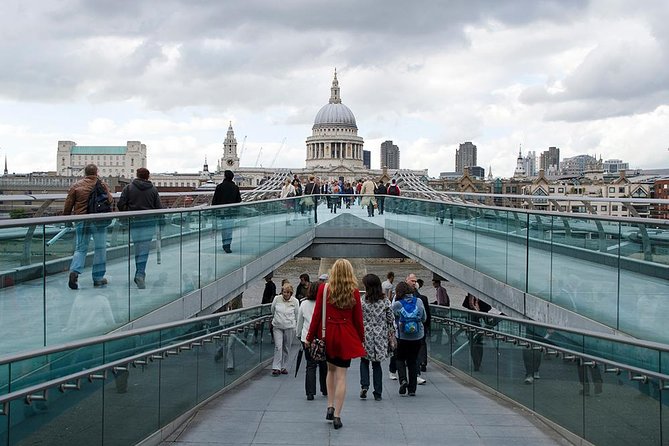
The 325-metre Millennium Bridge links Tate Modern with the City of London and St. Paul’s Cathedral. It opened on June 10, 2000, and gives you one of the clearest visual connections between the north and south banks.
You have about 10 minutes here, which is not a long time for a bridge crossing and a photo lesson. Keep your camera ready and listen for the guide’s suggestions as you move. The bridge offers strong lines and long views, with St. Paul’s as a major focal point on one side and Tate Modern on the other.
This is one of the route’s most rewarding settings for learning about composition. The bridge naturally guides the eye, so you can see how leading lines work in a real scene. It is also a good point to practise making a landmark part of a larger picture instead of filling the entire frame with it.
The crossing is a practical consideration for anyone who dislikes walking or needs frequent rests. The activity is only about two hours, but it is a continuous city walk with several stops.
River views toward Tower Bridge
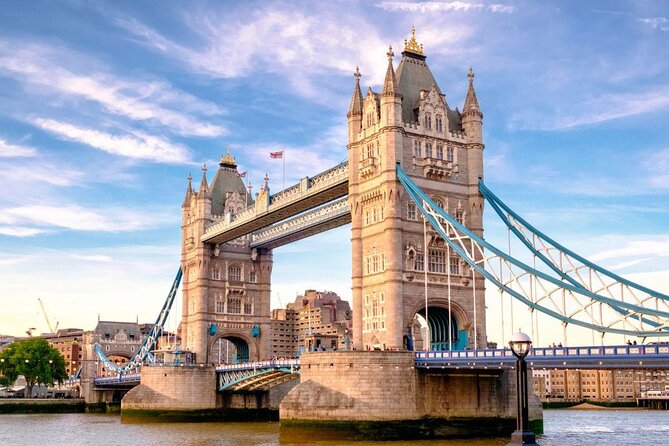
The route then gives you views of the River Thames and Tower Bridge. The Tower Bridge stop lasts about 10 minutes and provides a broad change from the tighter City streets.
This is the point where light and weather matter most. On a clear day, the river can give your photos space and reflection. On a grey day, the structure, water, and skyline still provide strong shapes, but your results may look more subdued.
The tour requires good weather. If poor weather forces a cancellation, you are offered another date or a full refund. That rule makes sense for an outdoor photography walk, though you should still dress for changing London conditions and bring equipment you can protect.
Tower Bridge is a famous subject, so you will not be photographing an unknown corner of London. The benefit is that your guide can help you approach a familiar landmark with a different frame, perhaps by using the river or nearby structures to create more depth.
Finishing at Tate Modern
The walk ends at Tate Modern, where you get about 10 minutes to photograph the building itself. The gallery occupies the former Bankside Power Station, designed by Sir Giles Gilbert Scott, who also designed Battersea Power Station.
Tate Modern’s tall brick exterior gives you a final architectural subject with a very different look from St. Paul’s or Guildhall. Its size can be challenging, so the guide’s advice on angles and composition remains useful right to the end.
Finishing here is convenient if you want to visit the gallery afterward, though admission to the photography walk does not include a gallery visit. The endpoint is also near the Millennium Bridge and the South Bank, so you can continue exploring without returning to the City.
Price, group size, and who gets good value
At $71.63 per person, this costs more than a basic sightseeing walk but less than a private photography lesson. The value depends on how actively you use the guide.
If you simply follow the route and take casual snapshots, the price may feel high. The major landmarks are free to view, and you can walk between them without paying for admission. If you ask questions, test settings, and try new ways to frame the city, the professional instruction makes the fee more worthwhile.
The group can contain up to 18 people. That is small enough for a personal question now and then, but not the same as one-to-one tuition. The route is aimed at adults, with a minimum age of 18. Children can attend only with an adult, and both need paid tickets.
The experience has a 4.5 rating from 10 supplied ratings, with 90 percent recommending it. The strongest pattern is the guide’s friendly, patient approach. Richard is singled out for helping people who were not confident with camera settings, and for keeping the walk relaxed and easy to follow.
There is also a clear limit to keep in mind. One participant expected rarer views and found the route too focused on tourist places. That criticism is fair. This is best understood as a photography lesson built around classic London sights, not a hunt for obscure locations.
Practical details that affect your day
Confirmation arrives when you book, and the ticket is mobile. The meeting point is St. Mary Woolnoth, while the finish is Tate Modern, so plan around a one-way route.
The listed stop times add up to a little more than the advertised approximate two hours. In practice, the schedule may depend on walking time, group pace, and how much advice people need at each location. Allow a little flexibility rather than arranging a tight appointment immediately afterward.
You need to bring your own camera or camera phone. The tour includes photography advice, but not equipment. Service animals are allowed, and the route is near public transportation. Most people can participate, though you should be comfortable walking through central London and across the Millennium Bridge.
The booking is non-refundable and cannot be changed for any reason. A full refund or alternate date is offered only if the operator cancels because of poor weather or because the minimum number of participants is not reached.
Should you book the History of London Photography Tour?
Book it if you want to improve your camera skills while seeing major London landmarks, especially if you sometimes rely too heavily on automatic settings. It is a good fit for solo adults, couples, local residents, and visitors who like learning by doing rather than sitting through a formal class.
I would also choose it if you want a well-shaped route through the City and South Bank, with enough history to give your photographs context. The friendly teaching style, practical advice, and range of camera abilities are major strengths.
Skip it if your top priority is access to secret corners or unusual locations that most visitors miss. The tour uses many famous sights, and the experience is strongest when you value better composition and camera guidance more than novelty. At $71.63, that distinction matters.
FAQ
Where does the photography tour start?
It starts at IMPRINT Church London, St. Mary Woolnoth, at 10 to 13 Lombard Street, London EC3V 9AN.
Where does the tour finish?
The tour ends at Tate Modern on Bankside, London SE1 9TG.
How long does the tour last?
The tour lasts approximately two hours.
Do I need to bring a camera?
Yes. You need to bring a camera or camera phone to get the most from the experience.
What is the minimum age?
The minimum age is 18. Children may attend only with an adult, and both must have paid tickets.
What happens if bad weather cancels the tour?
You will be offered a different date or a full refund if poor weather causes the operator to cancel.
Just added in London
- The Beatles and a Secret pub★ 4.5 · 36 reviews
- The Beatles & Liverpool Magical Mystery Tour from London★ 4.5 · 80 reviews
- Airport Coach Service from Heathrow to Oxford★ 3.5 · 67 reviews
- The Beatles Magical History Black Taxi Tour London★ 5.0 · 51 reviews
- The Beatles London walking tour. From Abbey Road to the Roof Top★ 5.0 · 61 reviews
- Private The Beatles Taxi Tour in London★ 5.0 · 12 reviews
- The Beatles London Walk★ 4.5 · 120 reviews
- Dinner and Jazz Cruise on the River Thames★ 4.0 · 140 reviews
Photography Sessions, compared.
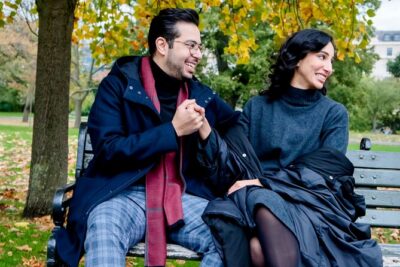
Professional Photoshoot in London Photographer
Read our review →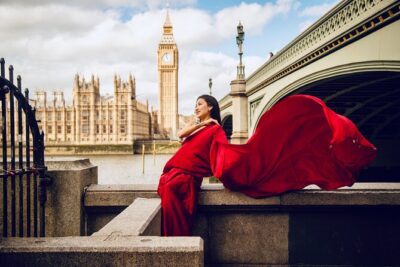
Browse the lists this tour appears in