Reviewed · TOURS IN LONDON
The women of London
London’s grandest landmarks often come with grand male names attached. This walking tour corrects the imbalance by tracing the women who shaped Britain’s politics, public life, wartime story, and literature, from Florence Nightingale to Emmeline Pankhurst and Agatha Christie.
I like the small maximum of 10 people, which gives you a fair chance to ask questions. I also like the focus on places you can see from the street, including Parliament Square, the Crimean War Memorial, and the Women of World War II Memorial, so the tour packs history into a modest price.
The main consideration is language: the tour is offered in Spanish or French, not English. It also lasts about two and a half hours, with much of that time spent walking outdoors, so comfortable shoes and suitable clothing matter.
Key points about the women’s history walk
- A clear feminist reading of central London: The route links royal power, public protest, military service, wartime work, and literature.
- Carmen may lead the Spanish tour: Her presentations are praised for their warmth, enthusiasm, and strong command of the suffragette story.
- A group capped at 10 people: The small size makes questions easier and keeps the discussion more personal.
- Eight focused stops: You’ll see Buckingham Palace, Parliament Square, Trafalgar Square, and several memorials connected to notable women.
- A useful two-and-a-half-hour route: The tour begins near Buckingham Palace and ends by Leicester Square at the Agatha Christie Memorial.
- Good value at $20.53: You get a guided historical walk rather than a ticketed attraction, with no extra admission charge at most stops.
Why this London walk feels different
I like tours that change the way you read a familiar city. Buckingham Palace, Parliament Square, and Trafalgar Square are already on most first-time London itineraries, but this route asks you to notice the women whose work, protest, courage, or talent helped shape what happened there.
The subject is not limited to one movement. You’ll hear about royalty, nursing, women’s suffrage, wartime service, political activism, and crime fiction. That broad range keeps the walk from becoming a single story about the vote.
The route also avoids the usual museum format. You are not spending two hours inside one building, looking at objects behind glass. You are moving through central London and connecting public monuments with the people they honor.
That approach has a practical advantage. You can see several major parts of Westminster and the West End in one afternoon while gaining a theme that is easy to miss on your own. The tradeoff is that the experience depends on the guide’s explanation. The monuments themselves often tell only part of the story.
Carmen is the guide specifically praised for her sympathy, enthusiasm, and command of the suffragette material. If she is leading your Spanish-language walk, expect an energetic presentation rather than a dry list of dates. The tour is also offered in French, making it a useful choice for Spanish- and French-speaking visitors who want more than a standard sightseeing circuit.
Other trips people book in London:
- Stonehenge, Windsor Castle, and Bath from London
★ 4.5 · 18,662 reviews - London Big Bus Hop-On Hop-Off Tour with Optional River Cruise
★ 3.5 · 10,803 reviews - London Small Group Tour of Historical Pubs
★ 5.0 · 10,422 reviews
Beginning at Buckingham Palace and the Mall
The meeting point is the Constance Fund fountain near Diana, at London SW1A 1RD. The tour begins at 2:00 pm, so plan to arrive early enough to find the fountain without rushing.
The first stop is Buckingham Palace, with about 15 minutes devoted to the Queen and the royal setting along the Mall. This is an exterior stop, and admission to the palace is not included. That is not a problem for the purpose of this tour, since the value here comes from discussing the public role of the monarchy and the women connected with it.
Buckingham Palace can easily become a quick photograph and a checkmark on a sightseeing list. A guide gives the stop more purpose by placing the palace within the story of women and national power. You’ll still have only a short time here, so do not expect a full royal-history lecture.
I see this opening as a smart choice. The palace provides an immediate sense of ceremony and authority, then the route moves toward women whose influence was won through service, campaigning, and public action rather than inherited position.
Florence Nightingale at the Crimean War Memorial
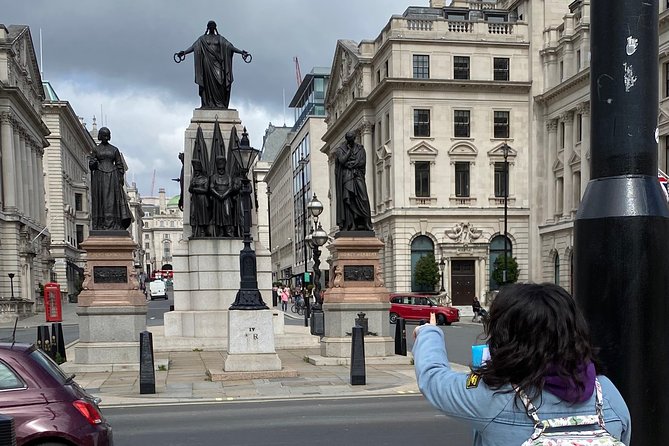
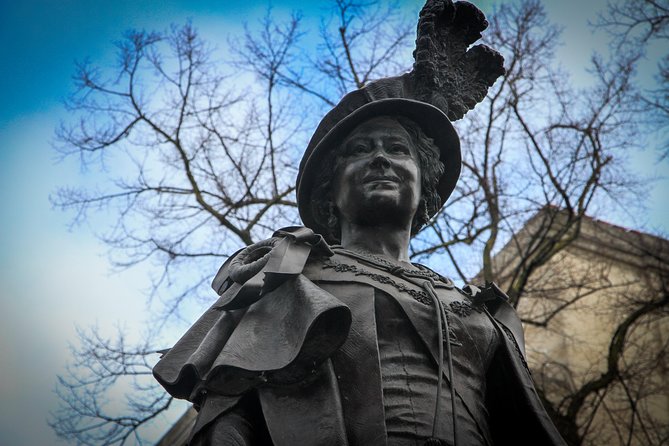
The next stop, lasting about 10 minutes, is the Crimean War Memorial, where Florence Nightingale becomes the focus. The memorial is free to view.
Nightingale is often reduced to a familiar image of the kindly nurse with a lamp. A good explanation can place her in a much larger story of medical care, military conditions, and the changing role of women in public service. This stop helps broaden the tour beyond suffrage alone.
The short time here is enough for the guide to introduce the subject and connect it with the surrounding monuments. It is not enough for a full account of Nightingale’s life, so you should treat this as a sharp historical chapter rather than a complete biography.
I especially like the contrast between this stop and Buckingham Palace. The tour moves from a symbol of national authority to a woman remembered for work carried out in difficult conditions. That change of focus is one reason the route feels more thoughtful than a simple list of famous sights.
Parliament Square and the pressure for political rights
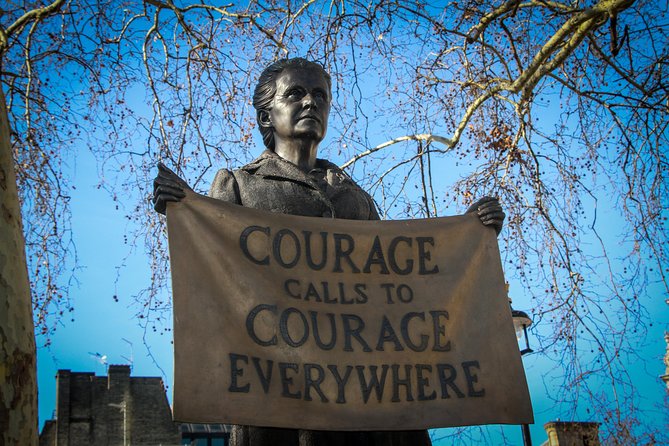
Parliament Square receives about 20 minutes, the longest stop on the scheduled route. Here the focus is Millicent Garrett Fawcett and Black Friday.
This is the political heart of the walk. Parliament Square gives the guide a natural setting for explaining the campaign for women’s voting rights and the conflicts that surrounded it. Millicent Garrett Fawcett represents one side of that struggle, and the reference to Black Friday points to the harsh resistance suffragettes faced.
The longer time allocation matters. Political movements are difficult to understand if you only hear names and dates. At this stop, you have more time to ask how the campaign worked, why disagreements developed, and how public protest collided with the political system.
You should also expect this to be one of the more serious parts of the afternoon. The subject is not simply a story of progress. The route emphasizes pressure, opposition, and the cost of demanding change.
For me, this is likely to be the intellectual center of the tour. Parliament Square is already one of London’s most politically charged public spaces, and the focus on women makes you read its statues and institutions in a new way.
Same base, a different kind of day:
- Stonehenge, Windsor Castle and Bath with Pub Lunch in Lacock
★ 4.5 · 7,402 reviews - Tower of London and Crown Jewels Exhibition Ticket
★ 4.5 · 6,677 reviews - Thorpe Park Admission Ticket
★ 4.0 · 5,915 reviews - Stonehenge, Windsor Castle and Bath Full Day Guided Tour
★ 4.5 · 5,346 reviews
Emmeline Pankhurst and the WSPU
The Emmeline Pankhurst Memorial is the next major stop, with around 15 minutes devoted to Pankhurst and the Women’s Social and Political Union, usually known as the WSPU.
Pankhurst offers a different angle from Millicent Garrett Fawcett. The tour can use the two figures to show that the campaign for the vote was not one smooth, unified effort. Different women used different methods, and the movement included debate over tactics, urgency, and public action.
This stop works well after Parliament Square because the route has already introduced the wider political struggle. You can now place Pankhurst and the WSPU within that setting rather than meeting them as isolated names.
The memorial itself is an important part of the experience, but the guide’s explanation does the heavy lifting. You may find that the brief stop leaves you wanting more detail about the WSPU and its campaigns. That is a fair limitation for a tour covering so many women in one afternoon.
If the guide is Carmen, this is where her particular interest in the suffragettes should be most useful. Her enthusiasm for the subject has been singled out, and that energy suits a figure as forceful and disputed as Pankhurst.
Downing Street and the Women of World War II Memorial
The route continues to the Women of World War II Memorial near Downing Street. The scheduled stop is short, about five minutes, and there is no admission charge.
Do not expect a long pause here. Instead, use it as a compact reminder that women’s wartime work extended well beyond the roles most often mentioned in basic history lessons. The memorial gives the guide a place to connect women’s service with the political center around Downing Street.
The reference to the suffragettes at this point also helps connect two periods of public action. Women who had demanded political rights before the war were part of a wider story of women taking visible responsibility in national life.
Five minutes is enough to orient you, but not enough to cover every branch of wartime service. I would listen closely and ask a question if the subject interests you, especially since the group size makes that more practical than on a large coach tour.
Trafalgar Square, World War I, and the vote
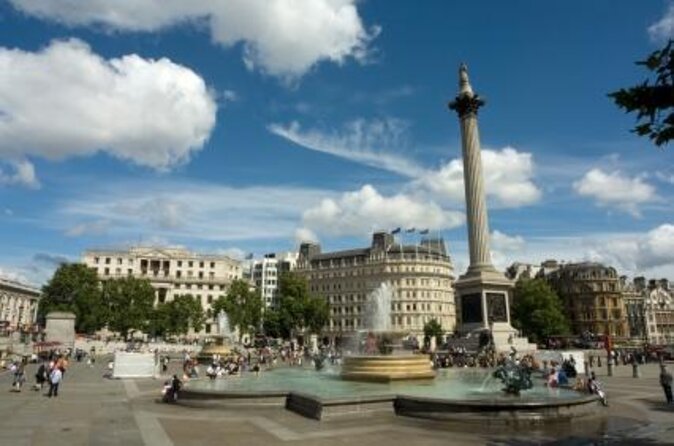
Trafalgar Square receives about 10 minutes and shifts the story toward World War I and votes for women. The square is one of London’s most recognizable public spaces, but its importance here comes from how public life and political rights intersect.
This stop can help you understand that the movement for the vote did not unfold in isolation from national events. War changed public responsibilities and political arguments, and the tour uses Trafalgar Square to connect those pressures with the campaign for women’s suffrage.
The square is also a busy public setting, so the experience may feel less quiet than a memorial stop. That is part of the point. Public protest, political speech, and civic gathering belong in places like this, not only in formal meeting rooms.
Again, the allotted time is brief. You will get a clear piece of the story, not a full course in constitutional history. I like the sequence, though, because it keeps the tour moving and shows how women’s political claims were tied to the larger life of London.
Edith Cavell Memorial and the cost of service
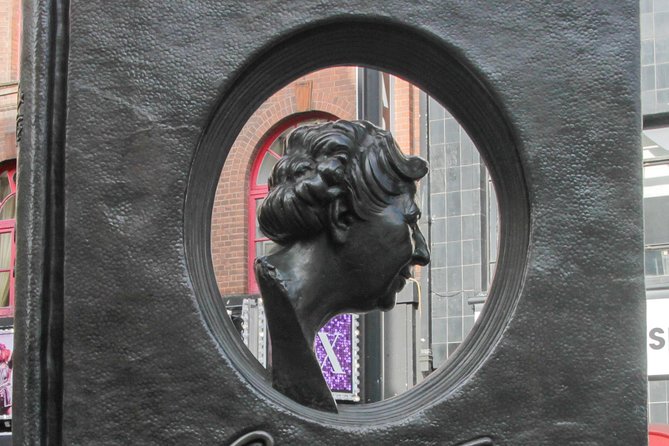
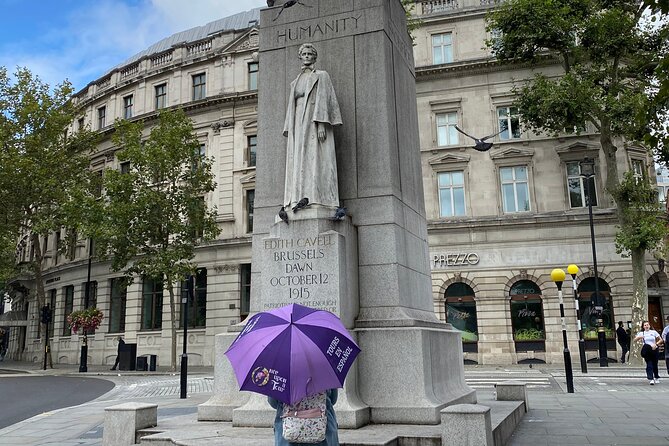
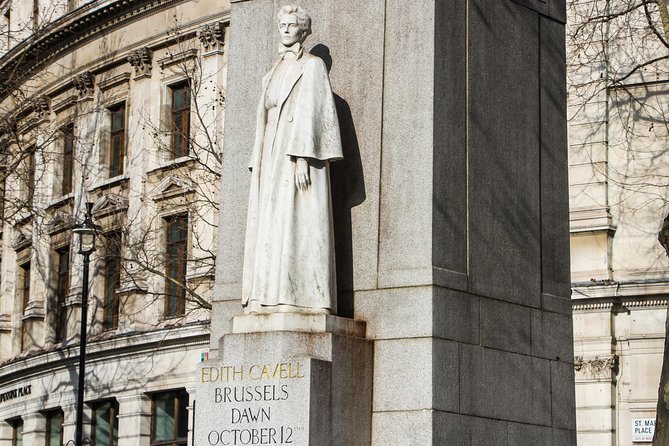
The Edith Cavell Memorial receives about five minutes. The subject is Cavell’s life, and the stop adds another form of courage to the route.
After the political focus of Westminster and Trafalgar Square, this brief memorial visit brings attention back to an individual woman. The tour does not present women only as organizers or campaigners. It also includes a figure remembered for personal service under dangerous conditions.
Because the stop is short, expect an introduction rather than a full life story. The memorial is best understood as one more piece in the larger pattern the guide is building: women affected national events and were also active within them.
I find this kind of short stop useful when the route is well paced. You see the memorial, hear why it matters, and continue before the afternoon becomes a single long lecture.
Agatha Christie and the West End finish
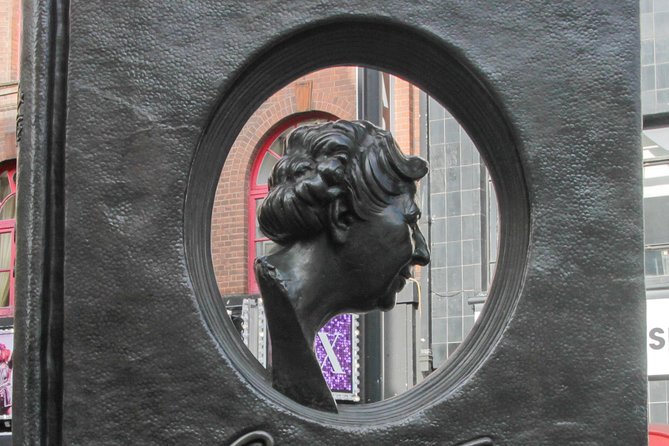
The final stop is the Agatha Christie Memorial on Cranbourn Street, near the West End. The scheduled time is about 10 minutes, and the tour ends here.
Christie gives the walk a welcome change of tone. After royal history, war, political protest, and suffrage, the route finishes with a woman whose work shaped popular literature. Her inclusion shows that the tour’s idea of influence is broad. Women changed London not only through public office or protest, but also through books read around the world.
Ending near the Agatha Christie Memorial is convenient if you plan to continue in the West End. The endpoint is on Cranbourn Street, London WC2H 7AB, rather than back at Buckingham Palace, so plan your afternoon around finishing in central London.
This final stop is also a useful reminder that memorials can simplify a life. You will hear about Christie as a literary figure, but the stop is necessarily short. If you are a serious Christie fan, you may want a separate visit or reading list after the walk.
What $20.53 buys you
At $20.53 per person, this is priced as an accessible guided walk rather than a major attraction. There are no expensive entry tickets built into the experience, but that is appropriate because the route is based around public spaces and outdoor memorials.
The value comes from interpretation. You could walk past Buckingham Palace, Parliament Square, Downing Street, and Trafalgar Square without knowing which women belong to those places. A guide gives the route a connecting idea and saves you the work of researching each stop in advance.
The small group improves that value. With no more than 10 people, you have a better chance to hear the guide clearly and ask about the women or events that interest you. That matters especially on a history walk, where a good question can turn a five-minute stop into a more useful conversation.
Tips are not included, but they are optional. The tour is also free to cancel up to 24 hours before the start time for a full refund. If the minimum number is not reached and the tour is canceled, you are offered another option or a full refund.
Who should book this walk
I would recommend this experience to you if you enjoy history told through people rather than buildings. It suits anyone interested in women’s rights, British politics, wartime service, royal history, or literary London.
It is particularly useful for Spanish- and French-speaking visitors who want to discuss the subject in their own language. The group size also makes it a better fit for you if you prefer conversation over a large, scripted sightseeing group.
You should think twice if you want to enter major attractions, sit indoors, or receive a full biography of every woman named. Buckingham Palace admission is not included, and most of the experience takes place outside. The many stops mean the treatment of each subject is focused and selective.
The route is near public transportation, and most people can participate. Still, you should be ready for a two-and-a-half-hour walk through central London and check the forecast before setting out.
Should you book The Women of London?
Book it if you want a fresh way to see central London and can follow the tour in Spanish or French. The mix of famous landmarks, memorials, suffrage history, wartime stories, and Agatha Christie gives you a useful alternative to the usual kings-and-buildings tour.
The strongest reasons to choose it are the small group, the focused theme, and the chance to ask questions. If Carmen is leading the Spanish walk, her particular enthusiasm for the suffragettes is another good reason to reserve.
Skip it if you need an English-language tour, dislike outdoor walking, or want extensive time at each stop. For the modest price, though, it offers a thoughtful historical route and gives you plenty of material to notice the next time you cross Westminster or the West End.
FAQ
What language is the tour offered in?
The tour is available in Spanish or French.
How long does the tour last?
The experience lasts approximately two hours and 30 minutes.
How many people can join the tour?
The tour has a maximum of 10 participants.
Where does the tour begin?
It begins at the Constance Fund fountain near Diana, London SW1A 1RD.
What time does the tour start?
The scheduled start time is 2:00 pm.
Where does the tour end?
The tour ends at the Agatha Christie Memorial on Cranbourn Street, London WC2H 7AB.
Is admission to Buckingham Palace included?
No. Admission to Buckingham Palace is not included.
Can I cancel for a full refund?
Yes. You can cancel at least 24 hours before the start time for a full refund. Changes or cancellations made less than 24 hours before the start time are not accepted for a refund.
Just added in London
- The Beatles and a Secret pub★ 4.5 · 36 reviews
- The Beatles & Liverpool Magical Mystery Tour from London★ 4.5 · 80 reviews
- Airport Coach Service from Heathrow to Oxford★ 3.5 · 67 reviews
- The Beatles Magical History Black Taxi Tour London★ 5.0 · 51 reviews
- The Beatles London walking tour. From Abbey Road to the Roof Top★ 5.0 · 61 reviews
- Private The Beatles Taxi Tour in London★ 5.0 · 12 reviews
- The Beatles London Walk★ 4.5 · 120 reviews
- The Alfred Hitchcock London Walk with Sandra Shevey★ 5.0 · 15 reviews
Tours in London, compared.
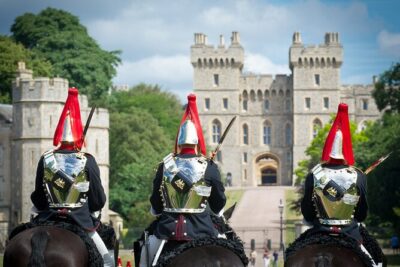
Stonehenge, Windsor Castle, and Bath from London
Read our review →
London Big Bus Hop-On Hop-Off Tour with Optional River Cruise
Read our review →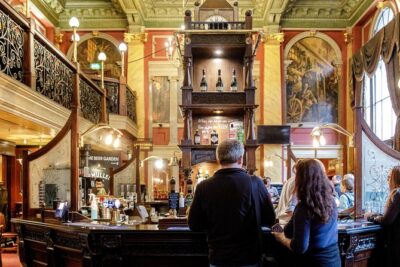
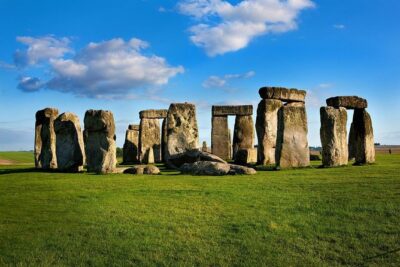
Stonehenge, Windsor Castle and Bath with Pub Lunch in Lacock
Read our review →
Tower of London and Crown Jewels Exhibition Ticket
Read our review →
Stonehenge, Windsor Castle and Bath Full Day Guided Tour
Read our review →
Windsor Castle, Stonehenge, and Oxford Day Trip from London
Read our review →